

Key findings
- Of 33 B2B software homepages we could read, 70% (23) carry a demo button and 73% (24) a contact sales or contact us button. 42% (14) show a free trial button.
- The button repeated most often is a demo on 15 of 33 homepages (45.5%), contact sales on 7, a free trial on 6 and a free sign-up on 4.
- 61% (20 of 33) offer a free trial somewhere on the pages we read and 30% (10) a free plan. Of the 13 that state a trial length, 7 say 14 days and 5 say 30.
- 16 of 33 (48.5%) run a demo or sales page next to a trial or free plan. 8 (24%) are demo only and 7 (21%) are trial or free plan only.
- 29 of 33 have a pricing page and 21 (64% of all 33) show actual prices. 12 of 33 (36%) give no public price we could read.
- Only 5 of 24 demo pages had a form we could read in the HTML. Those asked for 4 to 12 fields (median 7), and 3 of the 5 required a phone number.
Public homepages, pricing pages and demo or sales pages of B2B software companies, fetched as plain HTML and coded with published rules · 40 B2B software companies, 8 from each of five Wikipedia categories (HR, accounting, security, project management, CRM). 33 sites were readable: 5 blocked our requests and 2 returned pages drawn by JavaScript. · 20 November 2026 · How we did this · Download the data (CSV)
Every B2B PPC campaign ends on somebody's page, and that page makes an offer: book a demo, start a trial, talk to sales, see the price. We wanted to know which offers B2B software companies make on their own sites, so on 20 November 2026 we fetched the homepage, pricing page and demo page of 40 companies and coded the 33 we could read.
The short answer: most B2B software companies offer a demo and a self-serve route at the same time. 70% of the homepages carry a demo button, 61% of the companies offer a free trial, and 64% publish real prices. Only 8 of 33 (24%) are demo only. If your B2B PPC sends every click to a demo form, you are running a narrower offer than most of the market shows on its own site.
This study sits beside our longer guide to B2B PPC on Google and LinkedIn, which covers channels, keywords, measurement and budget. Here we look at one question that guide only touches: what the offer behind the click should be. We run paid accounts ourselves, so where we give an opinion we label it. Our own clients and accounts are not in this data.
Why we read company sites instead of ad libraries
Our first plan was to read the ads. The LinkedIn Ad Library gave us one page of results and then blocked our requests. The Meta Ad Library and the Google Ads Transparency Center showed no ad data without running a full browser. We chose not to work around any of that, so we went one step down the funnel: the pages those ads point to. A homepage is where a company states its main offer, and it is what a branded search click usually sees. Some ads go to other landing pages, which we did not see.
The 40 companies came from five public Wikipedia software categories, 8 from each: HR, accounting, security, project management and CRM. 5 sites blocked our requests and 2 drew their pages with JavaScript, which left 33.
The buttons on B2B software homepages
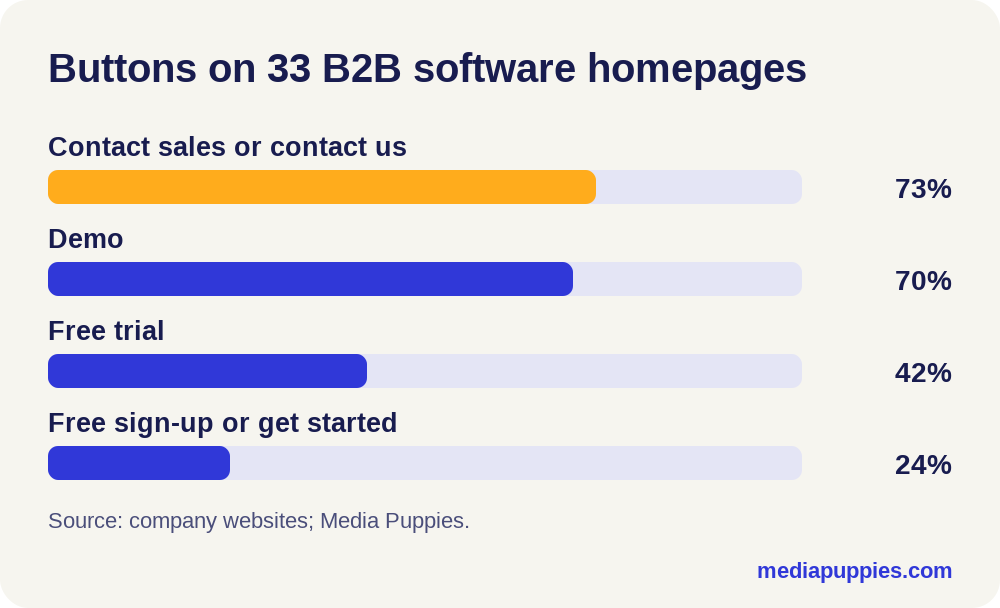
Contact sales (or a plain "contact us") was the most common button, on 24 of 33 homepages. A demo button was on 23. A free trial button was on 14 and a free sign-up or "get started" button on 8. 25 of 33 homepages carry two or more of these at once.
We also counted which button each homepage repeats most, as a rough read of what the company most wants. The demo won on 15 of 33 homepages (45.5%). Contact sales came next on 7, a free trial on 6 and a free sign-up on 4. On one site the only button we could find was "Pricing".
| Most repeated button on the homepage | Companies (of 33) | Share |
|---|---|---|
| Demo or sales call | 15 | 45.5% |
| Contact sales or contact us | 7 | 21.2% |
| Free trial | 6 | 18.2% |
| Free sign-up or get started | 4 | 12.1% |
| Pricing only | 1 | 3.0% |
We expected the demo to dominate, and on the main button it does. What surprised us was how often it shares the page. The button text varied more than we thought, too: "Get My Free Demo", "See Bob in action", "Schedule a call" and "Start Demo" all count as a demo in our coding.
Demo, trial, or both
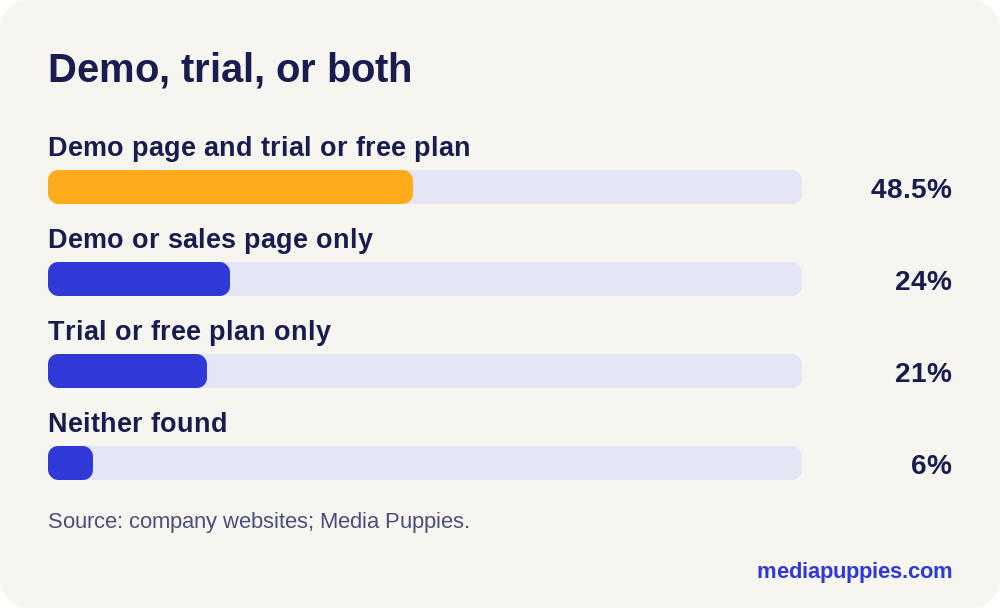
Next we combined two things for each company: whether it has a demo or sales page, and whether it offers a free trial or free plan anywhere on the pages we read. 16 of 33 (48.5%) had both. 8 (24%) had a demo or sales page and no self-serve option. 7 (21%) had a trial or free plan and no demo page we could find. 2 had neither.
20 of 33 companies (61%) mention a free trial. 10 (30%) offer a free plan, often a free tier for individuals or small teams. 13 state a trial length. 7 of those say 14 days, 5 say 30 days and one says 7.
The split followed the category more than we expected. Every one of the 7 readable CRM sites and 7 of 8 project management sites offered a trial or free plan. Security sites leaned on the demo: all 5 had a demo or sales page, and 3 of 5 offered any trial.
| Category | Readable sites | Show prices | Trial or free plan | Demo or sales page | Demo is main button |
|---|---|---|---|---|---|
| CRM | 7 | 7 | 7 | 6 | 2 |
| Project management | 8 | 8 | 7 | 7 | 3 |
| HR | 7 | 3 | 3 | 4 | 5 |
| Accounting | 6 | 5 | 3 | 2 | 2 |
| Security | 5 | 1 | 3 | 5 | 3 |
The groups are 5 to 8 companies each, so read this table as a description of these sites. Our reading: products a team can try in an afternoon publish a trial, and products that need a security review or a data migration sell through a call.
Pricing pages: most show the number
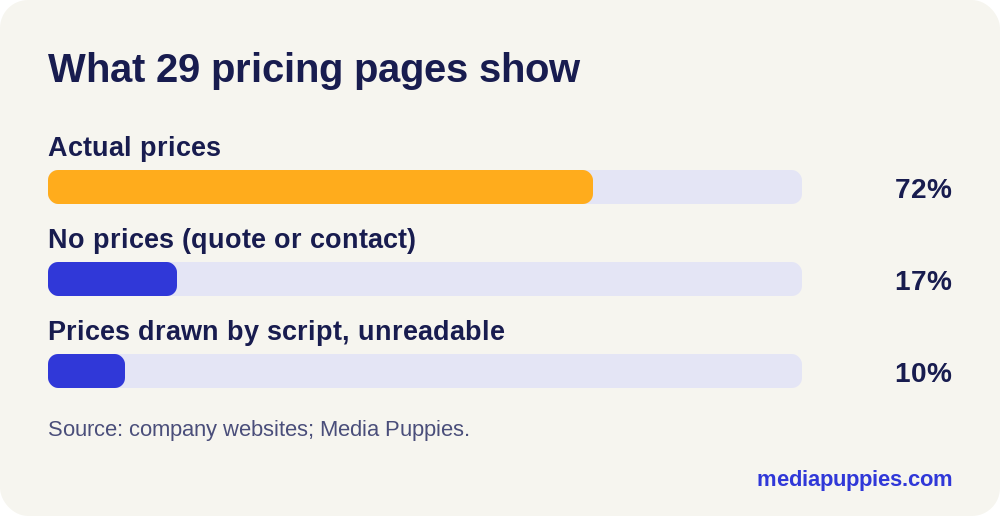
29 of 33 companies have a pricing page, and 21 of those 29 (72%) show actual prices. 5 pricing pages had no figures and pointed to a quote or a sales call. On 3 more, the plans were drawn by a script we did not run, so we could not tell. Across all 33 companies, 21 (64%) show a price we could read and 12 (36%) do not.
No price usually went with a demo-led site. HR and security were where prices were hardest to find: 3 of 7 HR sites and 1 of 5 security sites showed one. This matters for paid search, because people who type "pricing" after a brand name are close to buying. If your page has no number, those clicks land on a page that cannot answer the question they asked. Our study of B2B PPC cost per click shows how much each of those clicks can cost.
What the demo form asks for
24 of 33 companies had a demo or sales page we could fetch. Only 5 of those had a form in the page's HTML. The other 19 load their form with a script, most often from Marketo or HubSpot, or inside an iframe. That is normal on these sites, and it means our count of form fields covers only those 5.
Those 5 forms asked for 4 to 12 visible fields, with a median of 7. 3 of the 5 required a phone number, 3 required a job title and 2 required company size. One form also asked whether the visitor was already a customer.
4 of the 24 demo pages (17%) mentioned booking a time on the spot or loaded a scheduling tool. One read "Choose a time that works for you". The rest ended at "we will be in touch".
The field count matters more in paid traffic than anywhere else, because you pay for every visitor who gives up halfway. Our post on B2B lead quality and the sales feedback loop covers the other side: fields that filter out bad leads earn their place only if sales actually uses them.
Guides and webinars are everywhere
32 of 33 homepages linked to some kind of guide, ebook, report or template, and 28 (85%) linked to webinars or events. Most of these links sit in the resources menu. We did not check which ones sit behind a form, so this tells you the content exists. Whether it sits behind a form is a question we did not test. It does show that almost every company in the sample has a middle-of-funnel offer ready to use, and few of them put it in the main button.
Which offer to run in B2B PPC: what to copy and what to skip (our view)
This section is our opinion as a team that runs B2B accounts. It is built on the data above.
What to copy
- Offer two doors. Half the sample pairs a demo with a trial or free plan. In paid search, that lets a ready buyer book a call and a curious one try the product, and both count as a conversion you can value differently.
- Match the offer to the keyword. Brand and "pricing" searches deserve the pricing page or the demo. Problem searches ("how to track employee hours") deserve a trial, a template or a guide. One offer for every ad group wastes the second group.
- Publish a price if you can. 64% of these companies do. A visible starting price filters out buyers who can never afford you before you pay for their demo.
- Let people book the time. Only 4 of 24 demo pages offered it. A calendar on the thank-you page turns a form fill into a meeting while the buyer is still on your site.
- Use the content you already have. Almost every site had guides and webinars. On LinkedIn especially, where a cold audience rarely books a demo from one ad, a useful guide is the better first offer. Our LinkedIn ads arithmetic post shows why the numbers usually force that choice.
What to skip
- Skip the long form for cold traffic. A 12-field form can make sense for a buyer who already knows you. For a first click from search it is a lot to ask. Start shorter and enrich later.
- Skip "contact us" as the paid offer. It was the most common button on these homepages. It is also the vaguest. A buyer clicking an ad wants to know what happens next, so name it: a 20-minute demo, a trial, a price.
- Skip sending ads to the homepage. 25 of the 33 homepages here carried two or more competing buttons. A paid landing page should carry one offer and one form.
If you resell paid media to B2B clients, the same rules apply to their accounts. Our white label PPC service runs B2B campaigns under your brand and reports in your template.
How we did this
- Source
- Public homepages, pricing pages and demo or sales pages of B2B software companies, fetched as plain HTML and coded with published rules
- Country
- United States, United Kingdom (US English site versions where offered)
- Collected
- 20 November 2026
- Sample
- 40 B2B software companies, 8 from each of five Wikipedia categories (HR, accounting, security, project management, CRM). 33 sites were readable: 5 blocked our requests and 2 returned pages drawn by JavaScript.
- Fields
- Calls to action on the homepage, main call to action, pricing page, prices shown, free trial and length, free plan, demo or sales page, demo form fields and required fields, calendar booking, guides and webinars linked from the homepage
- Pages fetched
- Homepage, plus the first pricing, demo or contact-sales, and trial or sign-up link on it
We first tried to read the ads themselves. The LinkedIn Ad Library returned one page of results and then blocked our requests for over an hour. The Meta Ad Library and the Google Ads Transparency Center returned no ad data without running JavaScript in a browser. We did not work around either, so this study looks at what the ads point to: the companies' own sites.
The sample came from five public Wikipedia category pages (human resource management software, accounting software, computer security software companies, project management software, and CRM software). In each, in the order listed, we took the first 8 entries that are a company currently selling B2B software to US or UK buyers. We skipped topic pages, consumer-only products, defunct brands and the six largest conglomerates. One person made these calls.
On 20 November 2026 we fetched each homepage with curl, about 10 seconds apart, then the first pricing, demo or contact-sales, and trial or sign-up link on it. A second pass tried common demo paths where the homepage gave none. No form was submitted and no browser was used. The coding is a set of regex rules in compile.py: the main call to action is the one repeated most on the homepage, prices count when a currency amount above zero appears on the pricing page, and a demo form is read only when it sits in the page's HTML.
Limits. 33 companies is a small sample, and each category has 5 to 8, so category gaps are descriptive. Anything drawn by JavaScript is invisible to us: prices on 3 pricing pages and the forms on 19 of 24 demo pages. Guides and webinars linked from a homepage include menu links, and we did not check whether they sit behind a form. A homepage is not an ad landing page, and many of these companies send paid clicks to pages we did not see. Company names are in the data file only.
Download the data (CSV). Free to reuse under CC BY 4.0 with a link to this page.
Questions about B2B PPC offers
What is the best offer for B2B PPC?
There is no single best one. In our sample of 33 B2B software sites, 70% had a demo button and 61% offered a free trial, and 48.5% ran both. Our view: match the offer to the search. Brand and pricing searches suit a demo or the pricing page; problem searches suit a trial, template or guide.
Should B2B companies show prices on their website?
Most in our sample do. 21 of 33 B2B software companies (64%) showed real prices, and 5 of the 29 pricing pages asked visitors to request a quote instead. HR and security sites were the least likely to show a number.
How many fields should a B2B demo form have?
The 5 demo forms we could read asked for 4 to 12 fields, median 7, and 3 required a phone number. Most demo forms loaded by script, so we could not count them. For paid traffic, our view is to ask only what sales uses to qualify, and to add scheduling so the lead can book a time.
How long are B2B software free trials?
Of the 13 companies in our sample that stated a trial length, 7 offered 14 days and 5 offered 30 days. One offered 7 days. 10 of 33 also had a free plan with no time limit.
Is a demo or a free trial better for PPC for B2B?
It depends on how fast a buyer can see value. CRM and project management sites in our sample nearly all offered a trial or free plan, while all 5 security sites offered a demo or sales page. Our B2B PPC guide covers how to measure which one turns into pipeline.