

Key findings
- Of 25 white label PPC providers we read on 19 November 2026, 21 (84%) named Google Ads in their offer, 11 (44%) Meta, 10 (40%) Microsoft Advertising and 1 (4%) Amazon. 8 (32%) named Google Ads and nothing else.
- Branded reporting is the standard promise: 18 (72%) said reports carry the agency brand. 9 (36%) said the end client never sees the provider, and 3 (12%) said they will talk to the client under the agency brand if asked.
- Prices are mostly private. 5 providers (20%) published amounts and 12 (48%) said nothing about their own pricing. 2 said outright that they do not take a cut of ad spend.
- The terms that protect an agency were the rarest lines on the pages: 7 (28%) said month to month or no contract, 4 (16%) mentioned an NDA and 4 (16%) said who owns or accesses the ad account.
- The median page answered 5 of 11 checks an agency would want settled before signing, and the best answered 8. NDA mentions came from 3 of 6 India-based providers and 1 of 19 elsewhere.
Public white label PPC pages of providers found through web search, saved as text and read by hand · 25 providers from 10 searches (4 core, 6 UK and Australia), taken in result order after skipping directories, listicles, software tools and pages that would not load. 32 pages read. HQ: United States 14, India 6, Australia 2, United Kingdom 1, Canada 1, not stated 1. · 19 November 2026 · How we did this · Download the data (CSV)
Most white label PPC research is written by providers about the model. We wanted to see the market from the buyer's side. On 19 November 2026 we searched the way an agency owner would, opened the first 25 white label PPC providers that came up, and coded what each page commits to on 11 points: platforms, reporting, client contact, onboarding, pricing, minimums, contract, NDA, ad account ownership, certifications and case studies.
The short answer: white label PPC providers agree on the brand promise and go quiet on the terms. 18 of 25 (72%) said reports carry the agency's brand. Only 7 (28%) stated a contract term of any kind as month to month or no contract, 4 (16%) mentioned an NDA and 4 (16%) said who owns the ad account. The median page answered 5 of the 11 checks.
If you are new to the model, start with how white label PPC works, which covers the setup step by step. This post is the comparison that sits after it. We sell white label PPC ourselves, so we have an interest here. We left ourselves out of the sample, and we do not rank anyone. Where we name a provider, it is to quote what its page says.
White label PPC providers compared, feature by feature
This is the whole table. Each row is the number of the 25 providers whose page states the feature for its own offer. A blank is a page that does not say, which is a different thing from a provider that does not do it.
| What the page states | Providers | Share of 25 |
|---|---|---|
| Names Google Ads in its white label offer | 21 | 84% |
| Names Meta ads | 11 | 44% |
| Names Microsoft Advertising | 10 | 40% |
| Google Ads is the only platform named | 8 | 32% |
| Reports carry the agency brand | 18 | 72% |
| White label dashboard | 10 | 40% |
| States how often reports arrive | 11 | 44% |
| End client never sees the provider | 9 | 36% |
| Will speak to the client under the agency brand if asked | 3 | 12% |
| States onboarding time or steps | 10 | 40% |
| Publishes price amounts | 5 | 20% |
| Says month to month or no contract | 7 | 28% |
| Says there is no minimum | 4 | 16% |
| Mentions an NDA | 4 | 16% |
| Says who owns or accesses the ad account | 4 | 16% |
| Claims Google Partner status (any tier) | 6 | 24% |
| Claims any certification or partner status | 11 | 44% |
| Links case studies | 15 | 60% |
| Shows PPC results on the white label page | 3 | 12% |
We expected pricing to be the gap. It was a gap, but the bigger surprise was contracts and accounts. These are the two things that decide what happens when a partnership ends, and 17 of 25 pages said nothing about the contract while 21 said nothing about the ad account.
Platforms: Google Ads first, everything else optional
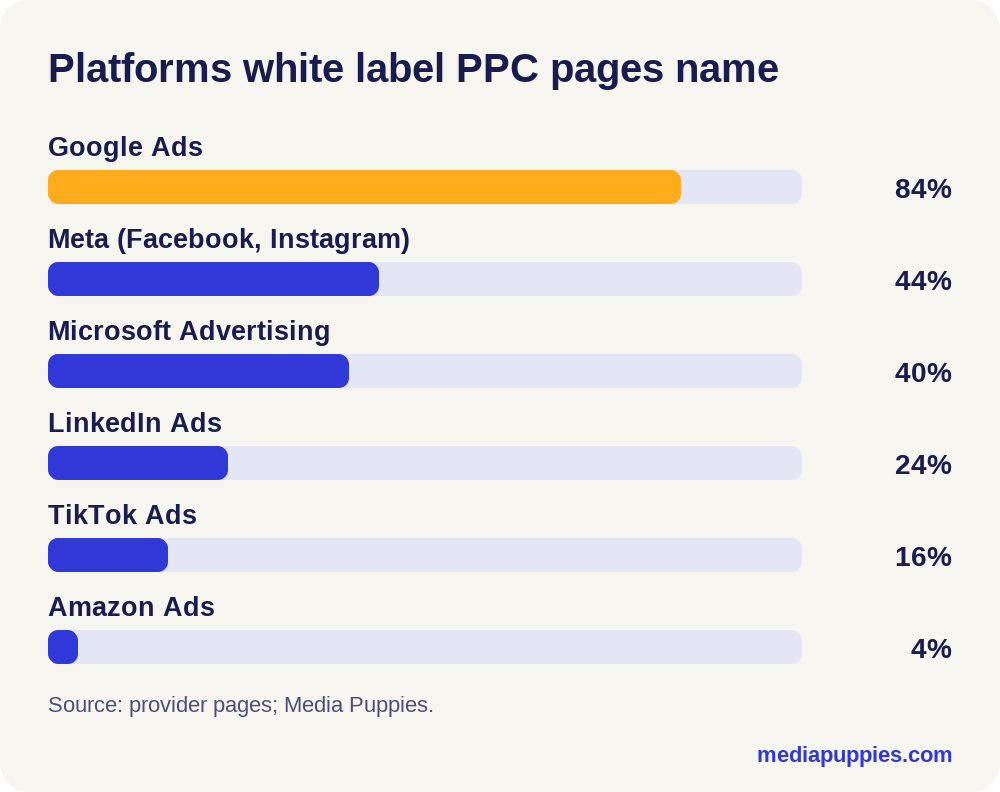
21 providers named Google Ads. The 4 that did not were a guide page with no stated offer, a second guide, and two broad white label marketing pages that promised "ad campaigns" without naming a platform. Meta came next at 44%, and Microsoft Advertising at 40%. Amazon appeared once.
8 providers (32%) named Google Ads and nothing else. Some say so on purpose. Josiah Roche's page states: "For partner accounts we run Google Search, Shopping, and YouTube only." Others simply describe a Google offer. 10 providers named three or more platforms, with Mavlers naming all six we tracked.
Our view: platform breadth matters less than whether the platform your client needs is in the written scope. An agency selling a Meta retainer to a client should not assume a "PPC" partner runs Meta.
Reporting and client contact
The brand promise is close to universal. 18 pages (72%) said reports go out under the agency's name, and 10 (40%) offered a white label dashboard. Fewer said how often. 11 pages (44%) gave a frequency, mostly monthly. One, PPC.io, offered a weekly report. Two offered reports every two weeks as an option. Our white label reporting guide covers what those reports should contain.
If you run reporting in house, our white label reporting tools study compares what 20 vendors offer.
How the provider handles your client splits three ways:
| Client contact model stated | Providers | Share of 25 |
|---|---|---|
| End client never sees the provider | 9 | 36% |
| Works behind the scenes, no contact rule given | 9 | 36% |
| Will join calls or talk to the client under the agency brand | 2 | 8% |
| Not stated | 5 | 20% |
The strongest wording was rare. Single Grain says "we never contact your clients directly", and PPC.io says "we never contact them unless you ask us to." Agency Elevation describes using generic contact details inside the ad accounts so nothing points to a third party. OuterBox offers the opposite option: "Client calls can stay fully branded, with behind-the-scenes support or silent-partner participation." Both are reasonable. They suit different agencies, and you should know which you are buying.
Pricing: mostly behind a call
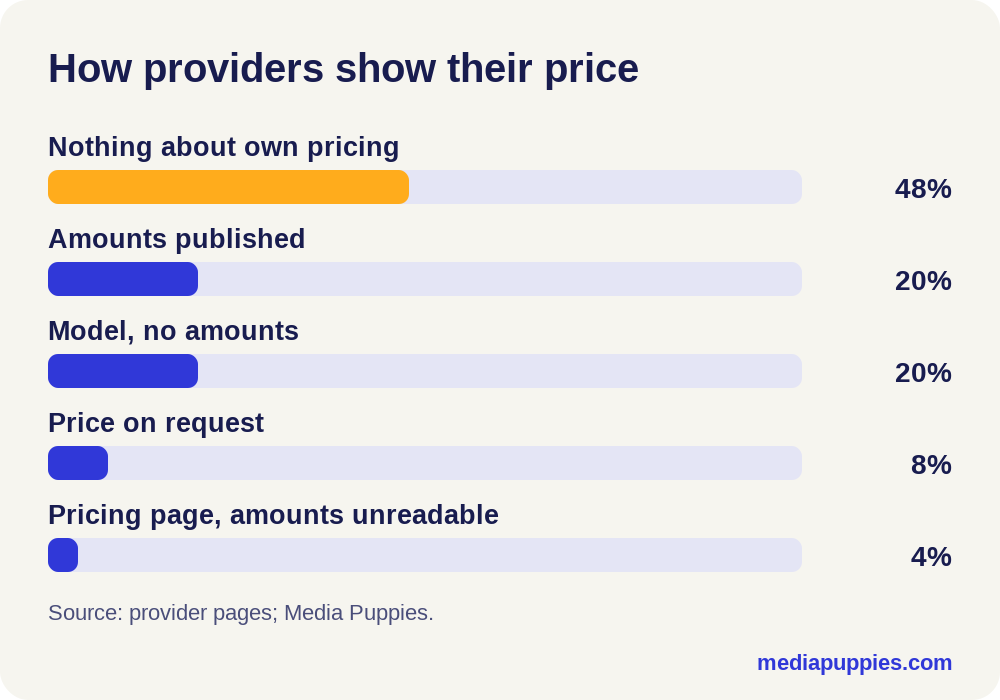
12 pages (48%) said nothing about the provider's own price. 5 (20%) published amounts, either on the page or on a linked pricing page. Another 5 described a model without numbers, and 2 asked you to request a quote.
Among the 10 providers that stated a model, we found five shapes:
| Pricing model stated | Providers |
|---|---|
| Flat monthly fee | 2 |
| Per client account per month, falling as you add accounts | 2 |
| Tiered packages by scope | 3 |
| Volume-based reseller or wholesale rates | 2 |
| Wholesale, with no percentage of spend | 1 |
No provider in the sample stated a percentage of ad spend as its own model, though several guide pages listed it as a common option. 2 pages ruled it out in writing. Our white label PPC pricing guide explains how each model works, and our economics study covers the margin side.
The quiet parts: contracts, minimums, NDAs and ad accounts
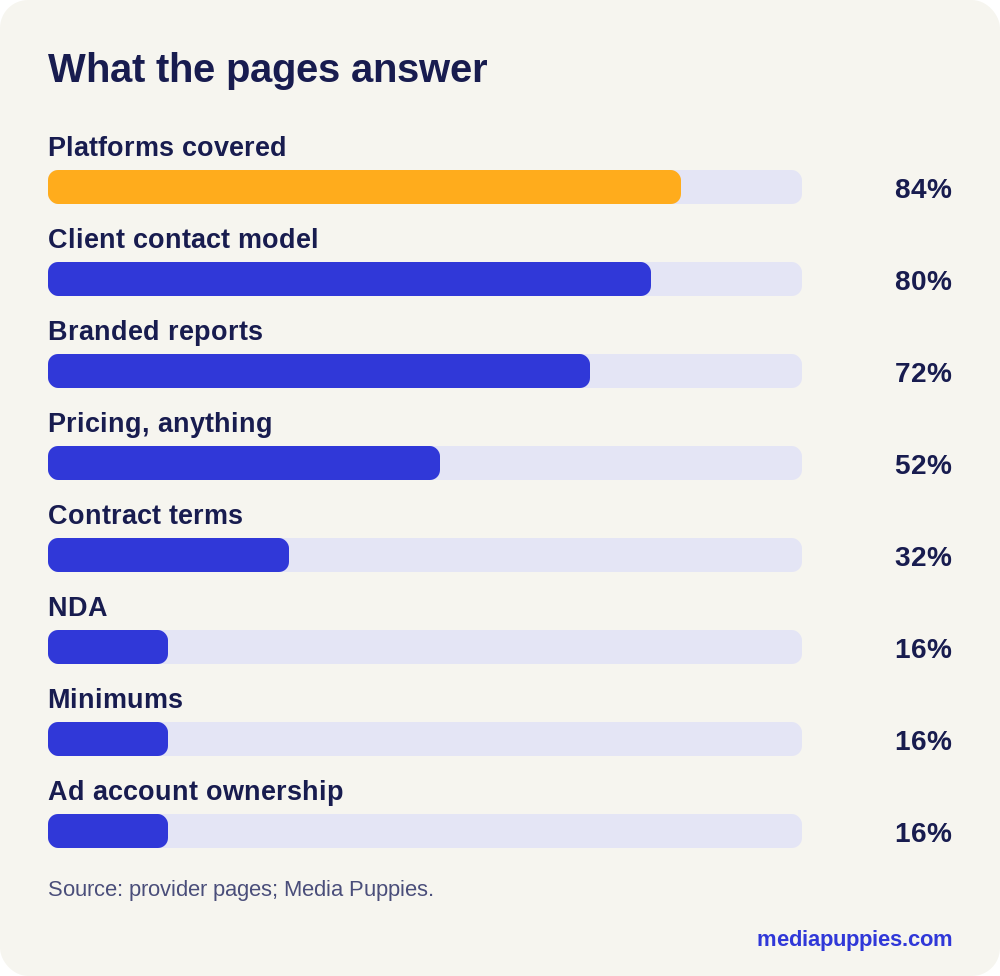
These are the lines that matter most when something goes wrong, and they were the rarest on the pages.
- Contracts. 7 providers (28%) said month to month or no contract. One stated a minimum term: Josiah Roche asks retainer partners to "commit to 3 months upfront", then rolls monthly on 30 days' notice. 2 pages gave a notice period at all.
- Minimums. 4 pages (16%) said there was no minimum number of clients or no minimum spend. None of the 25 stated a minimum ad spend or client count.
- NDA. 4 pages (16%) mentioned an NDA. 8 (32%) promised confidentiality in some form, which is weaker unless it is written into the agreement.
- Ad account ownership. 2 pages (8%) said the agency or client owns the ad account. PPC.io: "You own the account and every build, and it keeps running if we stop." 2 more said they work through access the agency grants, such as your MCC. The other 21 said nothing.
Our view: ad account ownership is the term we would want in writing first. Campaign history, conversion data and audiences live in the account. If the partner built the account under its own manager account and the relationship ends, you need to know in advance what you keep.
Certifications and proof
11 providers (44%) claimed a certification or partner status of some kind. 6 (24%) claimed Google Partner status, 4 of them Premier Partner. 1 claimed Microsoft Advertising partner status and 2 Meta Business Partner. Another 5 said their staff are certified without claiming a partner badge, which is a different and smaller claim.
15 providers (60%) linked a case study section, but only 3 (12%) showed PPC results on the white label page itself. PPC.io took a different route and published figures across its live accounts with the line "No hand-picked case study."
Where providers are based, and whether it changes the page
14 of the 25 providers were US-based, 6 India-based, 2 Australian, 1 British and 1 Canadian, with 1 not stating a country. The pages from India-based providers that sell into tier-1 markets read differently on a few points:
| What the page states | India-based (6) | Everyone else (19) |
|---|---|---|
| Mentions an NDA | 3 (50%) | 1 (5.26%) |
| Promises confidentiality in any form | 4 (66.67%) | 4 (21.05%) |
| Reports carry the agency brand | 6 (100%) | 12 (63.16%) |
| Claims any certification | 4 (66.67%) | 7 (36.84%) |
| States contract terms | 1 (16.67%) | 7 (36.84%) |
| Publishes price amounts | 1 (16.67%) | 4 (21.05%) |
With 6 providers on one side, treat these as pointers only. The pattern fits what we hear from agency owners: offshore partners expect the confidentiality question and answer it up front, while contract terms are left to the call on both sides.
We went back to the same 25 sites on 23 November and checked what a partner can verify before a call, from sample reports and NDAs to named staff and tags. The results are in our audit of 25 white label PPC provider websites.
How complete the pages are
Across the 11 checks, the median page answered 5 and the best answered 8. Four providers reached 8. 13 of the 25 (52%) answered 5 or fewer. Two ranking pages answered none, because they were general guides with a sales link and no stated offer. Pages built as service pages had a median of 6.5 against 4 for the 5 guide pages.
That gap is useful in itself. A provider whose page answers 8 of 11 has thought about what a buyer asks. A page that answers 3 may still belong to a good provider. It just leaves more work for your first call.
What to check before you sign (our view)
From what the 25 pages leave out, this is the list we would take into any first call, ours included. Our partner questions guide goes deeper on several of these.
- Who owns the ad account, and under which manager account it sits. Ask what happens to the account, its history and its audiences on the day you stop.
- The written scope by platform. If the client needs Meta or Microsoft, get it named. 32% of pages named Google Ads alone.
- Notice period and any minimum term. Only 2 pages stated a notice period.
- An NDA and a non-solicit clause. A promise of confidentiality on a web page is not a contract.
- The client contact rule. Decide whether the partner ever speaks to your client, and how emails and ad account notices are handled.
- The report itself. Ask for a sample in your template, the frequency, and who writes the commentary.
- The price model and what sits outside it. Landing pages, tracking fixes and creative are the usual extras.
- Proof you can check. Look up partner badges in Google's own directory and ask for a result in your client's industry.
For our part, the terms on our white label PPC page are a named buyer on each account, month to month with no lock-in, and a weekly written report in your client's template. If you are still deciding whether to resell PPC at all, our study of what agency keywords cost per click shows what winning those clients costs on Google.
How we did this
- Source
- Public white label PPC pages of providers found through web search, saved as text and read by hand
- Country
- Providers selling to agencies in the United States, United Kingdom, Canada and Australia
- Collected
- 19 November 2026
- Sample
- 25 providers from 10 searches (4 core, 6 UK and Australia), taken in result order after skipping directories, listicles, software tools and pages that would not load. 32 pages read. HQ: United States 14, India 6, Australia 2, United Kingdom 1, Canada 1, not stated 1.
- Searches
- "white label ppc", "white label ppc services", "white label google ads management", "ppc reseller program", plus 6 UK and Australia variants
- Coding
- 11 pre-signing checks per provider, quotes of 20 words or fewer kept as evidence
On 19 November 2026 we ran four searches an agency owner would type: "white label ppc", "white label ppc services", "white label google ads management" and "ppc reseller program". UK and Australian providers barely appeared, so we added six country searches. We took providers in the order they came up and counted each once.
We skipped directories and "best of" lists (Clutch, GoodFirms, DesignRush), software-only tools, education posts with no offer, and pages that returned an error or redirected away from any white label offer. We left ourselves out. The skipped list, with reasons, is in providers.json.
For each provider we saved the ranking page as text, and where the search result was a blog post we opened the provider's white label service page instead. For 5 providers we also read the pricing page linked from it. We coded only what a provider says about its own offer. Generic advice on the same page ("most providers offer...") did not count, and nor did agency-wide service menus.
Every field is "not stated" when the page is silent. That means the ranking page does not say it. A provider may answer on another page, in a deck or on a call.
Limits. 25 providers from one day of search results. The UK (1) and Australia (2) are thin. These are the providers' own claims: we did not test any service, check certifications in Google's partner directory, or verify results. One person coded the pages and borderline calls are noted beside the quote.
Download the data (CSV). Free to reuse under CC BY 4.0 with a link to this page.
Questions about comparing white label PPC providers
What do white label PPC providers usually offer?
In our sample of 25 provider pages from 19 November 2026, 84% named Google Ads, 44% Meta and 40% Microsoft Advertising. 72% said reports carry the agency's brand and 40% offered a white label dashboard. Contract terms, NDAs and ad account ownership were stated far less often.
Do white label PPC providers publish their prices?
Mostly not. 5 of 25 published amounts and 12 said nothing about their own pricing. The models we saw were flat monthly fees, per-account fees that fall with volume, tiered packages and wholesale rates. None stated a percentage of ad spend as its own model.
Will a white label PPC provider contact my client?
It depends on the provider, so get it in writing. 9 of 25 pages said the end client never sees the provider, 9 said they work behind the scenes without a stated rule, and 3 said they will talk to the client under your brand if you ask.
Who owns the ad account in white label PPC?
Only 4 of 25 pages addressed it. 2 said the agency or client owns the account and 2 said they work through access the agency grants. Ask before you sign, because the account holds the campaign history and conversion data.
Is an offshore white label PPC provider different from a US one?
On paper, a little. 3 of 6 India-based providers mentioned an NDA against 1 of the other 19, and all 6 promised branded reports. Contract terms were rarely stated on either side. The samples are small, so treat this as a pointer.