

Key findings
- Of 37 agency terms pages we collected, 17 (45.9%) only cover use of the website. 20 hold real contract clauses: 3 from the US, 9 from the UK and 8 from Australia.
- 15 of the 20 contracts state a client notice period. The median is 30 days and the range is 0 to 60. 9 of 20 (45%) let the client leave at any time on notice, and 9 of 20 have some lock-in: a minimum term, an exit only at the end of a term, or an early-exit charge.
- Only 3 of 20 terms pages (15%) say who owns the ad account. 2 say the client and 1 says new accounts the agency sets up stay the agency's. 17 (85%) are silent, although 6 of the 20 agencies promise client ownership on a sales page.
- 7 of 20 (35%) let fees change during the contract, and 3 (15%) build in a yearly rise of 5% or CPI. 18 of 20 (90%) cap the agency's liability, most often at 3 months of fees.
- On 6 of 20 agencies (30%), the pricing or services page says something different from the terms page. In 3, "no lock-in" or "30-day rolling" sits beside a 3 or 6 month minimum or a cancellation fee.
Published terms and conditions pages of US, UK and Australian PPC and marketing agencies, from our PPC agency public pages sample · 37 terms pages collected; 20 with service contract clauses (US 3, UK 9, Australia 8) and 17 covering website use only. Every clause count uses n=20. · 19 November 2026 · How we did this · Download the data (CSV)
Most agencies say "month to month" in the sales pitch. We wanted to see what their marketing agency terms and conditions say once you read the small print. We took every terms page from our sample of PPC and marketing agencies in the US, the UK and Australia, 37 pages in all, and read the 20 that hold real contract clauses line by line. The other 17 only cover use of the website.
The short answer: the typical exit is 30 days' notice, and 9 of the 20 contracts let you leave at any time on notice. 9 of 20 have some lock-in. Only 3 of the 20 terms pages say who owns the Google Ads account, and on 6 of the 20 agencies the sales page and the terms page do not say the same thing. These are published defaults collected on 19 November 2026, and we give n beside every share.
We run paid media for clients, so we have a view on contracts. We have kept our own terms, prices and clients out of this. Every count below comes from the published pages, and agencies are named only in our data file.
What we read, and what we left out
We expected most agencies with a "terms" link to publish a service contract. Fewer did. Of 37 terms pages, 17 (45.9%) were about using the website: cookies, copyright on blog posts, links. They tell a buyer nothing about notice or ownership. The split by country was uneven: 7 of 10 US pages were website-only, against 4 of 13 in the UK and 6 of 14 in Australia. That leaves 3 US contracts, 9 UK and 8 Australian.
A website-only page is no warning sign on its own. Many agencies send the real contract with the proposal. It does mean you cannot check the terms before the sales call, so ask for them in writing early.
Marketing agency terms and conditions, clause by clause
This is the full count. Each row is the number of the 20 contract pages that contain the clause.
| Clause | What we looked for | Pages with it (n=20) | Share |
|---|---|---|---|
| Client notice period | A stated number of days to end the contract | 15 | 75% |
| Exit at any time on notice | The client can leave for any reason, no minimum | 9 | 45% |
| Minimum term on the terms page | A fixed first period in months | 4 | 20% |
| Auto renewal or rolling on | The contract renews or rolls on unless ended | 5 | 25% |
| Early-exit charge | Fees due for leaving before the term ends | 5 | 25% |
| Ad account ownership | Any clause saying who owns the ad account | 3 | 15% |
| Handover on exit | Client keeps or receives accounts and data at the end | 3 | 15% |
| Access held while money is owed | Agency may keep logins or cut platform access | 2 | 10% |
| Fees can change | Rise on notice, yearly rise, or re-pricing | 7 | 35% |
| Mutual confidentiality | Both sides keep the other's information private | 8 | 40% |
| Billed in advance | Fees invoiced or paid before the month or work | 12 | 60% |
| Deposit | A deposit clause for any service | 5 | 25% |
| Late fee or interest | A charge on overdue invoices | 13 | 65% |
| Liability cap | A ceiling on what the agency can owe you | 18 | 90% |
| Client may not hire agency staff | Non-solicit binding the client | 3 | 15% |
| Non-disparagement | Neither side may criticise the other | 2 | 10% |
| Governing law named | A state, country or territory for disputes | 16 | 80% |
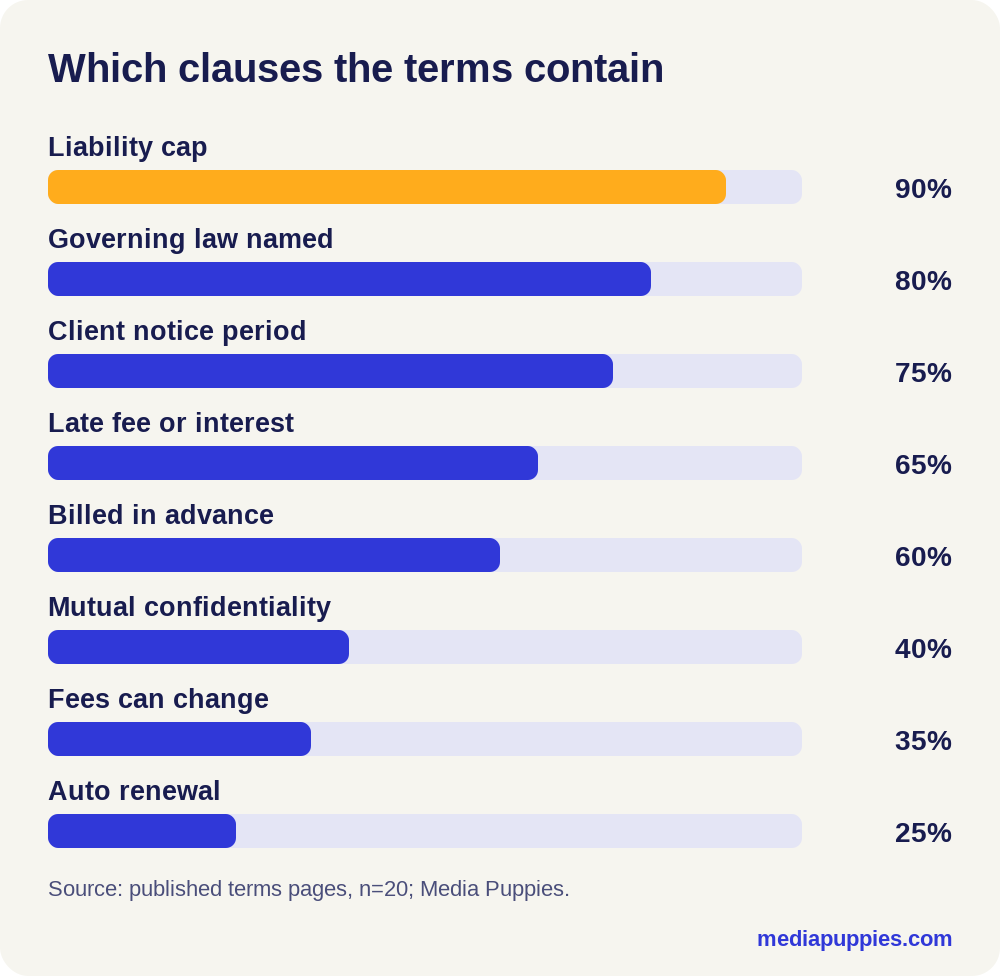
The pattern surprised us. The clauses that protect the agency (liability caps, late fees, billing in advance) are close to universal. The clauses a buyer cares most about when leaving (who owns the account, what gets handed over) are rare.
Notice and minimum term: how you actually leave
15 of 20 pages state a client notice period. 12 of them sit at 28 or 30 days, so the median is 30 days. The shortest was 0 (a page that lets the client terminate without written notice) and the longest 60 days, which one UK agency asks as non-renewal notice before each 12-month term rolls over.
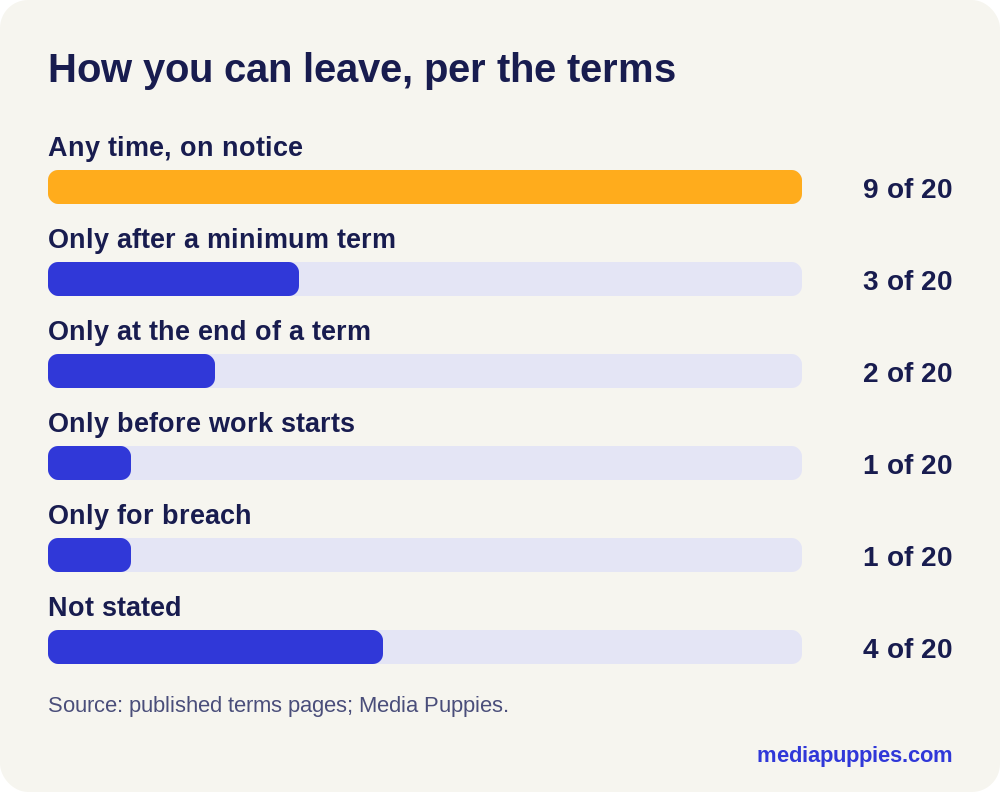
Notice is only half of it. The other half is when notice can take effect. 9 of 20 let you leave at any time on notice. 3 only allow it after a minimum term, 2 only at the end of a fixed or renewal term, 1 only before work starts, and 1 only for breach (with 20 days to fix the breach). 4 do not say.
Only 4 of 20 terms pages set a minimum term themselves: 3, 3, 6 and 12 months. 2 say rolling monthly, and 14 leave it to the proposal. 5 of 20 renew or roll on unless you end them.
The early-exit charges are where the money is. 5 of 20 contracts carry one. One UK contract makes "the full contract cost" payable at once on early exit. Another asks for 85% of the fees left in the term, and the same page says the charges still apply if the client cuts the ad budget. An Australian contract adds a cancellation fee of one month's fee if the term is under 3 months. It also treats notice as given on the next monthly anniversary date, and it allows one cancellation in any 12-month period.
Counting a minimum term, an end-of-term-only or before-start-only exit, a breach-only exit or an early-exit charge, 9 of 20 contracts (45%) have some form of lock-in. That is the same number that let you leave at any time.
One asymmetry is worth knowing about. One Australian contract lets the agency end the agreement on 30 days' notice at any time, while the client can only do so after 3 months.
Who owns the ad account, according to the contract
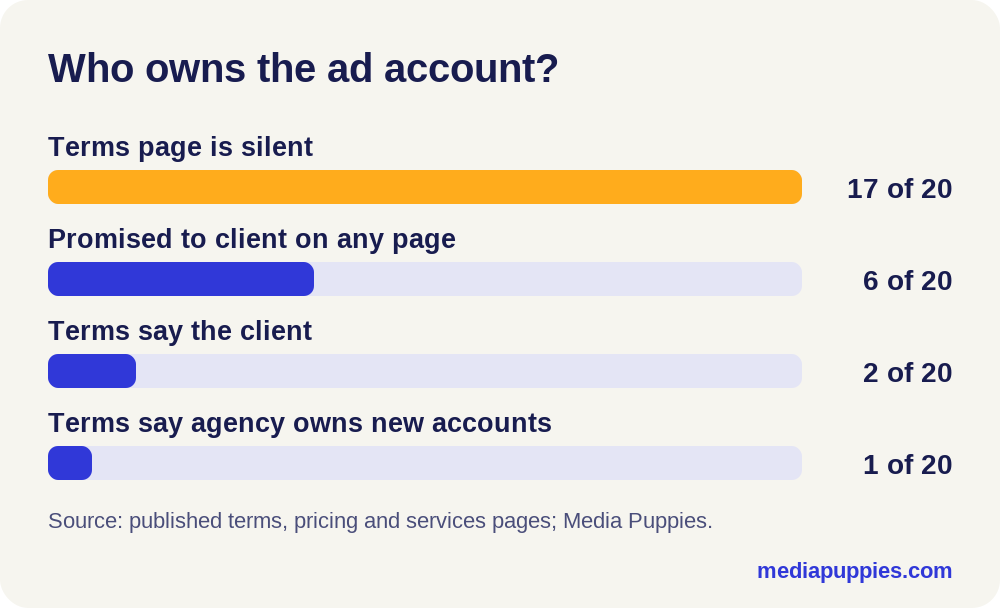
This was the clause we most wanted to find, and it was the rarest. Only 3 of 20 terms pages (15%) say who owns the ad account. 2 say the client, in plain words such as "remain the sole property of the Client" (a US agency). One UK contract splits it: existing accounts linked to its manager account stay the client's, while "New PPC accounts will be set up in our MCC and will remain the property of the Supplier", with ownership passed over on notice once invoices are paid.
17 of 20 terms pages are silent. Yet 6 of the same 20 agencies promise client ownership somewhere, usually on the pricing or services page. A sales-page promise is better than nothing, but it is the contract you sign that counts. We would want the promise in the terms or the proposal.
The exit side is thinner still. 3 of 20 say what happens to accounts and data at the end. One US agency promises to "deliver all final reports, active campaigns, and data exports" and keeps client data for 12 months. One UK agency says "you retain your accounts and their data" when it removes its access. 2 of 20 let the agency hold logins or cut platform access while invoices are unpaid.
Our guide on who owns your ad account covers how to check this inside Google Ads itself, which matters more than any clause.
Fees, payment and the money clauses
7 of 20 contracts (35%) let the fee move during the contract. 3 (15%) build in a yearly rise: one UK page adds 5% or CPI each anniversary, whichever is higher, another says fees "may be subject to a 5% annual increase", and one Australian page reserves the right to raise recurring fees "by a minimum of CPI annually". One more lets the rate change on 30 days' notice after the minimum term, one at the agency's discretion and one re-prices on scope changes. Only 1 of the 7 requires the client's consent.
12 of 20 bill in advance and 5 have a deposit clause, mostly for web projects. 13 of 20 charge a late fee or interest. On media, only 3 terms pages say the client pays the ad platforms directly, and 2 let the agency invoice media itself. One of those passes third-party invoices on with a 10% agency fee. 15 do not cover ad spend on the terms page at all.
Liability, confidentiality and the rest
18 of 20 (90%) cap what the agency can owe you. 9 cap it at fees paid over a set number of months, from 2 to 12, with a median of 3 months. 4 Australian pages limit the remedy to supplying the service again or paying for that. 5 use another fee measure, and 2 have no cap.
Confidentiality is thinner than we expected. 8 of 20 have a mutual clause. 2 only bind the agency, and 10 have none on the page. For a buyer handing over sales data and margins, that is worth raising.
3 of 20 stop the client from hiring the agency's staff, for 6 to 12 months after the end. 2 bind both sides not to criticise each other in public. 16 of 20 name a governing law, such as England and Wales, Scotland, New South Wales or a US state. 4 do not name one.
When the sales page and the terms page disagree
On 6 of the 20 agencies (30%), the pricing or services page says something the terms page does not. We report these as written, and keep both quotes in our study files. Pages change, and a proposal may override either one.
- A UK agency. The pricing page says "All monthly retainers operate on 30-day rolling contracts." Its PPC page mentions "an initial 3-month commitment". The terms page says PPC retainers "run for a minimum of 6 months unless otherwise agreed in a separate contract."
- An Australian agency. The pricing page says "No Lock In Contracts". The terms page adds a cancellation fee equal to one monthly fee if the term is under 3 months, deems notice given on the next anniversary date, and allows one cancellation per 12 months.
- A second Australian agency. The pricing page says "no lock in contracts". The terms page says the client may terminate "at any time after 3 months from the Commencement Date" with 30 days' written notice.
In 3 more cases the sales page says "no contracts", "no lock-in" or "free to cancel" and the terms page asks for 30 days' or one month's written notice. A notice period is a fair thing to ask for. The wording is still worth lining up before you sign.
10 clauses to check before you sign
This section is our view, drawn from what we saw in the 20 pages. It is not legal advice. For a contract of any size, have a lawyer in your own country read it.
- Notice, and when it takes effect. 30 days is the norm in this sample. Check whether notice can be given at any time or only at the end of a term.
- Minimum term in the terms, not the pitch. If the sales page says rolling and the terms say 6 months, ask which one you are signing.
- Early-exit charges. Look for "remainder of the term", "full contract cost" or a cancellation fee. 5 of 20 had one.
- Renewal. If it rolls into a new 12-month term, diary the notice date.
- Ad account ownership in writing. The account should be created in your name, with you as admin. 17 of 20 terms pages were silent, so put it in the proposal.
- What you get on exit. Access, conversion setup, audiences, reports and creative files. Our guide to leaving an agency cleanly lists them.
- Fee rises. A yearly CPI or 5% rise is common enough to expect. Agree a cap or a consent step.
- Who pays the platforms. Paying Google or Meta directly keeps media spend visible. If the agency invoices media, ask about any handling fee.
- Two-way confidentiality. Half the pages had none. Your sales and margin figures deserve the same protection as the agency's methods.
- Liability and the remedy. A cap of 3 months of fees is typical here. Check that it is mutual and that it does not exclude the agency's own negligence with your account.
Our earlier piece on marketing agency contract terms explains each of these clauses in more depth, and our note on what belongs in an agency SLA covers service levels, which a terms page rarely spells out.
What we would change
Our view: a buyer should be able to read the exit, ownership and fee-change rules on one page before the first call. In this sample a buyer often could not. Agencies that say "no lock-in" in the pitch would do well to make the terms say the same thing, and to state ad account ownership in the contract itself. Buyers should ask for the actual contract early and compare it against the sales page line by line.
If you want a second pair of eyes on how your current Google Ads account is set up and who controls it, our free ad account audit checks access and ownership along with the campaigns. Our Google Ads management page explains how we work with businesses in the US, UK and Australia.
How we did this
- Source
- Published terms and conditions pages of US, UK and Australian PPC and marketing agencies, from our PPC agency public pages sample
- Country
- United States, United Kingdom, Australia
- Collected
- 19 November 2026
- Sample
- 37 terms pages collected; 20 with service contract clauses (US 3, UK 9, Australia 8) and 17 covering website use only. Every clause count uses n=20.
- Unit
- One published terms page per agency, read as of 19 November 2026
- Parent sample
- PPC agency public pages, 43 agencies found through 33 free web searches
The pages come from our sample of PPC agency public pages, built on 19 November 2026 from 33 free web searches for agency pricing in the US, UK and Australia. We kept agencies based in those three countries and skipped any site that blocked a plain fetch. The full screening is in that study's plan.md.
Of 37 terms pages, 17 only cover use of the website (cookies, content, liability for the site). We count them once and leave them out of every clause share. The other 20 are coded clause by clause.
We read all 20 by hand and coded each from the terms page alone. Where an earlier extraction had filled a terms field from the pricing or services page, we blanked it on the terms side and kept the sales-page wording as a separate column. There are 17 such changes, each with a reason, in compile.py.
Every quote is checked word for word against the saved page text and kept to 20 words or fewer. "Not stated" means the page does not say it. Many pages also say a proposal or order form can change these defaults, so a signed contract may differ.
Limits. Twenty pages is a small sample, and the US has only 3. Agencies that publish terms lean toward small-business packages. Several pages are general templates for hosting, web design or SEO that also cover paid media. We are a marketing team, not lawyers, and nothing here is legal advice.
Download the data (CSV). Free to reuse under CC BY 4.0 with a link to this page.
Questions about marketing agency terms and conditions
What should marketing agency terms and conditions include?
At minimum: notice and when it takes effect, any minimum term or renewal, early-exit charges, who owns the ad account and data, what is handed over on exit, how fees can change, who pays the ad platforms, mutual confidentiality and a liability cap. In our sample of 20, the liability cap was the most common clause (18 of 20) and ad account ownership one of the rarest (3 of 20).
What is a normal notice period for a marketing agency?
In the 20 contracts we read, 15 stated a client notice period and the median was 30 days. The range ran from 0 to 60 days. Check when notice takes effect too: 9 of 20 let the client leave at any time, while others only allow it after a minimum term or at the end of a term.
Do marketing agencies have minimum contract terms?
Some do. 4 of the 20 terms pages set a minimum themselves (3, 3, 6 and 12 months), 2 said rolling monthly and 14 left it to the proposal. 5 of 20 carried an early-exit charge.
Who owns the ad account under an agency contract?
Most published terms do not say. 17 of 20 were silent, 2 said the client and 1 said new accounts set up by the agency stay the agency's. Ask for client ownership in writing and make sure the account is created in your name.
Is this legal advice?
No. It is a count of what 20 published agency terms pages said on 19 November 2026. Signed contracts can differ from the published default, and laws differ between the US, UK and Australia. Have a lawyer review any contract you plan to sign.