

Key findings
- 80.1% of the 296 med spa advertisers we found had exactly one active ad. Only 2.7% were running five or more.
- The median med spa ad had been live for 160 days, and 69% had been running for 90 days or longer.
- 60.1% of ads mentioned a price or a discount, and 28.7% were built around a new-client special.
- Book now was the most common button, on 32.6% of ads. 53.3% sent people to the clinic's own website.
- Of 180 ads for Botox-type treatments, 83.9% named a brand such as Botox or Dysport in the copy.
Meta Ad Library · 439 ads from 296 advertisers · 3 November 2026 · How we did this · Download the data (CSV)
We pulled every active med spa ad we could find in the Meta Ad Library for eight common search terms, filtered out the shops, product brands and training courses, and were left with 439 live ads from 296 US med spas and aesthetic clinics. This is what those med spa ads look like, measured rather than guessed.
The short version: most med spas run a single ad and leave it running for months, more than half lead with a price or a discount, and almost every Botox ad names the brand. Some of that matches what we expected. The single-ad finding did not, and it changes what we would tell a med spa owner first. The full dataset is free to download at the end.
Most med spa advertisers run just one ad
We expected busy accounts. Meta's delivery system now leans heavily on creative variety: it uses the ads themselves to decide who sees them, so an account with several genuinely different ads gives it more ways to find buyers. Instead, 80.1% of the 296 advertisers had exactly one active ad. The median was one. Only 2.7% were running five or more, and the busiest single advertiser had 21.
The ten most active advertisers accounted for 19.6% of all the ads in the sample, which tells you a handful of multi-location groups and franchises are doing most of the testing. Everyone else is relying on one creative to do every job: introduce the clinic, explain the treatment, overcome price worries and get the booking.
In our experience that is the biggest gap in small med spa accounts. One ad can work, but it cannot reach the person who wants subtle Botox, the person comparing lip filler prices and the person nervous about their first treatment all at once. If you are running one ad, the next step is usually two or three different concepts, not a bigger budget.
Med spa ads stay live for months
The median ad had been running for 160 days when we collected the data. A quarter had been live for 64 days or less, and a quarter for 326 days or more. 21.2% had been running for over a year. Only 3% were less than two weeks old.
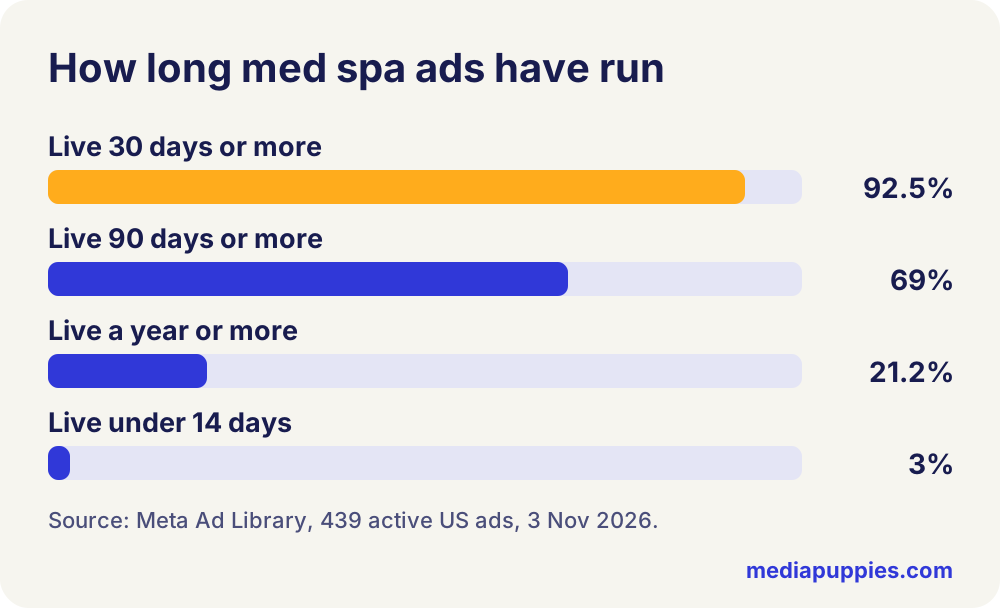
Long-running ads are often read as winners, since few advertisers keep paying for an ad that does nothing. That is a fair signal for big accounts that test constantly. For a med spa with one ad, it may simply mean nobody has touched the account since launch. Combined with the single-ad finding, our read is that many of these ads are running on autopilot.
Carousels had the longest median run in our sample at 257 days, compared with 177 for video, 160 for single images and 140 for dynamic creative. Treat that as a hint, not a rule: carousels were only 6.8% of ads, so the group is small.
Formats: images are holding their own
Video gets most of the attention in Meta advice, but med spas split almost evenly between three formats.
| Format | Ads | Share |
|---|---|---|
| Single image | 141 | 32.1% |
| Video | 132 | 30.1% |
| Dynamic creative (several assets) | 126 | 28.7% |
| Carousel | 30 | 6.8% |
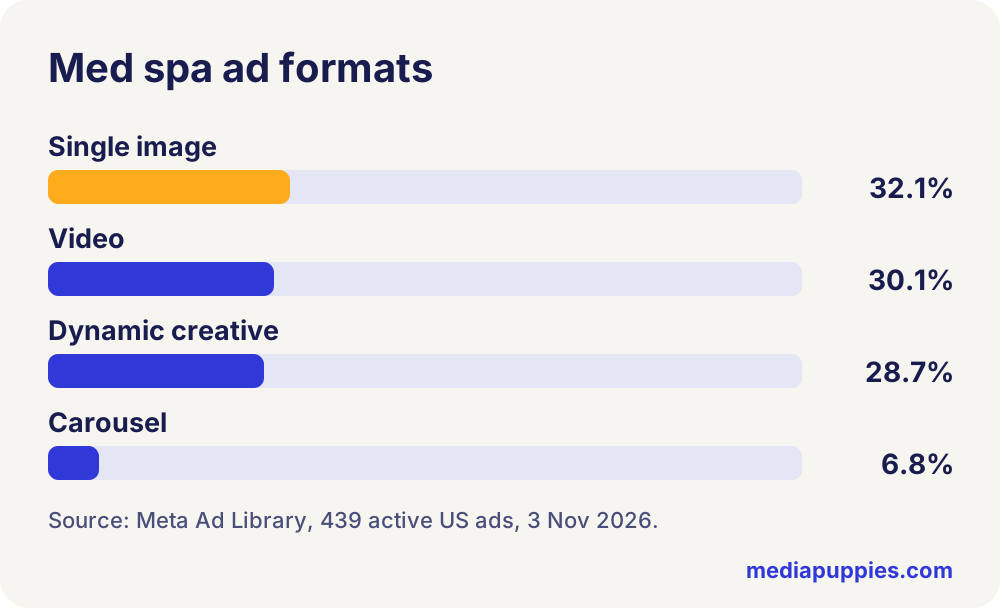
The images we saw were mostly offer graphics: a treatment name, a price, a deadline. The videos leaned toward injectors explaining a treatment or filming in the clinic. If you only have budget for one new piece of creative, a provider talking to camera about one treatment is the format most of these advertisers are not using.
Book now beats Learn more
Med spas are asking for the booking straight away. The most common button was Book now, on almost a third of ads.
| Button | Ads | Share |
|---|---|---|
| Book now | 143 | 32.6% |
| Learn more | 74 | 16.9% |
| Get offer | 59 | 13.4% |
| See details | 54 | 12.3% |
| Visit Instagram profile | 26 | 5.9% |
| Send message | 25 | 5.7% |
Where the click goes matters as much as the button. 53.3% of ads sent people to the clinic's own website or a landing page, 33.7% kept them inside Facebook, Instagram or WhatsApp (profiles, messages and forms), and only 5.2% linked straight to a booking platform such as Zenoti or Vagaro. Given how many ads say Book now, that last number surprised us. Sending a Book now click to a home page instead of a booking calendar adds a step at exactly the moment someone is ready.
Six in ten med spa ads talk about money
60.1% of ads mentioned a price or a discount somewhere in the text. Almost half showed a dollar figure, and almost half used words like special, deal, sale or offer.
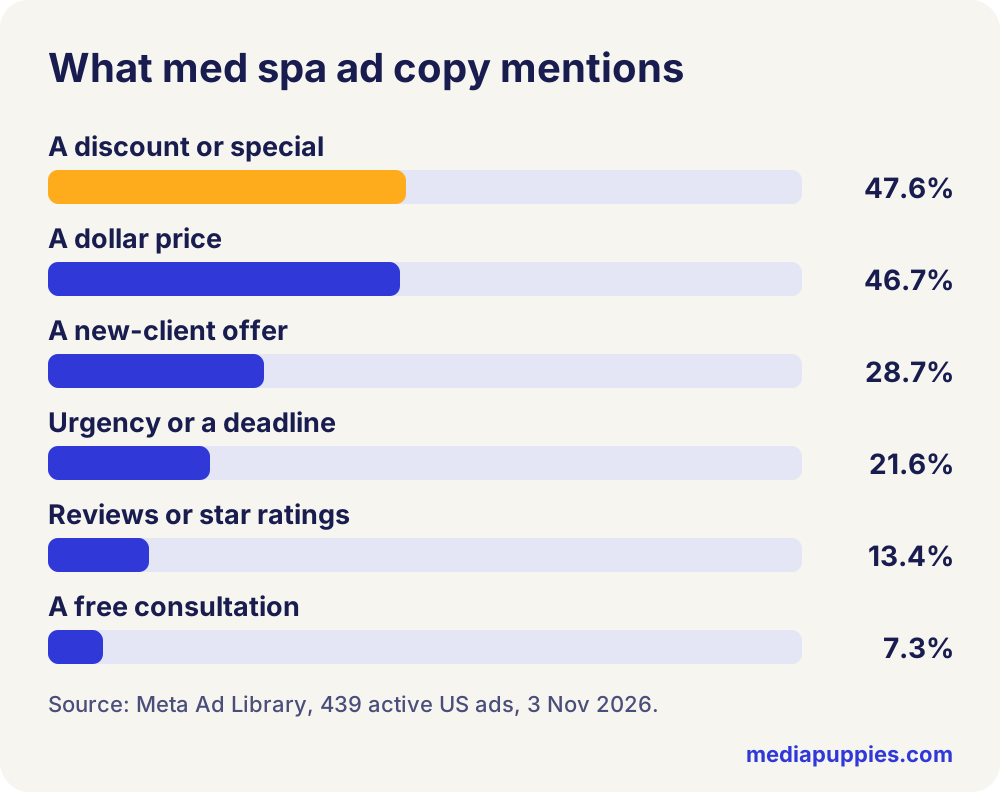
New-client specials were the most common structure, in 28.7% of ads: a first-visit price on Botox, filler or a facial. Urgency appeared in 21.6% (limited time, this month only, spots left). Reviews or star ratings appeared in 13.4%, and free consultations in only 7.3%.
Fourteen ads from 11 clinics stated a per-unit price for Botox in the copy. The median was $9.99 a unit, and the range ran from $8 to $12. That is a small group, and it skews toward clinics that compete on price, so read it as "what price-led Botox ads advertise", not as a market average.
Our view: price-led ads fill calendars fast and attract people who move to the next deal just as fast. The clinics with the longest-running ads in this sample did not lean harder on price. The median ad with a dollar figure had been live 155 days, against 183 for ads without one. We would test a consultation-led or treatment-explainer ad alongside any price ad before cutting prices further. We cover that trade-off in our guide to med spa marketing.
Botox brand names are everywhere on Meta
180 ads promoted Botox-type treatments, and 83.9% of them named a brand in the copy: Botox, Dysport, Xeomin, Daxxify, Jeuveau or Letybo. 41.1% of those ads also showed a price.
That matters because the same wording does not always travel to Google. Botulinum toxins are prescription products, and Google's healthcare policy is stricter about prescription drug names in ads and keywords, which is why med spas often find copy that runs on Meta gets limited on Google. If you run both, write Google ads around the treatment and the consultation, and keep brand names for landing pages where your policies allow.
What med spas advertise
| Treatment named in the ad | Ads | Share |
|---|---|---|
| Facials and peels | 188 | 42.8% |
| Dermal filler | 186 | 42.4% |
| Botox and similar neurotoxins | 180 | 41% |
| Microneedling | 60 | 13.7% |
| Body contouring | 60 | 13.7% |
| Laser hair removal | 53 | 12.1% |
| Laser and light resurfacing | 32 | 7.3% |
| Weight loss (GLP-1) | 17 | 3.9% |
Many ads named more than one treatment, so the shares add up to more than 100%. Weight loss was rare in this sample because our searches were aesthetic terms; clinics advertising GLP-1 programmes often run separate ads that these searches would not catch.
Where med spa ads run
Nearly every ad ran on Instagram (99.3%) and most on Facebook (90%). More interesting: 54.4% also ran on Audience Network, Meta's network of third-party apps and sites, and 33% on Threads.
Audience Network is usually left on because Advantage+ placements include it by default. For purchase campaigns that is often fine. For instant-form lead campaigns, which many med spas use for consultation requests, we switch Audience Network off by default, because in our experience it brings accidental form fills that never answer the phone. If your cost per lead looks cheap and your show rate does not, check the placement breakdown first. Our comparison of lead form ads and landing pages covers the rest of that decision.
What we would change after reading 439 ads
- Run more than one idea. Two or three genuinely different ads (an offer, a provider explainer, a first-timer reassurance piece) give Meta far more to work with than one ad left on for a year.
- Send Book now to a calendar. If the button says Book now, the click should land on available times, not a home page.
- Test a non-price ad. With six in ten ads talking money, a calm explainer from the injector stands out.
- Check placements on lead campaigns. More than half these ads were on Audience Network.
- Refresh on purpose. A long-running ad is fine if you are watching its results. It is a problem if nobody has looked since launch.
If you want a second pair of eyes on your own account, our Meta ads team runs campaigns for aesthetics clinics in the US, UK, Canada and Australia. You can also browse our other original research.
How we did this
- Source
- Meta Ad Library
- Country
- United States
- Collected
- 3 November 2026
- Sample
- 439 ads from 296 advertisers
- Searches
- med spa, medspa, medical spa, botox, dermal filler, laser hair removal, microneedling, hydrafacial
- Filtered out
- 784 of 1,223 ads returned (shops, product brands, training courses, software, creators, non-English ads, and ads naming no aesthetic treatment)
We searched the Meta Ad Library for active ads shown in the United States on 3 November 2026, using eight search terms and taking up to 200 results per term. The scrape returned 1,223 unique ads.
We kept an ad only if it came from a clinic or spa page, named at least one aesthetic treatment, was written in English, and was not selling a product, a course or software. Pages with broad categories such as Health & Beauty also needed a clinic signal in the copy (med spa, clinic, consultation, appointment, injector or new client). That left 439 ads from 296 advertisers.
Copy features (prices, discounts, urgency, reviews) were detected with keyword rules on the ad text, title and link description. Images and videos were not analysed, so claims shown only in a picture are not counted.
"Days live" is the time since the start date the Ad Library shows. It tells you how long an ad has run, which is not the same as how well it performed. The sample is the set of results Meta returned for each search, not a random sample of every med spa in the country.
Download the data (CSV). Free to reuse with a link to this page.
Questions people ask before hiring
How many ads do US med spas run on Facebook and Instagram?
In our sample of 296 advertisers on 3 November 2026, 80.1% had exactly one active ad and only 2.7% ran five or more.
How long do med spa ads run on Meta?
The median active med spa ad had been live for 160 days, and 69% had been running for 90 days or more.
Do med spa ads show prices?
Often. 60.1% of the ads mentioned a price or a discount, and 28.7% were built around a new-client special.
Can med spas name Botox in Facebook ads?
Many do: 83.9% of the 180 Botox-type ads in our sample named a brand. Google is stricter about prescription drug names, so the same copy may not work there.
What is the most common call-to-action in med spa ads?
Book now, used on 32.6% of the ads, followed by Learn more at 16.9%.
Can I use this data?
Yes. Download the CSV from this page and reuse it with a link back to the study.