

Med spa marketing is the work of attracting the right clients to a medical spa and turning them into booked consultations, treatments and repeat visits. For most US med spas that means Google Search for people already looking for a treatment, Meta ads on Facebook and Instagram to build demand locally, a strong Google Business Profile and reviews, and an online booking flow that makes the first consultation easy.
The med spa marketing plans that work share three traits. They lead with trust (qualified providers, real rooms, clear process) rather than discounts. They respect the platform rules on health and cosmetic advertising, which are strict. And they measure booked and attended consultations, then treatments and rebookings, instead of leads or likes. This guide sets out a practical plan along those lines.
How med spa clients actually decide
Aesthetic treatments are personal, often elective, and usually repeated. Clients rarely book a first treatment from a single ad. A typical path looks like this:
- They notice a concern or a treatment through friends, social media or search.
- They research options, prices and providers, often over weeks.
- They check reviews, provider credentials and photos of the clinic.
- They book a consultation, often online and often outside business hours.
- After a good consultation, they book treatment and, if it goes well, return for maintenance.
Marketing has a job at each step. Ads create awareness and capture searches; the website and reviews build trust; booking removes friction; and follow-up turns one treatment into a long relationship. Spending heavily on the first step while ignoring the others is the most common reason med spa ads disappoint.
It also explains why the same budget produces very different results at different clinics. A med spa with online booking, fast callbacks, a strong review profile and a membership programme turns each enquiry into far more revenue than one that relies on the ad alone. Fix the weakest step first; it is usually cheaper than buying more traffic.
Meta ads for med spas: what the rules allow
Meta allows ads for cosmetic procedures and aesthetic treatments, with restrictions that shape both targeting and creative. Read Meta's current health and wellness and cosmetic procedure policies before launching; the main points practitioners work with are:
- Age: ads for cosmetic procedures must be targeted to people aged 18 and over.
- No negative self-perception: ads must not try to make people feel bad about their appearance to sell a treatment. "Hate your wrinkles?" and similar hooks get rejected.
- No personal attributes: copy must not assert or imply something about the viewer's body or health ("You have sagging skin").
- Results imagery: before-and-after images and claims of dramatic results are restricted; side-by-side comparisons are a common cause of rejections.
- Unrealistic claims: promises of guaranteed or permanent results breach the policies and, in the US, can attract attention from the FTC and state regulators.
Accounts that repeatedly break these rules get restricted, which hurts far more than a rejected ad. Build compliance into the creative brief rather than fixing ads after rejection.
Creative that books consultations
Med spa creative works best when it shows the experience and the expertise, not the "after".
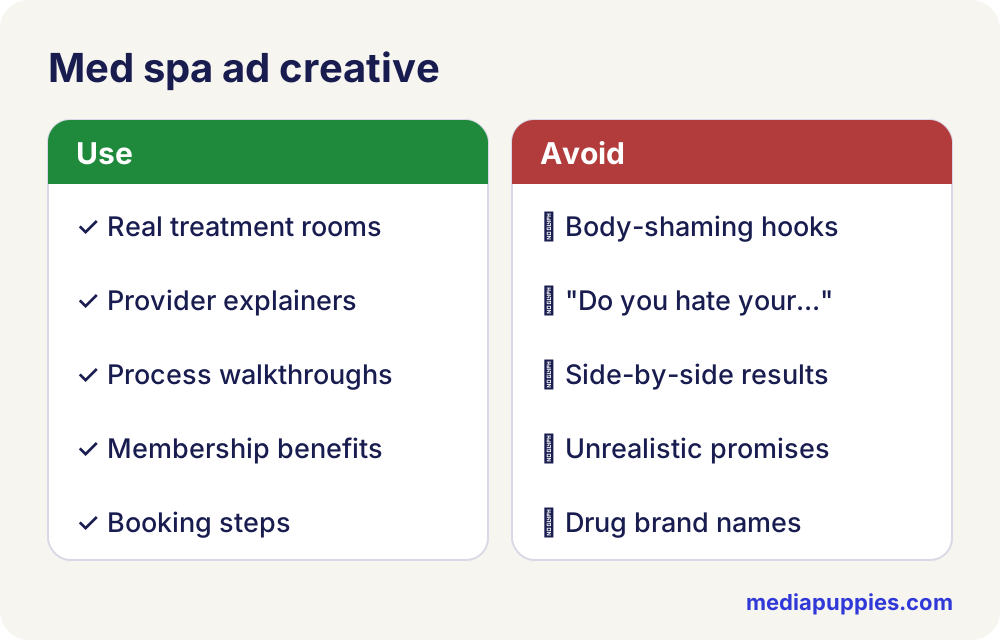
- Provider explainers: a nurse injector or medical director explaining what a treatment does, who it suits and what to expect, filmed in the clinic.
- Process walkthroughs: the consultation, the treatment room, the steps of a facial or laser session, without dramatic results.
- Answers to common questions: downtime, how long results typically last, how many sessions are usually needed, stated carefully and without guarantees.
- Clinic atmosphere: the space, the team and the care, which is what premium clients are paying for.
- Membership and booking information: how the membership works, how to book, consultation details.
Short vertical video for Reels and Stories, with captions, usually outperforms static images. Run three to five clearly different concepts at once, since Meta's delivery rewards creative variety more than small tweaks to one ad.
Google Search for med spas
Search captures people already looking for a treatment nearby, usually the highest-intent clicks a med spa can buy.
- Treatment and location keywords: "laser hair removal near me", "hydrafacial [city]", "lip filler [neighborhood]", "chemical peel [city]".
- Separate campaigns by treatment group, so budget follows margin and capacity rather than whichever treatment has the cheapest clicks.
- Brand campaign for the med spa's own name.
- Negatives for jobs, training, courses, certification, at-home devices, DIY and "cheap".
Prescription treatments need care. Botulinum toxin products and many fillers are prescription products, and Google's healthcare and medicines policy restricts how prescription drugs can be advertised. Med spas often see ads or keywords limited when they use drug brand names. Check the current policy and the disapproval reasons in the account, and build ads and landing pages around the consultation and the treatment category. The account structure follows the same principles as our guide to structuring Google Search ads.
Offers that do not cheapen the brand
Deep discounts fill the calendar with bargain hunters who rarely return. Med spas that build lasting revenue use offers that attract the right client and encourage repeat visits.
| Offer type | Effect on the brand | Effect on repeat business |
|---|---|---|
| Large first-visit discount | Signals "cheap"; attracts deal seekers | Low; clients move to the next deal |
| Consultation credit toward treatment | Neutral to positive | Good; rewards booking |
| Membership with monthly benefits | Positive; feels exclusive | Strong; built for repeat visits |
| Treatment series or package | Positive when clearly priced | Strong; matches how results are achieved |
| Added value (complimentary add-on service) | Positive | Moderate |
State every offer precisely: what is included, who qualifies, and when it ends. Vague or misleading offers break platform rules and consumer protection law, and they generate complaints.
Booking consultations: the part most ads depend on
A med spa's ads can only be as good as its booking flow. Many prospective clients research in the evening, when the front desk is closed.
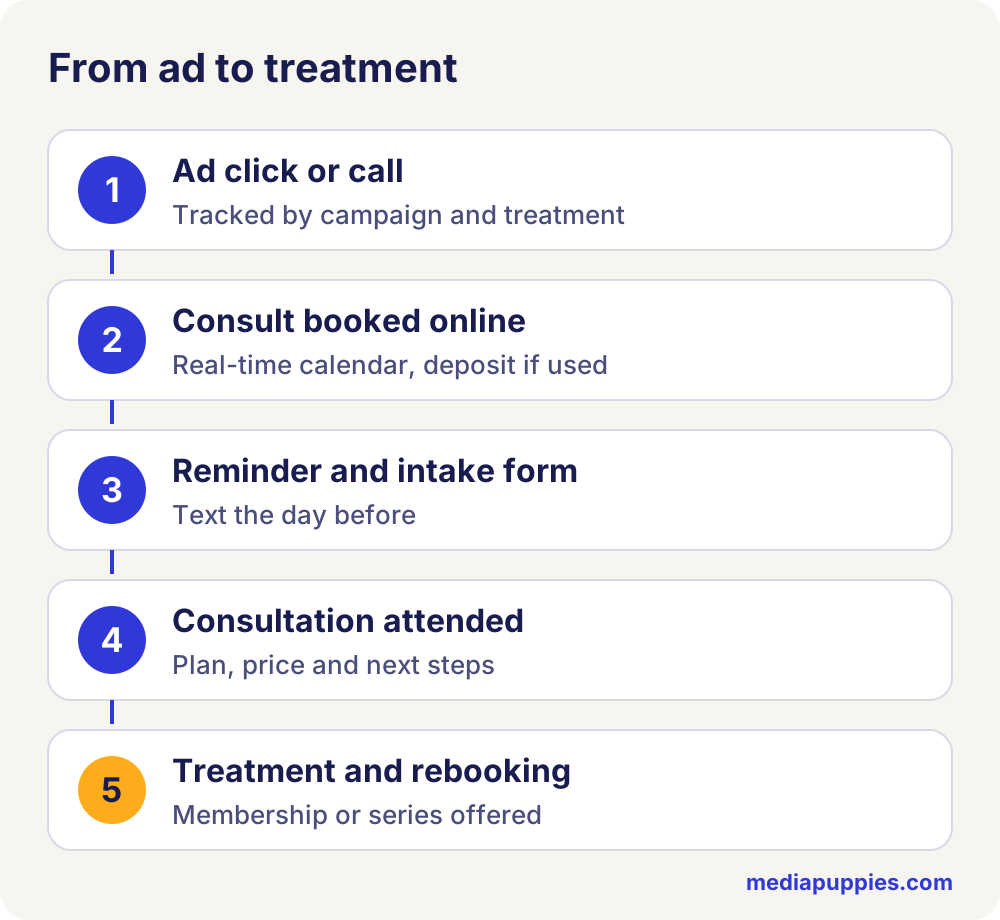
- Online booking with real-time availability for consultations, linked from every ad and landing page.
- A short form for those who prefer a callback, followed by a call within minutes during opening hours.
- Deposits or card holds for consultations, if no-shows are a problem, explained clearly at booking.
- Reminders by text and email the day before, with location, parking and what to expect.
- Intake forms sent ahead so the consultation focuses on the client.
Our guide to lead form ads vs landing pages helps choose between instant forms and booking pages, and why leads don't answer calls covers follow-up when clients go quiet.
Reviews, testimonials and the FTC
Reviews matter enormously in aesthetics. Clients read them closely before choosing a provider.
- Ask every satisfied client for a Google review, by text after the appointment.
- Respond to every review professionally, without confirming any client's treatment details.
- Never buy, fake or selectively gate reviews. The FTC's rule on fake reviews and testimonials, in force since late 2024, prohibits fake and AI-generated reviews and certain practices that suppress negative ones, with civil penalties.
- Testimonials in ads must reflect typical experiences and disclose any material connection, such as a free treatment, under the FTC's endorsement guides.
- Influencer content needs clear disclosure of any payment or free treatment.
Privacy, HIPAA and tracking pixels
Many med spas operate under a medical director and handle health information, so privacy rules apply to marketing too.
- Check whether HIPAA applies to the practice. If it does, tracking pixels on booking and intake pages can send protected health information to ad platforms. HHS has issued guidance on online tracking technologies, and parts of it were challenged in court, so take legal advice on how it affects your pages.
- Keep pixels off pages that collect health details, and pass conversions server side with only the data you are allowed to share.
- Get consent for texts and calls, as covered in consent language for US lead forms.
- Follow state privacy laws on consent for tracking; see US state privacy and conversion tracking.
Email, SMS and memberships
The cheapest booking a med spa ever gets is from an existing client. Retention marketing deserves as much attention as ads.
- Treatment reminders timed to when maintenance is typically due for each treatment.
- Membership communications: monthly benefits, exclusive booking windows, member events.
- Educational emails about new treatments, with consultation booking links.
- Win-back messages for clients who have not visited in several months.
All of this needs consent and an easy opt-out. Keep the tone consistent with the brand: helpful and calm, not daily discount blasts.
A worked example: the cost of a new client
All numbers here are hypothetical, to show the arithmetic. Say a med spa spends $6,000 a month: $3,500 on Google Search and $2,500 on Meta.
- Google brings 70 consultation bookings or calls; Meta brings 110 form leads.
- Google bookings attend at 75%: about 52 consultations. Meta leads are contacted, 35% book, and 70% of those attend: about 27 consultations.
- 60% of attended consultations become a first treatment: about 31 from Google and 16 from Meta, 47 new clients in total.
- Cost per new client: about $113 from Google, $156 from Meta, and $128 blended.
Now say the average client spends a certain amount on a first treatment and returns several times a year. The value of a new client over a year can be many times the cost to acquire one, which is why booking, attendance and rebooking matter more than shaving a few dollars off cost per lead. Our lead funnel calculator and LTV calculator run these numbers.
Google Business Profile: the free channel most med spas underuse
For "near me" searches, the map results often get more attention than the ads. A complete Google Business Profile brings calls, direction requests and bookings without ad spend.
- Primary category set accurately (for example medical spa) with relevant secondary categories.
- Services listed with plain descriptions, and a booking link to the online calendar.
- Photos of the real clinic, team and treatment rooms, updated regularly. Avoid client faces without written consent.
- Posts about new treatments, membership news and events, a few times a month.
- Questions and answers filled in with practical details: parking, consultation length, cancellation policy.
Treatment pages and local SEO
Every treatment you want to sell deserves its own page. These pages serve the ads, the map listing and organic search at once.
- One page per treatment, covering what it is, who it suits, what happens during the appointment, typical downtime, how results are usually maintained, and how to book a consultation.
- Provider credentials on the page: who performs the treatment and their qualifications.
- Pricing approach: many med spas show starting prices or explain that pricing is set at consultation; either way, be clear and consistent.
- Location signals: the city and neighborhood in the title and headings, embedded map, and consistent name, address and phone number across directories.
- Frequently asked questions written from the questions the front desk hears every week.
A marketing calendar for the year
Demand for different treatments moves through the year, and planning budgets around it beats running the same ads every month.
- Autumn and winter are popular times to start laser treatments and skin resurfacing, since many providers advise limiting sun exposure during and after them.
- Before holidays and wedding season, clients book facials and injectables with enough lead time before events.
- New year brings interest in wellness and memberships.
- Summer suits treatments with little downtime and maintenance visits.
Shift budget between treatment campaigns as the seasons change, and prepare creative a month ahead so ads are live when interest rises.
Multi-location med spas
Groups with several locations need structure that lets each clinic be measured on its own.
- Separate campaigns or ad sets per location, each with its own budget, so a busy clinic does not starve a new one.
- Location-specific landing pages and Google Business Profiles.
- Booking data by location, so cost per new client can be compared fairly.
- Shared creative library with local versions featuring each clinic's own team and rooms.
Influencers, creators and local partnerships
Aesthetics is a visual, word-of-mouth category, and local creators can introduce a med spa to people who trust their recommendations. It works best when it is treated as a partnership with clear rules.
- Choose creators whose audience lives nearby, not just those with the largest following. A few thousand engaged local followers can matter more than a national audience.
- Agree what they may say: their own experience of the visit, the clinic and the provider, without claims about medical results or permanence.
- Require clear disclosure of any payment or complimentary treatment, as the FTC's endorsement guides expect.
- Use Meta's partnership ads to run the best creator content as ads from both accounts, which often outperforms brand-made creative.
- Build local partnerships with salons, gyms, bridal shops and wellness businesses, with referral arrangements that follow your state's rules for medical practices.
Track each partnership with its own booking link or code, so you can see which ones bring clients who stay.
What to measure
- Booked consultations by channel and campaign.
- Show rate for consultations.
- Consultation-to-treatment rate by provider and treatment.
- Cost per new client by channel.
- Rebooking rate and membership sign-ups within 90 days.
Connect the booking system to the ad platforms where privacy rules allow, so bidding can learn from booked and attended consultations rather than form fills.
Common med spa marketing mistakes
- Leading with discounts. The calendar fills with clients who never return.
- Before-and-after-heavy creative that keeps getting rejected or restricts the ad account.
- Drug brand names in ads and keywords, leading to disapprovals.
- No online booking, so evening researchers go elsewhere.
- Slow follow-up on form leads.
- Pixels on intake pages without checking privacy obligations.
- Judging on cost per lead instead of cost per new client and rebooking.
Med spa marketing in Canada, the UK and Australia
- Canada: prescription drug advertising to the public is limited by federal rules to name, price and quantity, which affects how injectable treatments can be promoted. Provincial regulators set rules for regulated professionals.
- UK: botulinum toxin is a prescription-only medicine and cannot be advertised to the public; the ASA has ruled against many aesthetics ads. Advertise the consultation and the clinic, not the medicine.
- Australia: the TGA treats references to prescription-only medicines, including terms commonly used for injectables, as advertising those medicines to the public, which is not allowed. Cosmetic procedure advertising by practitioners also follows strict regulator guidelines.
The common thread: promote the clinic, the consultation and the expertise, and let the treatment discussion happen in the consultation.
Running med spa marketing in-house or with an agency
A single-location med spa can run its own Google Business Profile, reviews and email well, and many manage Meta content in-house. Paid search and paid social benefit from a specialist once budgets grow, more locations open, or ad rejections start to pile up. Ask any agency how they handle health ad policies, how they track booked and attended consultations, and how they protect the brand in offers and creative.
Our Meta ads and Google Ads teams run campaigns for aesthetics and wellness clinics in the US, Canada, UK and Australia, with policy-safe creative briefs and consultation tracking set up in the first month. Fees depend on the number of locations and platforms, and we say it on the first call.
Questions people ask before hiring
What is the best marketing for a med spa?
A mix of Google Search for treatment searches, Meta ads for local demand, a strong Google Business Profile with reviews, easy online booking and retention marketing for existing clients.
Can med spas run Facebook and Instagram ads?
Yes, within Meta's rules: target people 18 and over, avoid negative self-perception and personal attributes, and be careful with before-and-after imagery and results claims.
Why do med spa Google ads get disapproved?
Often because they use prescription drug brand names or make claims the healthcare and medicines policy restricts. Build ads around the consultation and treatment category and check the disapproval reason.
Should a med spa offer discounts in ads?
Large first-visit discounts tend to attract one-time deal seekers. Consultation credits, memberships and treatment packages usually protect the brand and bring repeat visits.
How do med spas get more consultations booked?
Online booking with real-time availability, fast follow-up on form leads, reminders before appointments and clear information about what the consultation involves.
Can med spas use client testimonials?
Yes in the US, if they reflect typical experiences and disclose any material connection. Fake or bought reviews are prohibited under the FTC's rule.
What should a med spa measure from its ads?
Booked consultations, show rate, consultation-to-treatment rate, cost per new client and rebooking or membership rates.