

Key findings
- We found 39 first-hand Performance Max reports (35 on the Shopify Community, 4 on Hacker News), one short of our target of 40. 3 said it worked, 10 were mixed, 18 said it did not work and 8 could not tell.
- Of the 31 advertisers who gave a clear verdict, 18 (58.1%) said Performance Max did not work and 3 (9.7%) said it did.
- 7 of the 10 mixed reports were campaigns that had worked and then fell away, after a tag broke, a feed changed or for no reason the owner could find.
- 12 of 39 reports (30.8%) named broken conversion tracking or product feed problems, and all 8 advertisers who could not tell whether it paid were in that group.
- All 7 new stores in the sample failed to make it pay: 6 said it did not work and 1 was mixed. Spend on the store's own brand name came up once, and nobody named missing search terms.
Public forum posts by store owners and in-house advertisers about their own Google Ads Performance Max campaigns (Shopify Community via its public Discourse JSON; Hacker News via the public Algolia search API), read and hand-coded · 39 first-hand reports in 35 threads: 35 from the Shopify Community and 4 from Hacker News, 2022 to 2026. Read from 210 Shopify posts in 90 topics that name Performance Max (out of 332 topics returned by 58 searches) and from 14 Hacker News comments and 7 posts that name it (out of 8,967 comments and 768 posts returned by 43 comment searches and 4 post searches). The target was 40; these sources held 39. · 24 November 2026 · How we did this · Download the data (CSV)
Does Performance Max work? In the 39 first-hand reports we could find in public forums, 3 advertisers (8%) said their Performance Max campaign worked, 10 had mixed results, 18 said it did not work and 8 could not tell. Of the 31 who gave a clear verdict, 18 (58%) said it did not work.
We aimed for at least 40 reports and found 39, so read this as a small study and every split in it as a handful of people. This is the fourth study in a series. Our Google Ads owner study found Performance Max in 9 of its reports and most were mixed, so we went back for a closer look at this one campaign type with the same sources and rules. We run Google Ads accounts ourselves and label our opinions. None of our own client or account data is in here.
Where the 39 reports come from
On 24 November 2026 we searched the Shopify Community and Hacker News, two public forums that load without a login. Reddit blocked plain requests three days earlier, so we did not try it.
On the Shopify Community, 58 searches returned 332 topics. We read every post that names Performance Max: 210 posts in 90 topics. Most came from agencies, feed-app makers and consultants answering questions, or from owners asking how to set a campaign up. 35 posts were store owners describing a campaign they ran. On Hacker News, 43 comment searches returned 8,967 comments, and only 14 named Performance Max in an advertising context. 4 comments and posts were advertisers describing their own campaigns.
We expected a negative sample, because the Shopify Community is a help forum and people post when something breaks. It was negative. What surprised us was the reason. The complaints agencies make most about Performance Max, spend on your own brand name and no view of search terms, hardly came up. Owners talked about tracking, feeds and campaigns that simply stopped.
Does Performance Max work? What 39 advertisers said
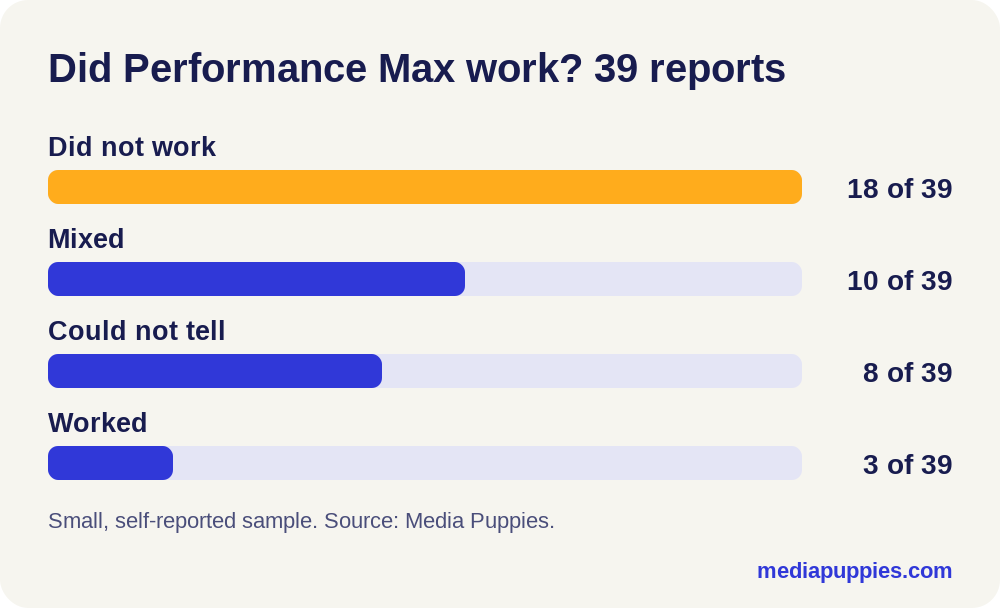
| Outcome | Shopify Community (35) | Hacker News (4) | All (39) |
|---|---|---|---|
| Worked | 3 (8.6%) | 0 | 3 (7.7%) |
| Mixed | 10 (28.6%) | 0 | 10 (25.6%) |
| Did not work | 14 (40%) | 4 (100%) | 18 (46.2%) |
| Could not tell | 8 (22.9%) | 0 | 8 (20.5%) |
The 3 positive reports were short. A home decor and gift retailer saw cost per conversion fall from $16 on Smart Shopping to $10 to $13 on Performance Max. A footwear store reported "solid luck" with it and wanted to scale specific products. Another store owner wrote that the campaign was "running fine" and asked how to add a Black Friday offer without disturbing it.
In our view, 3 happy reports out of 39 says more about who posts than about Performance Max. Owners whose campaigns work have little reason to write in. It does tell you what the failure modes look like, and the rest of this article is about those.
Mixed usually meant it worked, then stopped
7 of the 10 mixed reports describe a campaign that had worked and then fell away. One owner wrote that their campaigns "were working BRILLIANTLY until very recently", then found the purchase tag had stopped firing and the campaign had cut spend and sales. Another had run at a ROAS of 5 to 9 and dropped to about 0 within a month. A third had been stable for 6 months, then spent the day's budget in a few hours with no sales after switching to a new Google app.
6 reports said results fell away with no change made at all. A jewellery box seller had run Performance Max for about 2 years and described it as a little less than OK, with occasional great days and then drops. A motorcycle parts store in the US went from good sales to almost none in a few days.
In our view, this is the most useful thing in the sample. Performance Max bids on the conversion data it receives. When a tag breaks or a feed changes, the campaign keeps running and quietly optimises toward the wrong signal, and nothing in the interface warns you. A campaign that worked last month needs the same weekly check as a new one.
The 2022 switch from Smart Shopping
14 of the 39 reports date from 2022, the year Google moved Smart Shopping campaigns to Performance Max. 7 of those 14 said it did not work, and 5 blamed the switch or the new learning period directly. One owner wrote: "Since Google changed the ads we run our sales have plummeted." Another watched cost per conversion go from a steady $13 on Smart Shopping to $41 two weeks after the move.
The costliest case was a maker supplies store whose products stopped showing at migration because the new campaign needed product fields the old one did not. The owner wrote: "I estimate the cost of this 'migration', for us, around $15,000."
8 advertisers compared Performance Max with another campaign type. The table shows what they said.
| Compared with | Advertisers | Performance Max worse | Performance Max better |
|---|---|---|---|
| Smart Shopping | 6 | 5 | 1 |
| Standard Shopping | 1 | 1 | 0 |
| Search campaigns | 1 | 1 | 0 |
A fashion retailer said its first Performance Max tests were not effective and moved to Standard Shopping. A small service business found Performance Max paying far more for its own keywords than a Search campaign did once it moved them across. With 8 people this is a small pattern, and the Smart Shopping comparisons all come from the same few months of a forced migration.
What advertisers blamed
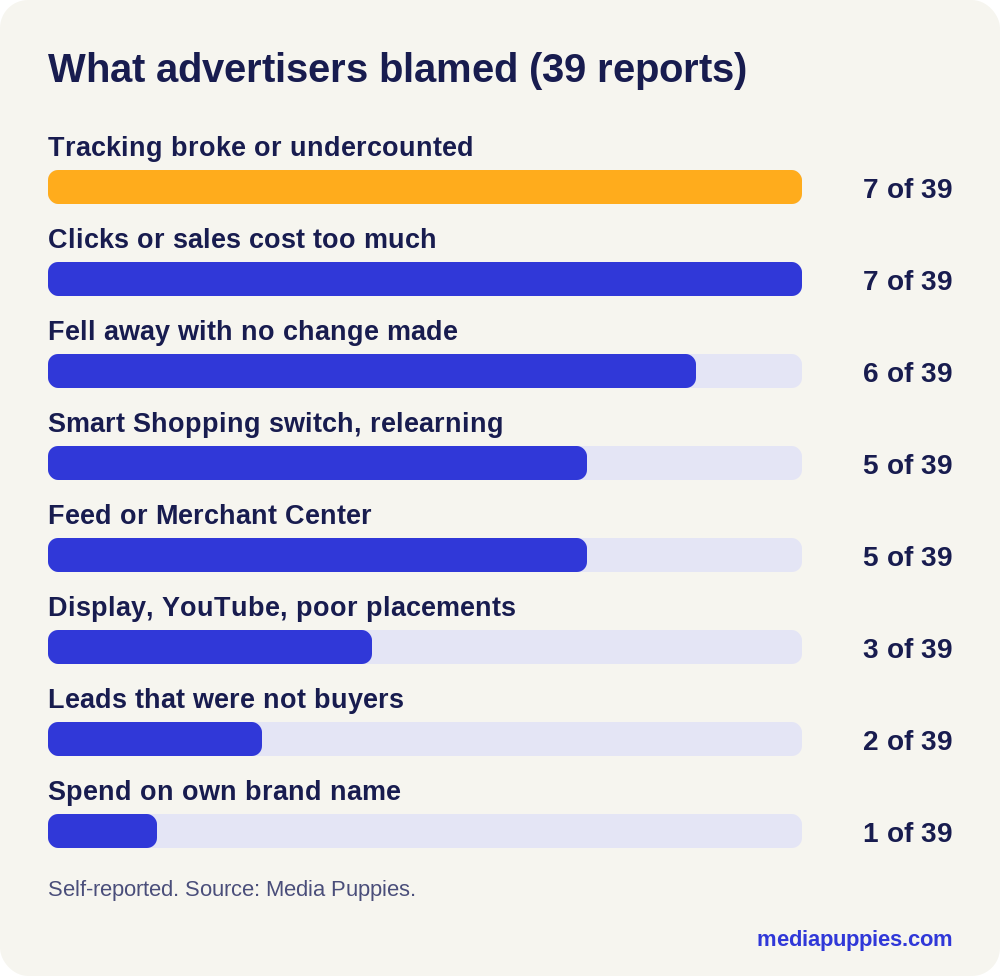
31 of the 39 reports named at least one problem. The two most common were conversion tracking that broke or undercounted (7) and clicks or sales that cost too much (7). Next came results falling away with no change (6), the Smart Shopping switch and relearning (5) and product feed or Merchant Center trouble (5).
Tracking and feeds explain most of the uncertainty. 12 of the 39 reports (30.8%) named broken tracking or a feed problem, and all 8 advertisers who could not tell whether Performance Max paid were in that group. One store found that some Google Shopping orders each day were never counted as conversions. Another found that a feed-only campaign stopped serving the moment the store moved platforms, because it still pointed at the old product feed. Our guides to checking Google Ads conversion tracking and Shopify customer events tracking cover the checks these owners were missing.
Placements came up 3 times. One store owner who gave up said to check where the money goes and exclude YouTube. A small service business on Hacker News found almost every Display click invalid and wrote that the Performance Max sales it did get "were because the campaign ended up spending for ranking for my own brand name." That was the only report naming brand-name spend.
Brand spend and search terms were nearly absent. 1 report named brand-name spend and none named missing search terms. In our view, that is because owners cannot see either problem without digging. A campaign that books your existing customers' brand searches looks like it is working. Our guide to Performance Max brand exclusions shows how to check, and the search terms report routine covers what you can still see.
New stores did worst
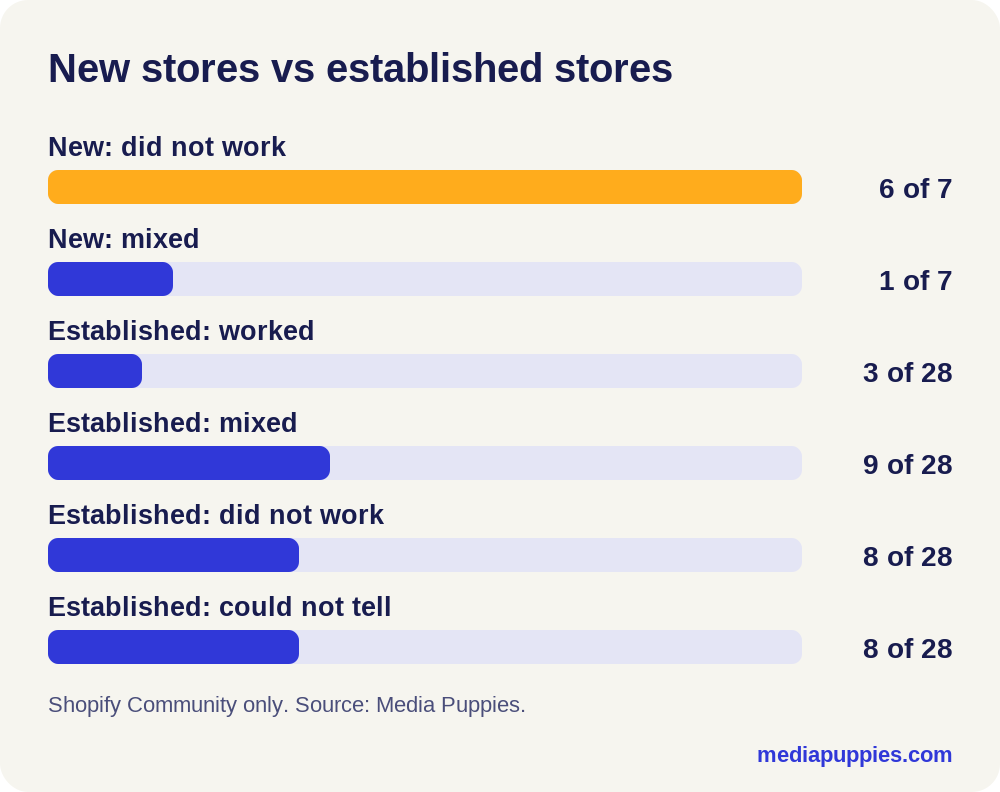
7 of the 35 Shopify reports came from new stores with little or no sales history. 6 said Performance Max did not work and the seventh was mixed: a few sales in its first month, none of them profitable, and no more sales when the owner raised the daily budget from $25 to $75. A UK swimwear brand put £1,200 plus £800 of free credit into Performance Max and Shopping ads and got no sales. A UK martial arts store paid £1.12 a click with no sales in its first few days. A new store with an average order of about $36 paid about $100 per purchase.
Established stores did better, and still not well: of 28, 3 said it worked, 9 were mixed, 8 said it did not work and 8 could not tell. In our view, Performance Max has little to learn from in a store with no sales, so it spreads the budget across every placement it has. A new store is better served by a campaign it can watch query by query.
The few numbers advertisers gave
Only 10 of the 39 reports gave any spend, ROAS or cost figure. Here they are as written.
| Advertiser | Outcome | What they reported |
|---|---|---|
| Home decor and gift retailer | Worked | Cost per conversion $16 on Smart Shopping, $10 to $13 on Performance Max |
| Online store, after the Smart Shopping switch | Did not work | Cost per conversion $13 on Smart Shopping, $41 on Performance Max |
| Online store | Mixed | ROAS 5 to 9, then about 0 |
| New store | Mixed | $25 to $75 a day, sales not profitable |
| New store, about $36 average order | Did not work | About $100 per purchase |
| New pet boutique | Did not work | $35 a day, no sales |
| New artificial plants store (US) | Did not work | Average cost per click $1.22, no sales |
| New martial arts store (UK) | Did not work | £13 a day, then £5 a day; £1.12 a click, no sales |
| New swimwear brand (UK) | Did not work | £1,200 plus £800 free credit across Performance Max and Shopping |
| Small service business | Did not work | $1,000 total across several campaign types |
Outside ecommerce: lead quality
All 4 Hacker News reports said Performance Max did not work, and 2 of them were B2B companies with the same complaint. One in-house marketer wrote that they "tried PMax on Google Ads and our sign ups increased but pipeline didn't move". Another said fake form fills from bot sites were booking meetings with the sales team and then not showing up.
In our view, both campaigns optimised toward a form submission, so they found more form submissions. A lead-generation account should only run Performance Max once it feeds back which leads became customers. Our guide to offline conversion import shows how.
What we would change (our view)
In our view, Performance Max can work for an online store with clean tracking, a clean feed and enough sales for the bidding to learn from. Most of the advertisers in this sample were missing at least one of those. These are the checks we would run first:
- Does a test order show up as one conversion, with the right value? Place one and check Google Ads the next day. Broken tracking sat behind every report where the owner could not tell whether the campaign paid.
- Did anything change in the store, the app or the feed? After a platform move, a theme change or a new Google app, check that products are still approved and that the campaign points at the current feed.
- How much of the reported return is your own brand name? Add brand exclusions and compare Performance Max revenue with total store revenue. If one rises and the other is flat, the campaign is taking credit for sales you would have had anyway.
- Is the store new? If there are few sales to learn from, start with Standard Shopping or Search, where you can see each query and add negative keywords, and add Performance Max later.
- Do you check it weekly? 7 of the 10 mixed reports were campaigns that stopped working without warning. Our Google Ads audit checklist is a good weekly routine.
If you want a second pair of eyes, our Shopify ads agency page explains how we run shopping accounts, and our free ad account audit starts with the tracking and feed checks above.
For agencies serving online stores, the lesson from these 39 advertisers is about monitoring. The campaign type rarely failed loudly. It failed when the data under it changed and nobody was watching.
How we did this
- Source
- Public forum posts by store owners and in-house advertisers about their own Google Ads Performance Max campaigns (Shopify Community via its public Discourse JSON; Hacker News via the public Algolia search API), read and hand-coded
- Country
- Mostly not stated (33 of 39; 3 UK, 2 US, 1 Australia); reports identifiably outside the United States, United Kingdom, Canada and Australia were excluded
- Collected
- 24 November 2026
- Sample
- 39 first-hand reports in 35 threads: 35 from the Shopify Community and 4 from Hacker News, 2022 to 2026. Read from 210 Shopify posts in 90 topics that name Performance Max (out of 332 topics returned by 58 searches) and from 14 Hacker News comments and 7 posts that name it (out of 8,967 comments and 768 posts returned by 43 comment searches and 4 post searches). The target was 40; these sources held 39.
- Fields
- Outcome (worked, mixed, did not work, could not tell), problems named, comparison with Smart Shopping, Standard Shopping or Search where stated, spend, ROAS, cost per sale or click as written, time run, whether the campaign had worked before it dropped, business type, year, country where stated
- Not used
- Reddit: it blocked plain requests with HTTP 403 and a login redirect on 21 November 2026, so we did not try it again
This study copies the method of our owner studies on Google Ads, Facebook ads and Microsoft Ads from 21 to 23 November 2026. Reddit blocked plain requests on 21 November, so we did not try it, and we did not work around any block, CAPTCHA or login. We used two sources that are readable without a login: the Shopify Community, through its public JSON, and Hacker News, through its public search API.
On the Shopify Community we ran 58 searches such as "performance max", "pmax roas", "performance max no sales" and "smart shopping performance max". They returned 332 topics. We downloaded the first page of posts in every topic and read each post that names Performance Max, or every post in a topic whose title names it: 210 posts in 90 topics. Replies from other store owners describing their own campaigns count as separate reports. On Hacker News we ran 43 comment searches and 4 post searches, kept 8,967 comments and 768 posts, and read the 14 comments and 7 posts that name Performance Max in an advertising context.
A report counts when the writer ran Performance Max for their own business, or for their employer as an in-house marketer, and says something about the result. We excluded agencies, consultants, feed-app and tool vendors describing client accounts or giving advice, which was most of the Performance Max discussion on the Shopify Community. We also excluded set-up questions where the campaign had not run, second-hand stories, promotional posts, non-English threads, repeat posts by the same person, and anyone identifiably outside the US, UK, Canada and Australia, including stores pricing in euros, Swiss francs, Swedish kronor or New Zealand dollars. Each report was coded once, by one person.
Limits. 39 reports is a small sample, and every split in this article is a handful of people. Everything is self-reported and unchecked. The Shopify Community is a help forum, so people post when something breaks, and 35 of the 39 reports are Shopify stores. 14 of the 39 date from 2022, when Google moved Smart Shopping campaigns to Performance Max. Only 10 reports gave any spend, ROAS or cost figure. No usernames are stored; the data file holds thread and post links only.
Download the data (CSV). Free to reuse under CC BY 4.0 with a link to this page.
Questions about Performance Max results
Does Performance Max work?
In the 39 first-hand reports we found, 3 advertisers said Performance Max worked, 10 had mixed results, 18 said it did not work and 8 could not tell. Of the 31 with a clear verdict, 18 (58%) said it did not work. The sample is small and comes mostly from a Shopify help forum, where people post when something breaks.
Why did my Performance Max campaign suddenly stop working?
In our sample, 7 of the 10 mixed reports were campaigns that had worked and then fell away. The usual causes the owners found were a purchase tag that stopped firing, a product feed that changed after a store migration or app switch, or nothing they could identify. Check tracking with a test order and check the feed before changing bids.
Is Performance Max better than Standard Shopping?
Few advertisers in our sample compared them directly. 1 said Standard Shopping did better. In our view, Standard Shopping suits a new store or a small budget because you can see every search term, and Performance Max suits a store with clean tracking and enough sales for the bidding to learn from.
Should a new store use Performance Max?
All 7 new stores in our sample failed to make it pay: 6 said it did not work and 1 was mixed. In our view, a new store should start with Standard Shopping or Search and add Performance Max once it has steady sales and working conversion tracking.
Does Performance Max spend money on my own brand name?
It can. Only 1 advertiser in our sample named it, a small service business that found most of its Performance Max sales came from its own brand name. Most owners never check. Add brand exclusions and compare campaign revenue with total store revenue to find out.