

Key findings
- We fetched the white label PPC page and the home page of 25 providers on 23 November 2026, and all 25 loaded. 14 are based in the US, 6 in India, 2 in Australia, 1 in the UK and 1 in Canada, and 1 states no location anywhere we could find.
- Proof was common: 22 of 25 (88.0%) showed client logos or named clients and 20 (80.0%) linked case studies. 13 (52.0%) claimed Google Partner or Premier Partner status, and 11 (44.0%) showed a third-party review platform, most often Clutch (8).
- White label specifics were scarce. 6 of 25 (24.0%) showed a screenshot or image of a report or dashboard, 4 (16.0%) mentioned an NDA, and 11 (44.0%) described what happens after an agency signs up.
- Only 5 of 25 (20.0%) published PPC fee amounts on the white label page or the pricing page it links. 8 (32.0%) did not say where they are based on either page, and 6 (24.0%) named a member of their own staff.
- India-based providers showed more of our 10 checkable items (median 7.5 of 10) than US-based ones (median 4). 3 of the 6 India-based providers mentioned an NDA; none of the 14 US-based providers did.
- Provider home pages carried Google Tag Manager more often than PPC agency home pages (92.0% against 70.7%). 10 providers list Microsoft Ads for white label work, and none of them had the Microsoft UET tag in the HTML of either page.
Raw HTML of white label PPC provider websites (white label page and home page), fetched with curl, measured with a stdlib Python script and hand-checked · The 25 providers from our 19 November 2026 study of white label PPC providers, found through 10 US web searches. Two pages each, plus 6 linked pricing pages: 56 requests, all loaded, none blocked. Media Puppies is excluded. · 23 November 2026 · How we did this · Download the data (CSV)
Most white label PPC provider websites show the same proof an agency site shows, and few of the things a partner needs before signing. Across 25 provider sites we fetched on 23 November 2026, 20 linked case studies, but only 6 showed a sample report, 4 mentioned an NDA and 5 published PPC fee amounts.
An agency that wants to outsource paid search builds a shortlist from search results and decides who to call from what the white label PPC provider websites say. Four days ago we read what those pages promise in our comparison of 25 white label PPC providers. This time we went back to the same 25 sites, fetched the white label page and the home page of each, and asked a narrower question: what can a partner check there before the first call?
We expected India-based providers to show the least, since they sell into the US, UK and Australia from a distance. They showed the most. We also reused the method of our audit of 41 PPC agency websites, so the tag and page weight numbers can sit side by side. We name no provider below. The dataset has one row per provider, with a country column for filtering.
Who is in the sample
All 25 sites loaded on the first request, and so did the 6 pricing pages their white label pages link. Nothing was blocked. The country split is the one we found in US search results on 19 November.
| Where the provider is based | Providers | Say so on these two pages |
|---|---|---|
| United States | 14 | 9 |
| India | 6 | 5 |
| Australia, UK, Canada or not stated | 5 | 3 |
| All | 25 | 17 |
8 of 25 (32.0%) did not say where they are based on either page. 5 of those are US companies by public company information, and 1 states no location on its site at all. India-based providers were the most open about it: 5 of 6 named India or an Indian city.
What white label PPC provider websites show as proof
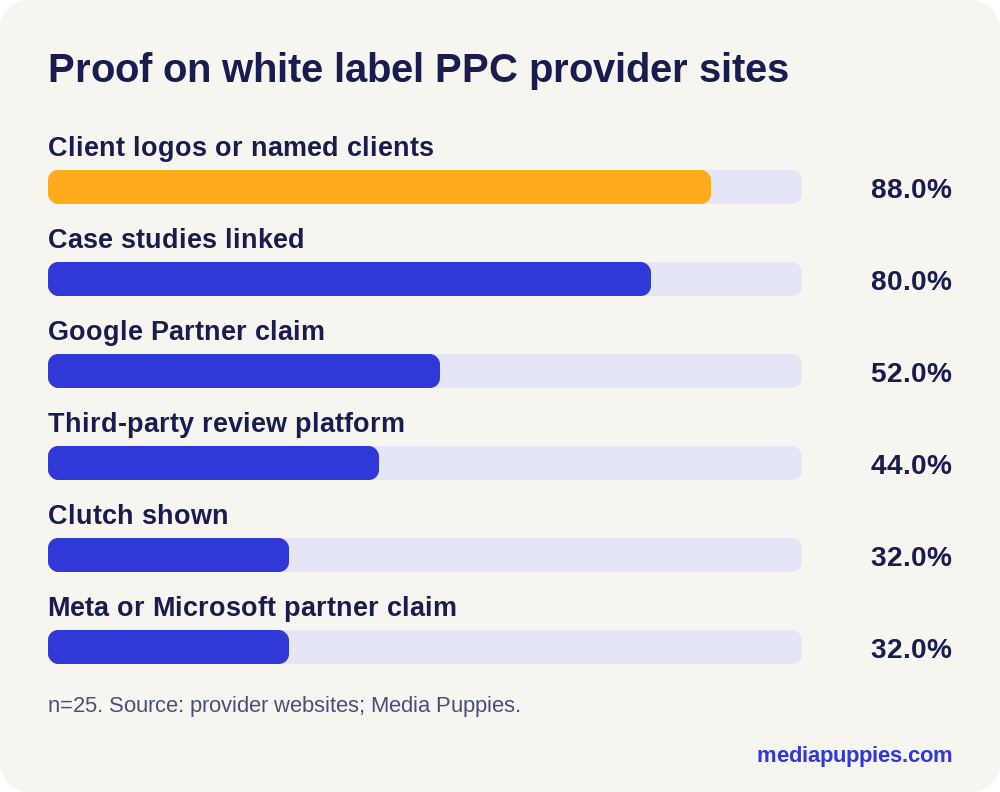
Proof was the strongest area. Client logos or named clients were on 22 of 25 sites (88.0%), and 20 (80.0%) linked a case studies, success stories or results page.
| Proof on the white label page or home page | Providers | Share of 25 |
|---|---|---|
| Client logos or named clients | 22 | 88.0% |
| Case studies linked | 20 | 80.0% |
| Google Partner or Premier Partner claim | 13 | 52.0% |
| Third-party review platform shown | 11 | 44.0% |
| Meta or Microsoft partner claim | 8 | 32.0% |
Clutch was the review platform of choice, on 8 sites (32.0%). Other directories such as GoodFirms or DesignRush appeared on 6, Trustpilot on 4, Google reviews on 2 and G2 on 1. 6 providers showed all four kinds of proof we counted (case studies, named clients, a review platform and a Google Partner claim), and 1 showed none.
There is a catch for agencies. In the pages we read, most of this proof is about end clients: a contractor's lead growth, a retailer's sales. Only a handful of case studies were framed around an agency partner, which is the relationship a white label buyer is entering. In our view, the case study that matters is the one where an agency like yours handed over accounts and kept the client.
Sample reports, NDAs and onboarding: the white label specifics
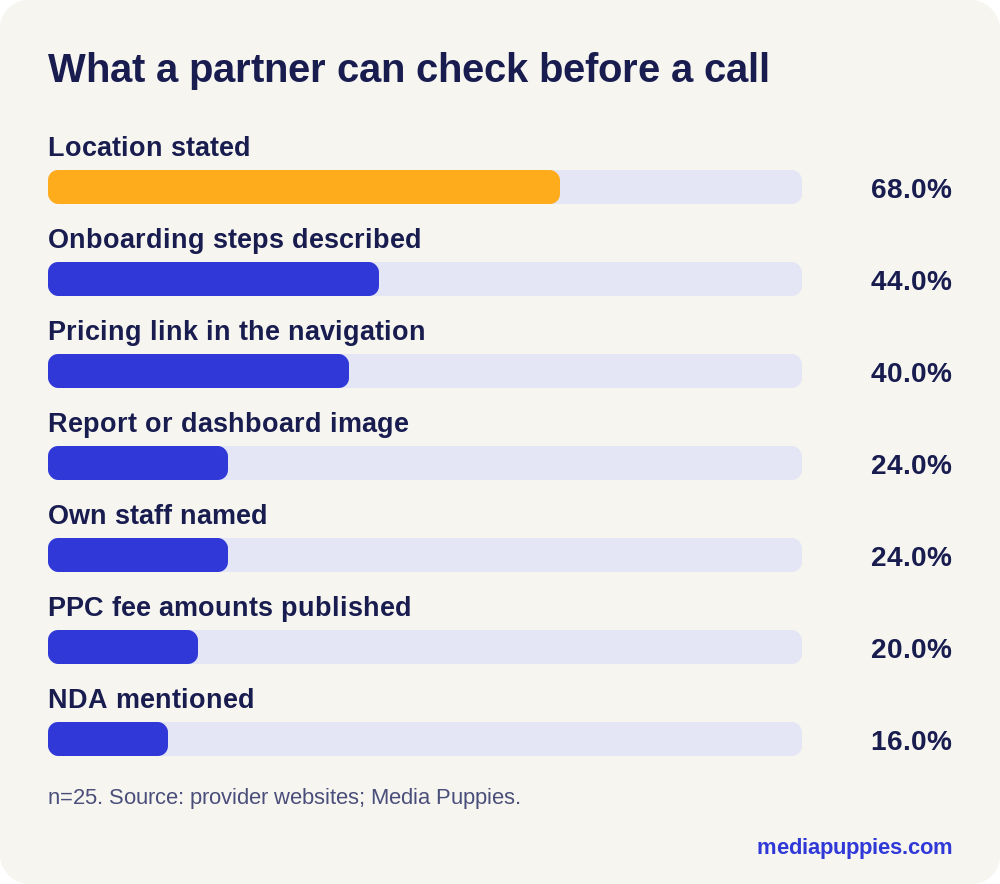
These are the items that separate a white label provider from any other agency, and they were scarce. 6 of 25 sites (24.0%) showed a screenshot or image of a report or dashboard. 2 more offered to show one on a demo or call, which we did not count. 4 (16.0%) mentioned an NDA. Counting either, 8 of 25 (32.0%) showed a sample or an NDA.
Onboarding did better. 11 of 25 (44.0%) described what happens after an agency signs up: an intake form, a handover call, account setup or a numbered process. The rest leave it for the sales call.
| Item | US (of 14) | India (of 6) | Other or not stated (of 5) |
|---|---|---|---|
| NDA mentioned | 0 | 3 | 1 |
| Onboarding steps described | 5 | 5 | 1 |
| Report or dashboard image | 2 | 2 | 2 |
| Third-party review platform | 4 | 5 | 2 |
| Google Partner claim | 7 | 4 | 2 |
| Location stated | 9 | 5 | 3 |
| Own staff named | 2 | 2 | 2 |
| Median checks shown (of 10) | 4 | 7.5 | 5 |
The country split was the biggest surprise of the study. India-based providers showed a median of 7.5 of our 10 checkable items against 4 for US-based ones. Half of them put an NDA on the page, and 5 of 6 described onboarding. Our read is that providers selling from a distance expect trust questions and answer them up front. US providers lean on being US-based: several made "US team" a headline claim, while 5 of 14 still gave no city or state on either page.
Across all 25, the median provider showed 5 of the 10 items. 13 showed 5 or more. The best showed 8 and the weakest showed 1.
Pricing, people and how to reach them
Only 5 of 25 (20.0%) published PPC fee amounts, either on the white label page or on the pricing page it links. 10 (40.0%) had a pricing link in the header or navigation, but several of those pages priced SEO or other services and gave no PPC amount. Our guide to how white label PPC works explains the fee models you will hear about on the call.
6 of 25 (24.0%) named a member of their own staff on either page, a founder, a strategist or an account manager. The rest present a team without faces. For a partner who will hand over client accounts, in our view, knowing who runs them matters more than any badge.
| Route to a person (either page, raw HTML) | Providers | Share of 25 |
|---|---|---|
| Form in the HTML | 17 | 68.0% |
| Phone number visible | 16 | 64.0% |
| Chat widget | 4 | 16.0% |
| Scheduling tool loaded | 3 | 12.0% |
The median provider offered 2 of these 4 routes. 5 sites showed none of them in the raw HTML, which usually means the form or scheduler loads through JavaScript. A visitor will still find a way to make contact; our measure just cannot see it.
Provider websites against PPC agency websites
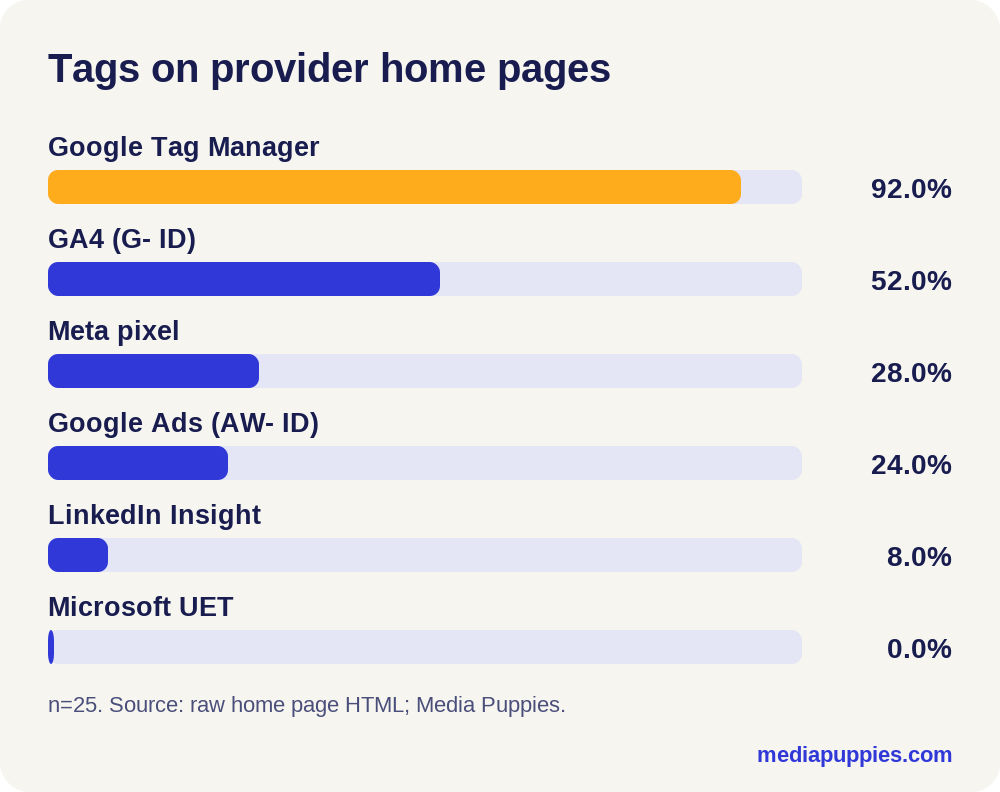
We measured the home pages with the same rules as yesterday's agency audit. Where a field was measured the same way, here are both sets side by side.
| Home page measure | PPC agencies (41) | White label providers (25) |
|---|---|---|
| Median HTML size | 236.7 KB | 313.6 KB |
| Median script tags | 41 | 42 |
| More than 50 script tags | 26.8% | 40.0% |
| More than 500 KB of HTML | 19.5% | 8.0% |
| Google Tag Manager | 70.7% | 92.0% |
| GA4 (G- ID) | 41.5% | 52.0% |
| Google Ads (AW- ID) | 22.0% | 24.0% |
| Meta pixel | 24.4% | 28.0% |
| LinkedIn Insight | 9.8% | 8.0% |
| Microsoft UET | 2.4% | 0.0% |
| Form on the home page | 61.0% | 60.0% |
| Scheduling tool loaded | 4.9% | 12.0% |
| Phone number visible | 85.4% | 64.0% |
| Pricing link in the navigation | 48.8% | 36.0% |
Provider home pages were heavier in the middle and lighter at the top end: a higher median, fewer pages past 500 KB. They carried Tag Manager more often, and they showed a phone number less often, which fits a business selling to agencies in other time zones.
The tag gap is the same story we saw with agencies, with one twist. 21 providers list Google Ads for white label work, and 5 of them showed a Google Ads tag in their HTML. 13 claim Google Partner status, and 4 of those showed one. 10 list Microsoft Ads, and none showed the UET tag. Tag Manager can load all of these later, so read the low numbers as floors. Still, a provider that sells Microsoft Ads and runs no visible UET on its own site is worth one question on the call.
What we would check before the first call (our view)
A website cannot tell you whether a provider runs accounts well. It can tell you what the provider is willing to show before you ask. These are the checks we would make, each in a few minutes:
- Find a sample report. If the site shows none, ask for a redacted one before the call. Our white label reporting guide lists what it should contain.
- Ask for the NDA up front. Only 4 of 25 sites mentioned one. A provider that has a standard NDA will send it the same day.
- Find out where they are and who runs your accounts. 8 of 25 did not say where they are based, and only 6 named anyone on their staff. Ask for a name and a time zone.
- Look for agency-partner proof. End-client case studies are fine. A reference from another agency is better.
- Get the onboarding in writing. If the page skips it, ask what happens in the first two weeks and who touches the client.
Our list of questions to ask a white label partner turns these into a call script. Media Puppies also offers white label PPC, which is why we left ourselves out of this sample and rank no one.
How we did this
- Source
- Raw HTML of white label PPC provider websites (white label page and home page), fetched with curl, measured with a stdlib Python script and hand-checked
- Country
- White label PPC providers selling to agencies in the US, UK, Canada and Australia, based in the US, India, Australia, the UK and Canada
- Collected
- 23 November 2026
- Sample
- The 25 providers from our 19 November 2026 study of white label PPC providers, found through 10 US web searches. Two pages each, plus 6 linked pricing pages: 56 requests, all loaded, none blocked. Media Puppies is excluded.
- Hand-checked fields
- Case studies, client logos or names, review platform, Google Partner and Meta or Microsoft partner claims, sample report or dashboard image, NDA, onboarding steps, PPC fee amounts, stated location, named staff
- Measured fields
- HTML size, script tags, third-party script hosts, Google Tag Manager, GA4, Google Ads, Meta pixel, LinkedIn Insight, Microsoft UET, form, scheduler, phone, chat, pricing link in the navigation
- Comparison
- Our 22 November 2026 audit of 41 PPC agency home pages, on the fields measured the same way
On 23 November 2026 we requested each provider's main white label PPC page and its home page once with curl, a desktop browser User-Agent and a one second pause between requests. Where the white label page linked a pricing page, we fetched that too. Every request returned the page. Had a site refused us, we would have recorded it as blocked and moved on.
For two providers the page that ranked in our 19 November searches was a blog guide while the site has a white label service page. We used the service page. Three providers still have only a guide on the topic, so their white label page is that guide.
Proof, white label and contact items were checked by hand from regex hits on both pages. A claim counts when the provider makes it; we did not verify partner status in Google's or Meta's directories, test any service or read any sample behind a form.
Tags, forms and schedulers are measured from the raw HTML before any JavaScript runs, with the same rules as our agency audit. Tags loaded later by Google Tag Manager do not show, so tag counts are floors.
Limits. Two pages per provider, one fetch on one day. A provider may show more on other pages, in a deck or on a call. The groups outside the US are small (6 in India, 5 elsewhere), so one site moves their percentages a lot. We name no provider in this article; the dataset has one row per provider and a country column so you can filter.
Download the data (CSV). Free to reuse under CC BY 4.0 with a link to this page.
Questions about white label PPC provider websites
What do white label PPC provider websites usually show?
Mostly proof about end clients. In our audit of 25 provider websites on 23 November 2026, 22 showed client logos or named clients and 20 linked case studies. 13 claimed Google Partner status and 11 showed a review platform such as Clutch.
How many white label PPC providers show a sample report?
6 of 25 (24.0%) showed a screenshot or image of a report or dashboard on their white label page or home page. 2 more offered to show one on a demo or call. Ask for a redacted sample before you commit.
Do white label PPC providers sign NDAs?
Few say so on their site. 4 of 25 provider websites mentioned an NDA. 3 of the 6 India-based providers did, and none of the 14 US-based providers did.
Do white label PPC providers publish their prices?
Rarely. 5 of 25 published PPC fee amounts on the white label page or a linked pricing page. 10 had a pricing link in the navigation, but several of those pages priced other services.
Are India-based white label PPC providers less transparent?
Not on their websites. In our sample, the 6 India-based providers showed a median of 7.5 of 10 checkable items against 4 for the 14 US-based providers. The dataset has a country column so you can filter.