

Key findings
- On 3 November 2026 Google showed an AI Overview on 196 of 339 US searches that advertisers pay for (57.8%). Leaving out "near me" searches, it was 175 of 278 (62.9%).
- Cost questions almost always got one: 33 of 36 (91.7%), and all 33 of those AI Overviews quoted dollar figures.
- The priciest clicks were not spared. With near-me searches left out, keywords with an estimated CPC of $30 or more showed an AI Overview 62.5% of the time, against 63.1% below $30. Cheaper keywords got more overall, mostly because cheap cost questions almost always get one.
- With near-me searches left out, every insurance and software keyword showed an AI Overview. Home service searches other than cost questions showed one only 39.1% of the time, and legal searches 44.8%.
- At least 128 of the 196 US AI Overviews (65.3%) asked the searcher a question, such as their city, budget or loan amount. Among the 135 we captured in full, 128 did (94.8%).
- On 95 searches run in all four countries the rates were close: Australia 80%, Canada 74.7%, the UK 73.7% and the US 72.6%. With a single run, that order could easily change.
Google results pages fetched with Apify (apify/google-search-scraper) · 339 US keywords from 11 industries, plus 118 of them in the UK, Canada and Australia (693 results pages) · 3 November 2026, 20:09 to 20:21 UTC · How we did this · Download the data (CSV)
AI Overviews showed up on 57.8% of the 339 US searches we checked on 3 November 2026. Every one of those searches is a keyword advertisers pay for in Google Ads. Leave out the "near me" searches, whose results depend on where the searcher is, and the share rises to 62.9%. Cost questions almost always got one, and the most expensive clicks were not spared.
This matters to advertisers because Google now sells ad space inside and around AI Overviews and AI Mode. On 28 October it started rolling AI Mode ads out in Australia and Canada, with the UK planned for later this quarter. Before changing budgets for it, you need to know how often the AI answer is on the page for the searches you buy. We took the 339 keywords from our CPC by industry study, fetched their Google results in the US, and ran 118 of them again in the UK, Canada and Australia.
How often AI Overviews appear on searches advertisers pay for
Of the 339 US keywords, 196 returned an AI Overview. To compare industries fairly we left out near-me searches, because Google answers those with local results and our scraper's location was unreliable (more on that below). That leaves 278 keywords, and 175 of them had an AI Overview.
Insurance and software showed one on every keyword left in. Searches for marketing agencies were close behind at 93.3%. Legal and home services saw the fewest: 44.8% and 50%. The home services figure hides a split. 27 of its 30 cost questions had an AI Overview, while its other service searches, such as roofing company or hvac contractor, got one 39.1% of the time (36 of 92). Both industries also lean on local searches, where our location problem (below) bites hardest.
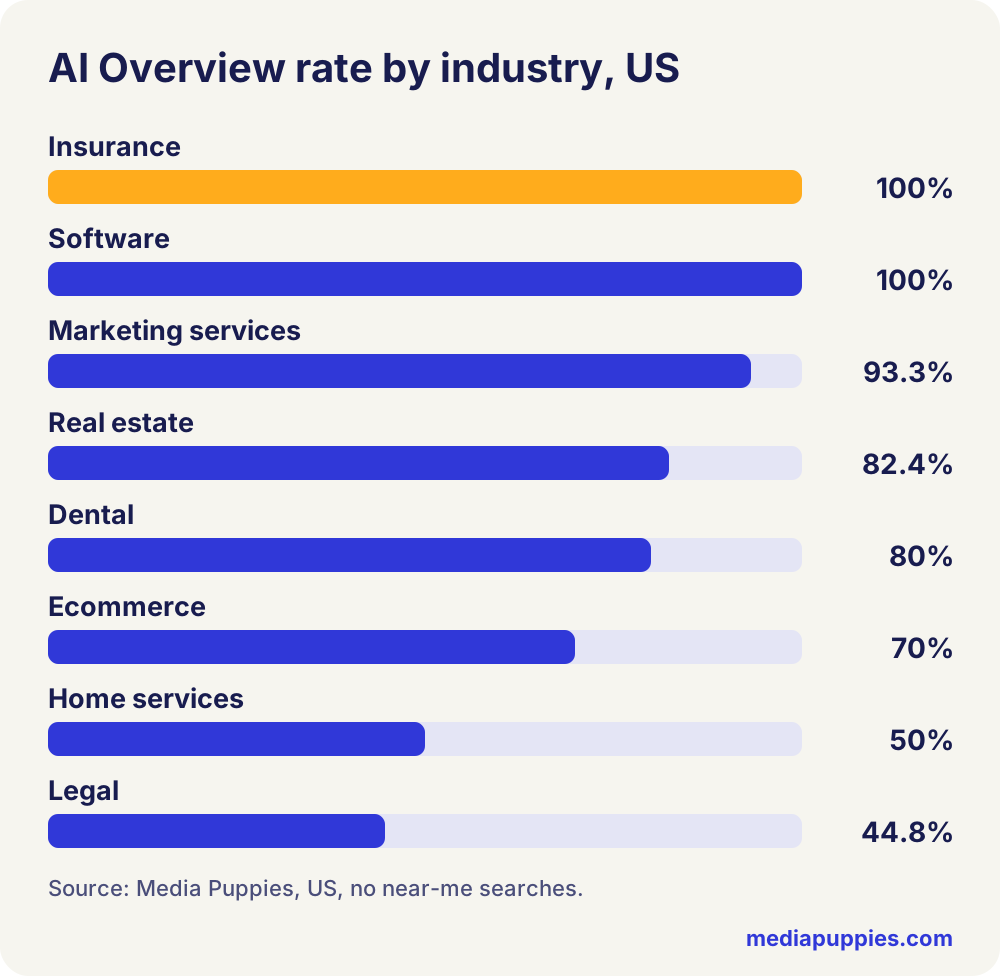
Marketing services surprised us. We assumed Google would leave commercial searches like google ads management to ads and agency pages. Instead the AI Overview opened with a definition: "Google Ads management involves setting up, monitoring, and optimizing advertising campaigns to turn ad spend into measurable business results rather than wasted clicks." A business owner comparing agencies now sees Google's description of the service first.
Cost questions got an AI Overview 91.7% of the time
36 of the keywords ask about price, such as roof replacement cost or root canal cost. 33 of them showed an AI Overview, and all 33 put dollar figures in the answer. Two examples from 3 November:
- "A roof replacement typically costs between $5,800 and $46,000, with a national average of around $9,500 depending on size and materials."
- "Hiring a plumber typically costs between $180 and $450 for a standard service call, with a national average of $315."
Across all 196 US AI Overviews, at least 51% contained a dollar figure. Cost searches usually cost less per click than the service searches they relate to, and advertisers often buy them to catch people early. When the price range sits at the top of the page, fewer people need to click anything to get it.
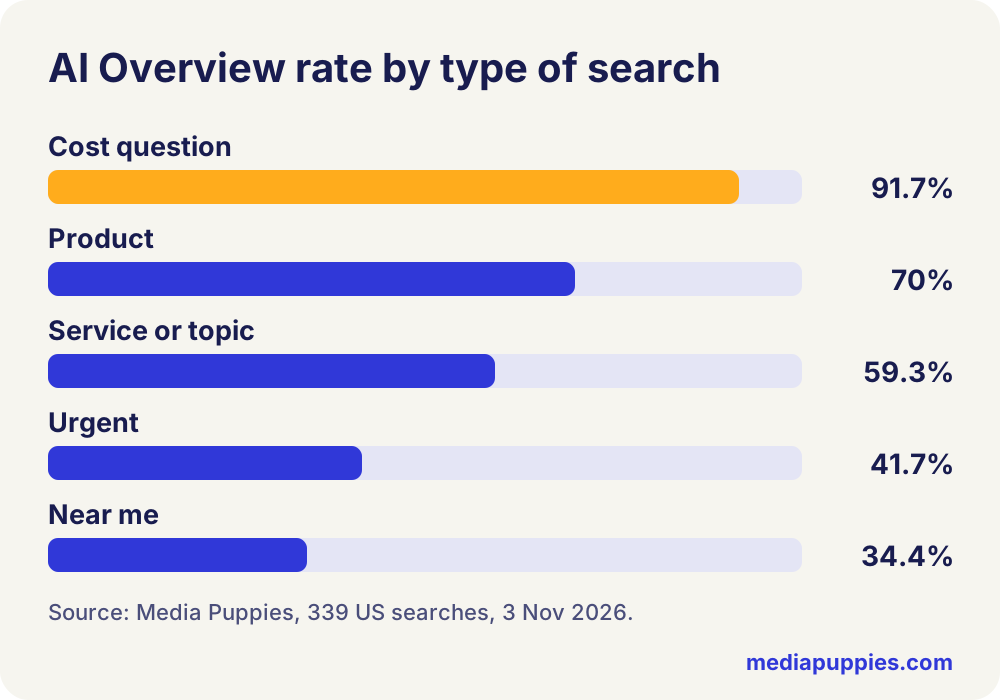
Near-me searches had the lowest rate at 34.4%, and urgent searches such as emergency plumber or 24 hour locksmith came next at 41.7%. These are the searches where Google has long shown a map of nearby businesses, and the AI Overview appeared less often.
Expensive clicks were not spared
We expected Google to hold AI Overviews back on its most valuable ad searches. At the top end, it did not. Among the 278 keywords without "near me", those with an estimated CPC of $30 or more showed an AI Overview 62.5% of the time (35 of 56). Those under $30 showed one 63.1% of the time.
| Estimated CPC (Semrush) | Keywords | With an AI Overview |
|---|---|---|
| Under $5 | 49 | 83.7% |
| $5 to $15 | 99 | 65.7% |
| $15 to $30 | 74 | 45.9% |
| $30 to $60 | 38 | 57.9% |
| $60 and up | 18 | 72.2% |
Near-me searches are left out of the table. Cheaper keywords did get more AI Overviews overall: the median CPC was $9.90 for keywords with one and $17.57 for those without. Most of that gap comes from home services, whose cost questions are cheap (median $6.21) and whose service searches cost more (median $17.99). 57 of the 74 keywords priced between $15 and $30 are home service searches, and only 19 of those 57 had an AI Overview, against 15 of the other 17. Outside home services, price made little difference: 75% of keywords under $15 had one, and 80% of those at $15 or more.
Personal injury shows how hard this is to predict keyword by keyword. Of 11 personal injury searches without "near me", 6 had an AI Overview. Mesothelioma lawyer (estimated CPC $222.28) and slip and fall lawyer ($160.00) had one. Truck accident lawyer ($252.78), car accident lawyer ($186.31) and personal injury lawyer ($112.69) did not. The slip and fall answer was a list of local law firms with star ratings and review counts.
What is inside an AI Overview now
Three things stood out in the AI Overview text. One caution first: the scraper captured 135 of the 196 in full, many of the other 61 were cut off, and most source lists stop at three links. So the shares below are floors.
Most of them ask you something back. At least 128 of the 196 (65.3%) asked the searcher a question, almost always at the end. Among the 135 we captured in full, 128 did (94.8%). The small business loans answer finished with "To help narrow down the best options, tell me:" and asked for the loan amount. If the searcher answers, the conversation carries on in AI Mode, where Google is launching ads on follow-up questions in the US.
YouTube is cited more than any other site, mostly on home repair searches. We counted which sites each AI Overview linked to, leaving out links back to Google's own pages (16 AI Overviews had one).
| Site cited | AI Overviews citing it | Share of 196 |
|---|---|---|
| YouTube | 36 | 18.4% |
| 25 | 12.8% | |
| Directories and review sites (Angi, Yelp, Thumbtack, BBB, Zocdoc) | 14 | 7.1% |
| Government sites | 11 | 5.6% |
| NerdWallet, Forbes, Bankrate | 11 | 5.6% |
| Wikipedia | 5 | 2.6% |
27 of the 36 AI Overviews citing YouTube were home service searches. Outside home services, YouTube appeared in 9 of 117 (7.7%), and in none of the 18 legal ones.
Sites that rank are usually the sites that get cited. 69.5% of the links inside the AI Overviews came from a site that also had an organic result on page one of the same search, and 56.9% were the very page that ranked there. So ranking a good page is still most of the work, though more than 4 in 10 cited pages were not in the page-one results. People also ask appeared on 95.9% of all the pages.
Near me: a list of businesses, wherever Google thinks you are
21 of the 61 near-me searches returned an AI Overview, and 14 of those 21 named specific businesses with an address, phone number or star rating. It is a local listing written out as text.
Then we checked where those businesses were. The scraper's requests came from IP addresses in many countries, and Google appears to have used them to decide what "near me" meant. Of the 21, 10 were set in a US place and 5 in another country: Irkutsk in Russia, South Africa, Valencia in Spain, Saskatchewan in Canada and Guatemala. The other 6 said they did not know where we were. 5 of those asked for a location, and one listed law firms in four US cities anyway. That is the reason we leave near-me searches out of most rates in this study.
The same thing touched searches with implied local intent. In the US run, restoration company came back with firms in Zagreb, Croatia, wisdom teeth removal with clinics in the State of Mexico, and plumber with firms around Midvale, Utah. 12 of the 175 US AI Overviews on searches without "near me" listed specific businesses. So read the rates for local trades as approximate.
UK, Canada and Australia
We ran 118 of the keywords in all four countries. On the 95 of them without "near me", Australia showed the most AI Overviews at 80%, then Canada at 74.7%, the UK at 73.7% and the US at 72.6%. The gaps are small, and single keywords swing a lot: the US and UK runs disagreed on 25 of the 95 keywords despite almost identical rates. With one run, the order could easily change. 45 of the 95 showed an AI Overview in all four countries and 7 showed one in none.
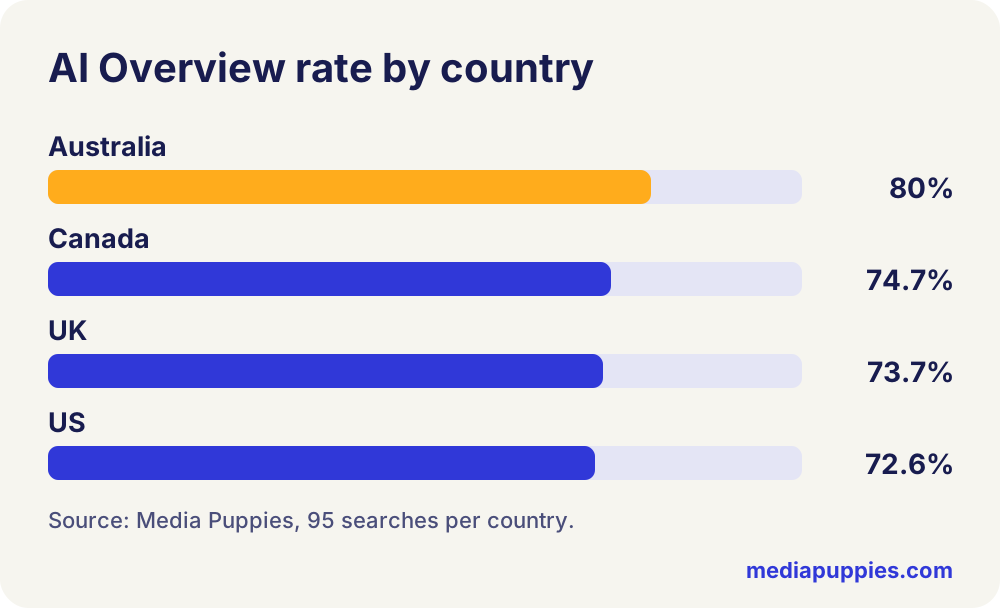
Most answers followed the country we set. At least 37.2% of the UK AI Overviews quoted a price in pounds, and the UK answer for payroll software talked about pension auto-enrolment, which a US answer would not. A few local searches did not: the Australian answer for dentist, for example, listed clinics in Miami. So read the country gaps as rough. Where the four markets clearly differ is the ad side.
Ads in AI Overviews and AI Mode on 4 November 2026
Here is what Google has confirmed, from its Google Ads help page on AI Overviews and AI Mode and its 28 October announcement:
- Where ads show inside the answer. In English, in the US, Canada, Australia, New Zealand and eight other countries on Google's list, such as India and Singapore. Ads above and below AI Overviews can run in every country where AI Overviews exist. The UK is not on the list yet. Google says it plans to bring AI Mode ads to the UK in the fourth quarter of 2026, and has given no date for ads inside UK AI Overviews.
- Which campaigns qualify. Existing Search, Shopping and Performance Max campaigns are eligible automatically, with no new campaign or budget. Broad match, AI Max for Search, Shopping and Performance Max can be matched to the search and the AI answer together. Exact and phrase match only show for clearly commercial searches.
- What you control. You cannot opt out of these placements separately from Search, and you cannot target AI Overviews or AI Mode on their own. Negative keywords, brand exclusions and asset pinning still apply. It is the same auction with no extra charge.
- What the ad looks like. Text and Shopping ads, labelled "Sponsored", with local inventory and vehicle ads in testing. In some placements Gemini adds a short explainer drawn from the search, the AI answer and public sources, including your site. You cannot write, edit or turn it off.
- What you can measure. There is no separate report. Results are folded into your normal campaign numbers and the search terms report. For these placements the search term you see is Google's best guess at what the person meant, which may differ from the words they typed.
The rules moved fast. In a July 2026 Q&A video, Google's Ads Liaison Ginny Marvin said ads are matched on the search and the AI answer together, and that only AI-powered targeting got ads in. Google has since opened these placements to exact and phrase keywords on clearly commercial searches. Google also says AI Mode passed 1 billion monthly users this year, and that in the US its queries run about three times longer than a normal search.
What we would change in a Google Ads account
- Treat cost questions as research clicks. 91.7% of them had an AI Overview with prices in it. Bid them below your service searches, send them to a page that states your real price range, and judge them on the calls and forms they bring.
- Choose your match types on purpose. Only broad match, AI Max, Shopping and Performance Max can be matched to the AI answer itself. Exact and phrase can still show inside the answer on clearly commercial searches. They are matched to the search alone, which can be the right trade on a tight budget. If you test AI Max, give it its own capped campaign, add negatives and brand exclusions first, and read the search terms weekly.
- Fix the pages Google reads. The explainer next to your ad can draw on your site. Old prices, wrong service areas or missing hours can show up there.
- Local trades: work on reviews and your Business Profile. 14 of the 21 near-me AI Overviews named businesses, 10 of them with star ratings and review counts. Law firms and home service companies buy some of the priciest clicks in our law firm and home services studies, and the same ratings and review counts appear on the map and in the AI answer.
- Home service firms: film your cost and repair answers. YouTube was cited in 18.4% of the AI Overviews, more than any other site. 27 of those 36 were home service searches, and 9 were cost questions. A two-minute video that answers "what does this cost and why" is cheap to make.
- Do not wait for an AI Overview report. There is none for ads yet. Watch top-of-page rate, click-through rate by keyword group and the search terms report. If you advertise in Australia or Canada, compare against the weeks before 28 October to see what AI Mode ads changed.
If you run Google ads in the US, UK, Canada or Australia, give us read access to the account. A senior buyer will write a free audit of your ad account. It covers the search terms you pay for and would never choose, what each costs per month, and the three things we would fix first. It takes about two working days and the document is yours. Not advertising yet? The same page gets you a free plan. Our Google Ads management runs month to month, with a named buyer and a written report every week. More studies are on our research page.
How we did this
- Source
- Google results pages fetched with Apify (apify/google-search-scraper)
- Country
- United States, United Kingdom, Canada, Australia
- Collected
- 3 November 2026, 20:09 to 20:21 UTC
- Sample
- 339 US keywords from 11 industries, plus 118 of them in the UK, Canada and Australia (693 results pages)
- Device and language
- desktop, English, one results page per search, no city set
- Keywords
- the 339 keywords with a CPC estimate from our 3 November Semrush study of Google Ads CPC by industry
The keywords come from our CPC by industry study: 339 US searches across legal, insurance, software, marketing services, home services, finance, education, dental, med spa, real estate and ecommerce, each with a Semrush CPC estimate. For the UK, Canada and Australia we dropped terms that are US-only in wording or law (attorney, DUI, workers comp, realtor, HVAC, furnace, mortgage and refinance terms, US-style education programs, among others), then kept the most searched remaining keywords by US volume, ties going to the higher CPC: up to 30 home service keywords and up to 10 for every other industry, 118 in all.
Each search ran once, on desktop, in English, with the country set and no city. We counted an AI Overview when the scraper returned one. An AI Overview that loads late, or that Google shows to some people and not others, can be missed, so these rates are more likely to be low than high. Google changes what it shows by person, place and hour, so treat this as one snapshot. We planned a second US run to measure how stable the result is, and could not run it because our scraping credit ran out.
Location is the biggest limit. The scraper sends requests from IP addresses in many countries, and Google appears to have used the IP address to decide where the searcher was. That broke near-me searches most clearly, so several headline rates leave them out, and we say so each time. It also touched some searches without "near me": 9 of the 175 US AI Overviews on those searches listed specific businesses, often in one particular city, and a few in the UK, Canada and Australia runs listed businesses in another country. Treat the industry and country rates for local trades as approximate.
The scraper returned 135 of the 196 US AI Overviews in full. Many of the other 61 were cut off, and most answers list at most three source links. So the share quoting prices, the share asking a question and the shares citing each site are all floors.
We did not measure ads. In a pilot run with the scraper's ads option switched on, no ads came back even for car insurance quotes, and in the main runs the scraper saw ads on only 23 of the 339 US pages, far fewer than a real US searcher sees. Ad counts from this data would be wrong.
Query types come from the wording: cost questions contain "cost", "how much" or "price"; near-me searches contain "near me"; urgent searches contain words like "emergency", "24 hour" or "same day"; quote requests are the four insurance quote searches. Every ecommerce keyword counts as a product search. The rules are blunt, so "same day dental implants" counts as urgent and "how much is my house worth" as a cost question. An AI Overview "names a business" when it gives a star rating, review count, phone number or street address. Industry rates for small groups (2 to 10 keywords) are a rough guide.
Download the data (CSV). Free to reuse with a link to this page.
Questions about AI Overviews and Google Ads
How often do AI Overviews appear on Google?
On the 339 high-CPC US searches we checked on 3 November 2026, 57.8% showed an AI Overview, or 62.9% with near-me searches left out. Cost questions showed one 91.7% of the time. Near-me searches showed one 34.4% of the time, though their results depended on where our requests came from.
Can you run Google Ads inside AI Overviews?
Yes, in English in the US, Canada, Australia and several other countries listed on Google's help page, though not yet in the UK. Existing Search, Shopping and Performance Max campaigns are eligible automatically. Broad match, AI Max, Shopping and Performance Max can be matched to the AI answer; exact and phrase match only show for clearly commercial searches. You cannot opt out of these placements separately from Search.
Are ads in AI Mode available in the UK?
Not yet. On 28 October 2026 Google started rolling out AI Mode ads in Australia, Canada and other countries and said it plans to add the UK in the fourth quarter of 2026. Ads inside UK AI Overviews are not available either, with no date given. Ads above and below AI Overviews can already show in the UK.
Do AI Overviews show on expensive keywords?
Yes. In our data, keywords with an estimated CPC of $30 or more showed an AI Overview 62.5% of the time, against 63.1% for cheaper keywords, with near-me searches left out. Cheaper keywords got more AI Overviews overall, mainly because cheap cost questions almost always get one. Some of the priciest personal injury searches had one and others did not.
Can I see AI Overview performance in Google Ads?
Not separately. Google folds results from AI Overviews and AI Mode into your normal campaign numbers and the search terms report, with no dedicated segment as of 4 November 2026. For these placements the search term shown is Google's best approximation of what the person meant.
Which sites do AI Overviews cite most?
In our 196 US AI Overviews, YouTube was cited in 18.4% (mostly on home service searches) and Reddit in 12.8%, more than any other sites. 69.5% of cited links came from a site that also had an organic result on page one, and 56.9% were the ranking page itself.