

Key findings
- Of the 209 distinct ads among the first 100 live "black friday" ads listed for the US, UK, Canada and Australia, 56.5% started before 2026, most of them (105) during last year's Black Friday season. The median ad started 342 days before we read it. The default order probably favours long-running ads, so this describes the top of the list.
- The same online stores led all four countries. 38 ads were in the first 100 of every country, and only 14 of Canada's first 100 were in no other country's first 100.
- Only 56 of the 209 ads (26.8%) started this season, from 1 September 2026. Their median start was 29 October, 29 days before Black Friday, and 38 of them came from large retailers and well-known brands such as Walmart, Currys, Canadian Tire and Amazon Australia.
- 58.4% of the ads put a percentage in the main text, and among those the median top figure was 50%. 31.6% of all the ads wrote 50% or more, 37 of those 66 as "up to".
- 11 of this season's 56 ads (19.6%) used the word "early", against 13 of the 153 older ads (8.5%). Ten of the 11 came from large retailers and brands.
Meta Ad Library · 400 country listings of 209 distinct live ads from 136 advertiser pages (top 100 in each country) · 9 November 2026 (18 days before Black Friday) · How we did this · Download the data (CSV)
Black Friday ads are easy to look up in the Meta Ad Library, but the list you get first is mostly last year's. On 9 November 2026, 18 days before Black Friday, we searched the Library for "black friday" in the US, UK, Canada and Australia and read the first 100 live ads listed in each country. Of the 209 distinct ads, 56.5% had started before 2026, and the median ad had started 342 days before we read it.
Those older Black Friday ads came mostly from online stores outside our list of large retailers and brands, and 80 of the 153 were listed in two or more countries. This season's Black Friday ads were a minority of the top lists: 56 ads, mostly from large retailers and well-known brands, with a median start date of 29 October. The full dataset is free to download at the end.
What we read in the Black Friday ads
We searched the exact phrase in each country with active ads selected and read the first 100 in the Library's default order, which its own page address labels as total impressions. Every country showed more than 50,000 results, so this is the top of a very long list.
| Country | Ads read | Advertiser pages | Started before 2026 | Started from 1 Sep 2026 | Median days since start | Also in another country's top 100 |
|---|---|---|---|---|---|---|
| United States | 100 | 72 | 62% | 23% | 345.5 | 56 |
| United Kingdom | 100 | 68 | 65% | 24% | 347 | 60 |
| Canada | 100 | 62 | 71% | 13% | 347 | 86 |
| Australia | 100 | 61 | 70% | 12% | 347 | 78 |
| All four, distinct ads | 209 | 136 | 56.5% | 26.8% | 342 |
Most top-listed Black Friday ads started last year
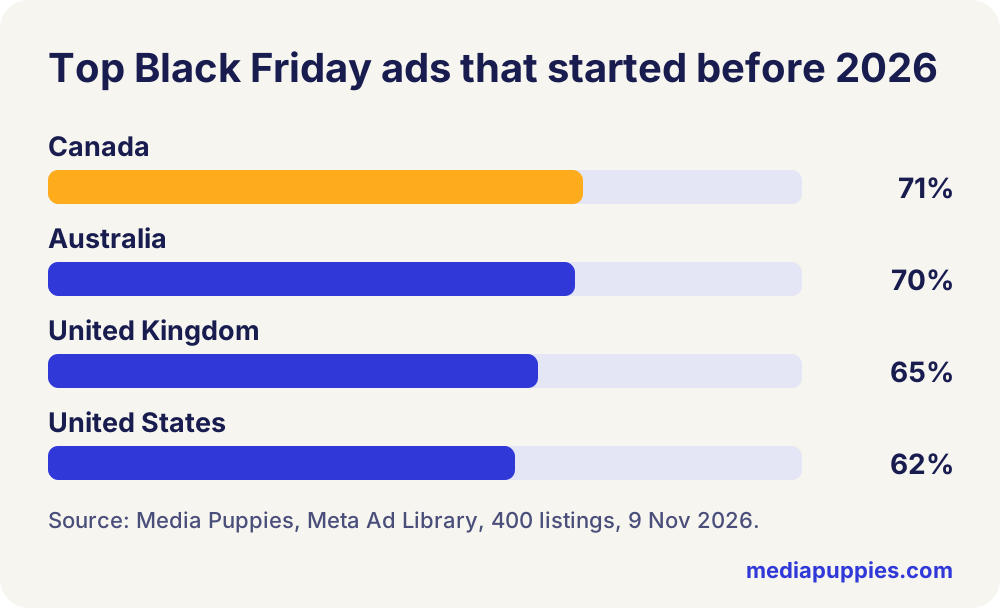
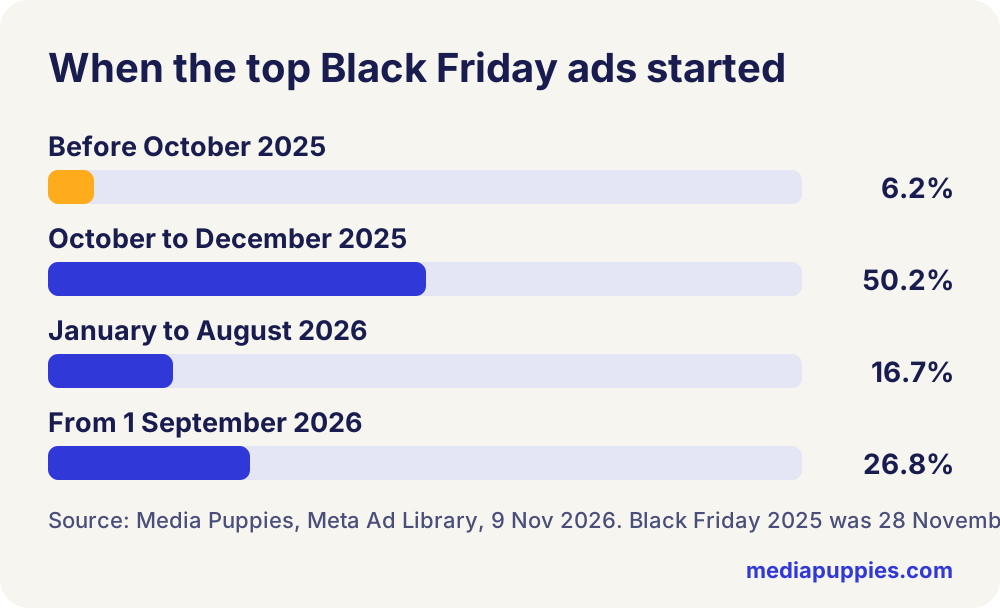
In every country, at least 62 of the top 100 ads had started before 2026. Counting each ad once, 105 of the 209 started between October and December 2025, during last year's Black Friday season, and 13 started earlier still. The oldest had started in November 2024. 58.4% of the distinct ads had started more than 300 days before we read them.
The advertisers behind these older ads were mostly online stores whose page names suggest jewellery, clothing, hair and beauty, fitness gear and car gadgets. Skiguard, Anaconda Fightwear and Parijan had seven older ads each; Worthy Always had five, plus two from this season. Only 9 of the 153 ads that started before September 2026 came from the large retailers and brands on our list.
Our reading is that the default order rewards time. An ad that has run for a year has had more time to collect impressions than one that started last week, so older ads rise to the top. For anyone using the Library to research competitors, that means the first screen of results can mix ads that started last year with this season's, and only the start date tells them apart. Each ad card shows a "Started running on" date, and it is worth checking before you copy an idea.
The same stores top every country
The four lists overlapped heavily. 38 ads were in the top 100 of all four countries, and 89 were in at least two. Canada's list was the least local: 86 of its top 100 ads also appeared in another country's top 100, and only 14 were in no other country's top 100. The US had the most ads of its own, 44, followed by the UK with 40.
The local ads were where the big retailers showed up. Large retailers and well-known brands had 16 ads in the US top 100 and 17 in the UK, against 8 in Canada and 9 in Australia. Canada and Australia also had the fewest ads from this season, 13 and 12, so a marketer in either country looking at the default list would mostly see last year's global ads.
This season's Black Friday ads started in late October
56 of the 209 distinct ads started on or after 1 September 2026. Their median start date was 29 October, 29 days before Black Friday. 57.1% of them started in October and 33.9% in the first nine days of November. 38 of the 56 came from large retailers and well-known brands.
The start dates line up closely across countries. In the US, Ulta Beauty started on 25 October, L.L.Bean on 26 October and Walmart on 2 November. In the UK, Tesco started on 26 October, Currys on 29 October and Wayfair on 2 November. In Canada, Canadian Tire started on 4 November and Best Buy Canada on 6 November. In Australia, Temple & Webster started on 29 October and Amazon Australia on 1 November.
11 of this season's 56 ads (19.6%) used the word "early" in the main text, against 13 of the 153 older ads (8.5%). Ten of the 11 came from brands on our list, among them Ulta Beauty, L.L.Bean and Canadian Tire. Urgency words went the other way: 14.3% of this season's ads used them, against 18.3% of the older ones.
How deep the discounts were
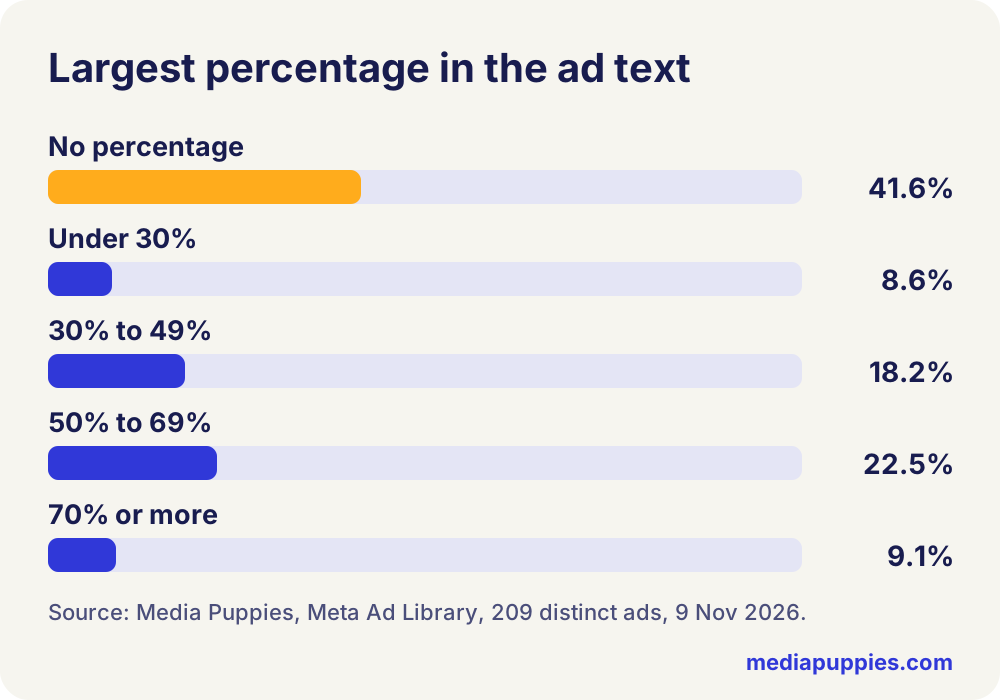
58.4% of the distinct ads wrote a percentage in the main text. Among those 122 ads, the median top figure was 50%. 31.6% of all the ads wrote 50% or more, 37 of those 66 as "up to", and in total 61 ads, half of those with a percentage, wrote the number as "up to". The rule counts any percentage in the text, so some may not be discounts. Other offers were less common: free shipping or delivery appeared in 13.9% of the ads, a code or coupon in 11.5% and buy one get one in 5.3%. 17.2% used urgency words such as last chance or limited time.
This season's ads were less likely to write a percentage in the text (44.6%, against 63.4% of the older ads), but when they did, the figure was usually 50% or more. The Library also showed multiple versions or shared creative more often for this season's ads, 82.1% against 50.3%. These gaps line up with the brand mix: 38 of the 56 new ads came from brands on our list, against 9 of the 153 older ones. 45.9% of all the ads showed a video player, and video was about as common in this season's ads (44.6%) as in the older ones (46.4%).
Partner posts were rare. Only 7 of the 209 ads (3.3%) ran as a creator's or publisher's post "with" the brand, against 11.2% (34 of 303) of the Diwali ads we read in the same four countries on 8 November, from a broader search.
What we would do with this before Black Friday
- Check start dates when you research competitors. Most of the first-listed Black Friday ads in the Library started last year.
- Plan to be live by late October next year. 34 of the 38 this-season ads from large retailers and brands started between 25 October and 6 November.
- Decide whether the number goes in the text. 63.4% of the older ads wrote a percentage in the main text, against 44.6% of this season's ads.
- Think twice before running a Black Friday ad all year. Our view is that a sale that never ends stops sounding like a sale, and a long run makes it harder to tell whether the offer still works.
For how the Library works for local businesses, see our Facebook Ad Library study, and for another seasonal read, our Diwali ads study. For budgets in the last quarter, see our guide to US Q4 ad costs. If you run Meta ads in the US, UK, Canada or Australia, give us read access to the account. A senior buyer will write a free audit of where the spend goes, whether your tracking counts real results, how your creative is holding up, and the three things we would fix first. It takes about two working days and the document is yours. Our Meta ads management runs month to month with a named buyer. More studies are on our research page.
How we did this
- Source
- Meta Ad Library
- Country
- United States, United Kingdom, Canada, Australia
- Collected
- 9 November 2026 (18 days before Black Friday)
- Sample
- 400 country listings of 209 distinct live ads from 136 advertiser pages (top 100 in each country)
- Search
- "black friday" as an exact phrase, active ads, all ad types, one search per country
- Order
- the Library's default order, which its own address labels as total impressions, highest first
On 9 November 2026, 18 days before Black Friday on 27 November, we searched the Meta Ad Library for the exact phrase "black friday" in each of the four countries, with active ads and all ad types selected. The Library reported more than 50,000 results in every country. It lists results in a default order that its own page address labels as total impressions, highest first, but it shows no impression figures for these ads. We read the first 100 ads in each country. That is the top of each list, a very small share of the results, and it is not a random sample.
The same ad was often listed in more than one country. The 400 listings hold 209 distinct ads: 89 ads were listed in two or more countries and 38 in all four. Country figures describe each country's top 100 as the Library showed it. Figures for all four countries together count each distinct ad once.
For each ad we recorded the start date the Library shows, whether a video player appeared, whether the page appeared as one page "with" a brand (a partner post), whether the Library showed several versions or several ads using the same creative, and words in the main ad text: "early", "up to" a percentage, free shipping or delivery, code, coupon or promo, buy one get one, Cyber Monday or Cyber Week, and urgency words (ends soon, last chance, limited time, while stocks last, hurry, don't miss). We also recorded the largest percentage written in the main text. Discounts shown only in the image or headline are missed, and the percentage rule counts any "N%" in the text. In 22.5% of the ads the phrase "black friday" itself was outside the main text. 7 ads were read slightly differently in different countries (for example the version count); pooled figures use the first reading, and counting a reading from any country would put the phrase outside the main text in 20.1%. We did not keep the ad text.
Large retailers and well-known brands were marked by hand from the page names, for example Walmart, Ulta Beauty, L.L.Bean, Currys, Tesco, Wayfair, Canadian Tire, Best Buy Canada, Amazon Australia, Temple & Webster and Temu. Two ads showed no readable page name. The Library's date filter works on when ads were shown, so it could not pick out ads by start date; we used each ad's start date instead.
Limits. The default order likely favours ads that have collected impressions over a long time, which would push older ads up the list. We only see ads still running, so last year's ads that stopped are missing. The Library shows no spend or results for these ads, so nothing here says which ads worked. The CSV has one row per country listing, with an ad number that links listings of the same ad and no page names.
Download the data (CSV). Free to reuse with a link to this page.
Questions about Black Friday ads
What do Black Friday ads look like in the Meta Ad Library?
In the first 100 live "black friday" ads listed for the US, UK, Canada and Australia on 9 November 2026, 56.5% of the 209 distinct ads had started before 2026, mostly during last year's Black Friday season, and the median ad had started 342 days earlier.
When do brands start their Black Friday ads?
The 56 ads in our sample that started this season had a median start date of 29 October 2026, 29 days before Black Friday. The top-listed ads from Ulta Beauty, Currys, Walmart and Canadian Tire started between 25 October and 4 November.
What discount do Black Friday ads offer?
58.4% of the ads we read wrote a percentage in the main text, and among those the median top figure was 50%. 31.6% of all the ads wrote 50% or more, many of them as "up to".
How do I find this year's Black Friday ads in the Ad Library?
Search the phrase in quotes, select active ads and your country, then check the "Started running on" date on each card. The default list mixes in ads that have run since last year.
Can I use this data?
Yes. Download the CSV from this page and reuse it with a link back to the study. It has one row per country listing and no page names.