

Key findings
- Mainstream brands ran 59.4% of the 303 distinct live Diwali ads we read across the four countries. Indian and South Asian brands ran 26.1%, and 8.9% were ads aimed at people in India.
- Canada's list was the most mainstream: mainstream brands ran 81.9% of its top-listed Diwali ads (86 of 105), led by Walmart Canada with 13. In Australia they ran 25.3%.
- Of the 300 ads with a start date, the median began 14.5 days before Diwali, and 55.3% started between 15 and 31 October.
- Indian and South Asian brands used sale, offer or discount wording in 48.1% of their Diwali ads. Mainstream brands did so in 10%.
- 17.8% of mainstream brands' Diwali ads were partner posts, which the Library shows as a creator or publisher "with" the brand, such as Sheena Melwani with Lexus.
- Six mainstream pages from four companies used Hindi words written in English letters in their Diwali ads. Five of the six pages were Canadian, including Walmart Canada.
Meta Ad Library · 397 country listings of 303 distinct live ads from 169 advertiser pages (US 125, UK 88, Canada 105, Australia 79) · 8 November 2026 (Diwali) · How we did this · Download the data (CSV)
Diwali ads in the US, UK, Canada and Australia came from a much wider set of advertisers than Indian jewellers and grocers. On Diwali day, 8 November 2026, we searched the Meta Ad Library for "diwali" in each country and read the top-listed live ads: 397 listings of 303 distinct ads from 169 advertiser pages. Mainstream brands ran more than half of them (59.4%), from Lexus and Walmart Canada to Tesco and Cadbury, but only Canada's list was mostly mainstream.
Canada and Australia sat at opposite ends. In Canada, mainstream brands ran 81.9% of the top-listed Diwali ads; in Australia they ran 25.3%, and a fifth of the Australian list was ads aimed at people in India. Most of the live Diwali ads started in the second half of October. Indian and South Asian brands used sale, offer or discount wording in about half their ads, mainstream brands in one in ten, and about one in six mainstream brands' ads ran as partner posts with a creator or publisher. The full dataset is free to download at the end.
What we read in the Diwali ads
We read each country's list as far as it loaded, in the Library's default order, which its own page address labels as total impressions. That gave us between 2.2% and 3.6% of each country's results: the advertisers the Library lists first.
| Country | Library results for "diwali" | Ads read | Advertiser pages | Mainstream brands | Indian or South Asian brands | Aimed at India |
|---|---|---|---|---|---|---|
| United States | 5,800 | 125 | 70 | 48% | 33.6% | 12.8% |
| United Kingdom | 2,500 | 88 | 56 | 50% | 29.5% | 12.5% |
| Canada | 4,300 | 105 | 59 | 81.9% | 8.6% | 6.7% |
| Australia | 2,200 | 79 | 53 | 25.3% | 41.8% | 21.5% |
| All four, distinct ads | 303 | 169 | 59.4% | 26.1% | 8.9% |
The lists overlapped. 65 ads were listed in two or more countries, and 41 of the 125 US listings (32.8%) were the same ads that appeared in the Canadian list, such as Walmart Canada's and Clorox Canada's. The Library's country filter returned them for the US search, and we kept them in the US list, because that is what someone checking competitors in the Library would see. When we add up all four countries, each ad counts once.
Mainstream brands lead Diwali advertising in Canada
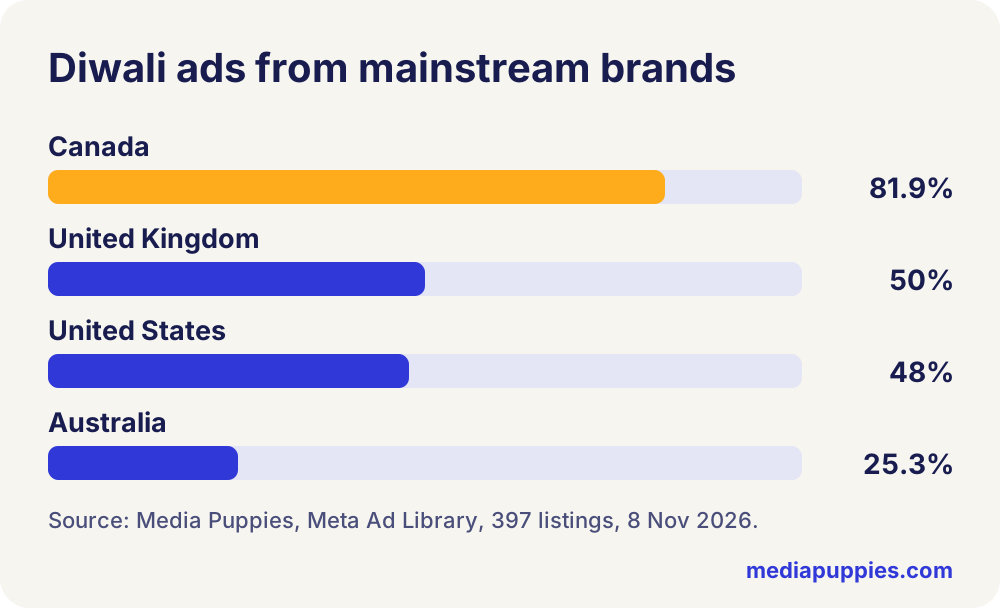
Canada's list was full of big grocery, food, banking and car names. Walmart Canada ran 13 of the 105 ads, more than any other page in any country. No Frills, Loblaws and Real Canadian Superstore were there too, along with Cadbury, Ferrero Rocher, Cheerios, Nature Valley and merci, the banks TD and BMO, and Lexus, Toyota and Volkswagen. Even the City of Toronto had a Diwali ad running.
In the UK, shops and supermarkets were 26.1% of the list. Tesco, Morrisons and Co-op ran their own ads, Sainsbury's and Lidl appeared through partner posts with food publishers, and Asda through its George clothing brand. The US list had the most jewellery, 14.4% of its ads, mostly Tanishq USA (8) and Malabar Gold and Diamonds (5). Australia was the outlier. Indian and South Asian brands ran 41.8% of its top-listed Diwali ads, and the ethnic-wear store Mirraw alone ran 12 of the 79. Mainstream brands such as Krispy Kreme, Westpac and Remitly made up a quarter of the list.
Counting each ad once, mainstream brands ran 180 of the 303 distinct ads. Their ads were mostly shops and supermarkets (54 ads), food and drink (32) and cars (17). Indian and South Asian brands ran 79, mostly food and drink (23), fashion (20), jewellery and gold (19) and charities and religious groups (8).
When the live Diwali ads started
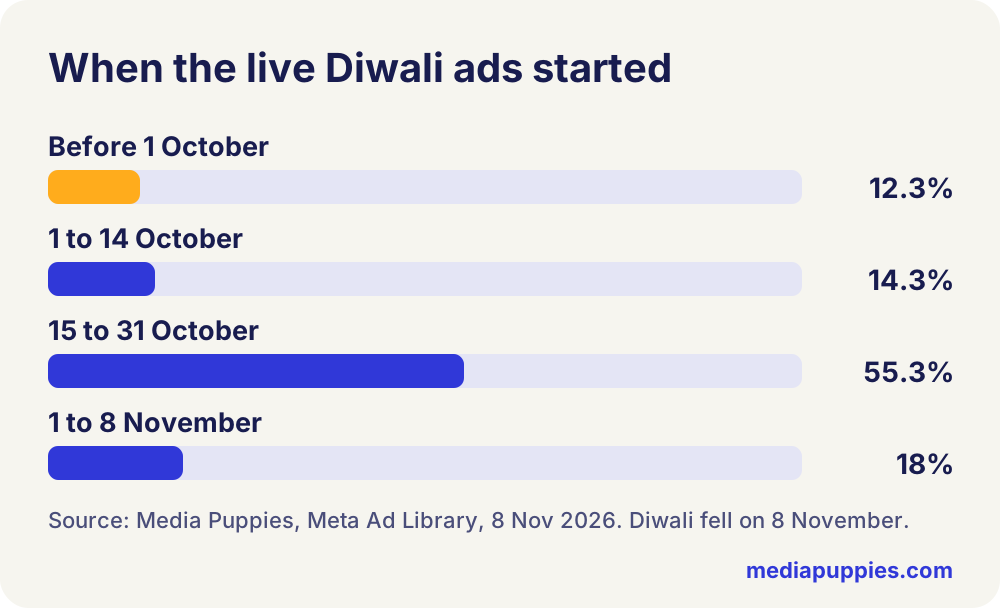
Of the 300 distinct ads with a start date, the median had started 14.5 days before Diwali. 55.3% started between 15 and 31 October, and 18% started in the final eight days, from 1 November. Only 12.3% were running before October. These are ads still live on Diwali, so any early ads that had already stopped are not counted.
Most of the early starters came from Indian and South Asian brands, 25.3% of whose ads began before October, and from ads aimed at India (26.9%). Only 3.9% of mainstream brands' ads started that early. Mainstream brands were the most bunched: 65% of their ads started between 15 and 31 October. By country, the UK and Australia had more ads at both ends: 26.7% and 28.6% of their lists started in November, and 23.3% and 23.4% were running before October. Canada was the most concentrated, with 64.8% of its list starting in the second half of October.
Our view: for a brand new to Diwali, mid-October is the point to be live with tested creative, because that is when most of the big advertisers start.
How the ads sell
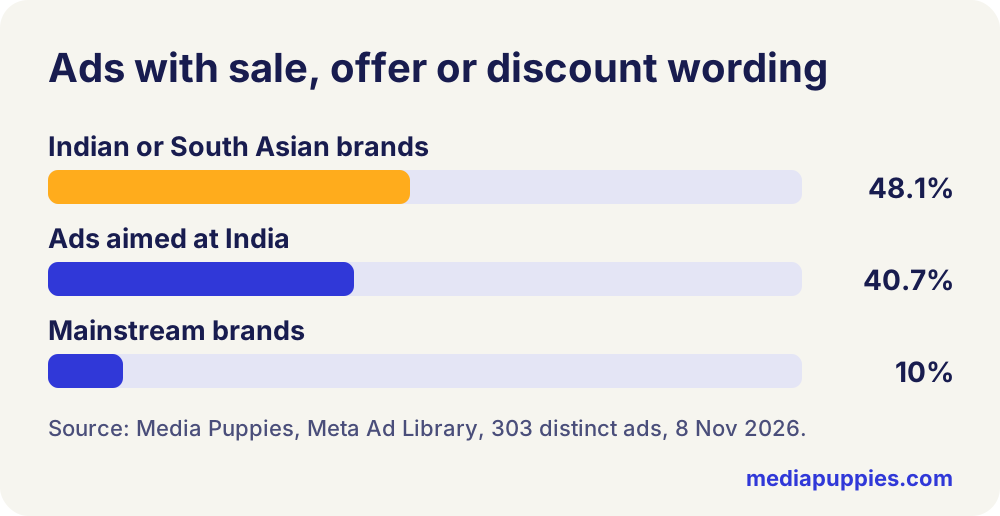
Indian and South Asian brands used sale, offer or discount wording, such as percent off, sale, deal, offer or a code, in 48.1% of their distinct ads. Ads aimed at India did so in 40.7%. Mainstream brands did so in 10%, so most of their Diwali ads had none of these words.
About one in six mainstream brands' Diwali ads (17.8%) ran as a creator's or publisher's post "with" the brand, such as Lexus with Sheena Melwani, Walmart Canada and Gravol Canada with two creators each, and Tesco with LADbible. In the UK list, 14.8% of all ads were partner posts. At least 49.8% of all the ads showed a video player, and only 3% used contest words such as win or giveaway.
9.9% of the distinct ads used Hindi words in English letters or an Indian script. Six mainstream pages from four companies used Hindi words: Walmart Canada, three Clorox Company brands in Canada (Clorox, Glad and Pine-Sol), Toyota Canada, and a Twisted partner post for Sainsbury's in the UK. In the Canadian list, 10 ads used Hindi words, 6 of them from Walmart Canada. We think that shows how seriously some Canadian marketers take the South Asian shopper.
Ads aimed at India also appear in these searches
8.9% of the distinct ads were aimed at people in India, by our labels: rupee prices, Indian shop addresses, Indian apps, travel agents and electronics stores. In the Australian list the share was 21.5%. 25.9% of these India-facing ads used an Indian script such as Devanagari or Gujarati, against 0.6% of mainstream brands' ads, and 25.9% showed prices in rupees.
Five advertiser pages appeared in the top results of all four countries, and four of them were India-facing or personal: a phone maker's Diwali contest, an Indian mall group, a travel firm writing in Gujarati and one individual's post. The fifth was the Lexus partner post with Sheena Melwani. We cannot see where any of these ads were delivered. Our view: if you advertise to South Asian customers in one of these countries, check your location settings, so the budget reaches people in your own country.
What we would do for a Diwali campaign in these markets
- Be live by mid-October. 55.3% of the 300 live ads with a start date began between 15 and 31 October.
- Decide whether you are selling a deal. Indian and South Asian brands used sale, offer or discount wording in about half their ads, mainstream brands in one in ten. Both kinds of ad were in the top results.
- Consider partner posts. 17.8% of mainstream brands' Diwali ads ran with a creator or publisher.
- Think about a few words of Hindi. Six mainstream pages used Hindi words in English letters, five of them in Canada.
- Check location settings. Make sure the budget reaches people in your own country.
- Look at the Library yourself. Search "diwali" for your country and read the top of the list before you brief creative.
For how local businesses use the Library, see our Facebook Ad Library study, and for what the words in ads look like, our Facebook ad copy study. If you run Meta ads in the US, UK, Canada or Australia, give us read access to the account. A senior buyer will write a free audit of where the spend goes, whether your tracking counts real results, how your creative is holding up, and the three things we would fix first. It takes about two working days and the document is yours. Our Meta ads management runs month to month with a named buyer. More studies are on our research page.
How we did this
- Source
- Meta Ad Library
- Country
- United States, United Kingdom, Canada, Australia
- Collected
- 8 November 2026 (Diwali)
- Sample
- 397 country listings of 303 distinct live ads from 169 advertiser pages (US 125, UK 88, Canada 105, Australia 79)
- Search
- "diwali", active ads, all ad types, one search per country
- Order
- the Library's default order, which its own address labels as total impressions, highest first
On 8 November 2026, Diwali day, we searched the Meta Ad Library for "diwali" in each of the four countries, with active ads and all ad types selected, while logged out. The Library reported about 5,800 results for the US, 2,500 for the UK, 4,300 for Canada and 2,200 for Australia. It lists results in a default order that its own page address labels as total impressions, highest first, but it shows no impression figures for these ads. We scrolled each list as far as it kept loading and read every ad shown: 125 in the US, 88 in the UK, 105 in Canada and 79 in Australia, between 2.2% and 3.6% of each country's results. That is the top of each list, not a random sample, and it only covers ads whose text includes the word Diwali.
The same ad was often listed in more than one country. The 397 listings hold 303 distinct ads; 65 ads were listed in two or more countries and 4 in all four. 41 of the 125 US listings (32.8%) were the same ads that appeared in the Canadian list. Country figures describe each country's list as the Library showed it. Figures for all four countries together, and for each advertiser type, count each distinct ad once.
For each ad we recorded the start date, whether the Library showed several versions, whether a video player appeared, whether the Library showed the page as one page "with" a brand (a partner post), and words in the text: two or more Hindi words written in English letters, any Indian script, sale, offer or discount words (percent off, sale, discount, deal, offer, cashback, code, save), contest words (win, raffle, contest, giveaway, chance to) and rupee prices. We kept these measurements, not the ad text. Video is a lower bound, because a video that had not loaded showed no player.
We sorted the 169 advertiser pages by hand into four types: mainstream brands (companies outside the South Asian market, such as supermarkets, carmakers, banks and confectioners), Indian and South Asian brands selling to customers in these countries (jewellers, ethnic fashion, grocers, restaurants, charities and religious groups), ads aimed at people in India (rupee prices, Indian shop addresses, Indian apps and travel agents), and individuals or unclear pages. Each page also got a category. Partner posts count under the brand they promote. For small advertisers the type is a judgement call.
Start dates only cover ads still running on Diwali, so early ads that had already stopped are missing, and the timing figures lean late. The Library shows no spend or results for these ads, so nothing here says which ads worked. The CSV has one row per country listing, with an ad number that links listings of the same ad, our labels and no page names.
Download the data (CSV). Free to reuse with a link to this page.
Questions about Diwali ads
Who runs Diwali ads in the US, UK, Canada and Australia?
In the top-listed live Diwali ads we read on 8 November 2026, counting each distinct ad once, mainstream brands ran 59.4%, Indian and South Asian brands 26.1%, and 8.9% were ads aimed at people in India. In Canada's list mainstream brands ran 81.9%.
When should Diwali ads start?
Of the live ads we read, the median had started 14.5 days before Diwali, and 55.3% started between 15 and 31 October. We aim to be live with tested creative by mid-October.
Do Diwali ads use discounts?
Indian and South Asian brands used sale, offer or discount wording in 48.1% of their Diwali ads. Mainstream brands did so in 10%, so most of their ads had none of these words.
Should Diwali ads use Hindi words?
9.9% of the ads we read used Hindi words in English letters or an Indian script, and six mainstream pages, five of them Canadian, used Hindi words. A few words can fit if they sound natural to your customers.
How do I see competitors' Diwali ads?
Open the Meta Ad Library, choose your country, select active ads and search for Diwali. The default order, which the Library's address labels as impressions, puts the ads we read at the top.
Can I use this data?
Yes. Download the CSV from this page and reuse it with a link back to the study. It has one row per country listing with our labels and no page names.