

Key findings
- Across 37 US patient keywords, the median Google cost per click was $6.39. Implants and dentures had the highest group median at $10.26, driven by implants.
- For treatment searches, adding "near me" raised the click price sharply: by 82% for dental implants and 130% for Invisalign. For general searches such as "dentist" it barely moved.
- Price searches were cheaper than the treatment itself in all 5 pairs with an estimate, for example $3.23 for "invisalign cost" against $4.68 for "invisalign".
- One implant chain ran 73 of the 192 live dental ads on Facebook and Instagram. Across the other 98 advertisers' 119 ads, single images led at 42% and video was 26.9%.
- 71.4% of those 119 ads had been running for a year or more, and the median ad had been live for 456 days.
Semrush Keyword Overview (US) and Meta Ad Library · 48 keywords (45 with a CPC estimate, 37 of them patient keywords) and 192 ads from 99 dental advertisers · 3 November 2026 · How we did this · Download the data (CSV)
Most dental marketing advice is a list of channels with no prices attached. We wanted numbers. On 3 November 2026 we put two datasets side by side: Semrush's US Google cost-per-click estimates for 48 dental keywords, and 192 live dental ads from 99 advertisers in the Facebook Ad Library.
The short answer for dental marketing budgets: Semrush puts a typical US patient click on Google at about $6, implants cost the most, and adding "near me" pushes the price up for treatment searches. On Facebook and Instagram, one implant chain ran 38% of the dental ads we found. The other 98 advertisers mostly run one ad each and leave it running: single images are their most common format, and their median ad had been live for well over a year. The keyword data is free to download at the end.
Dental marketing costs by treatment
Across 37 patient keywords with an estimate, the median click was $6.39. Implants and dentures had the highest group median at $10.26, driven by implants; denture searches on their own sat below the overall median. Cosmetic searches had the lowest group median at $4.28.
| Keyword group | Keywords | Median CPC | Priciest keyword | Its CPC |
|---|---|---|---|---|
| Implants and dentures | 8 | $10.26 | same day dental implants | $19.34 |
| General and emergency | 9 | $6.86 | dentist near me | $8.30 |
| Orthodontics | 6 | $6.85 | invisalign near me | $10.78 |
| Other treatments (root canals, crowns, extractions, sedation, gum disease) | 8 | $5.34 | dental crown | $6.39 |
| Cosmetic | 6 | $4.28 | cosmetic dentist near me | $6.26 |
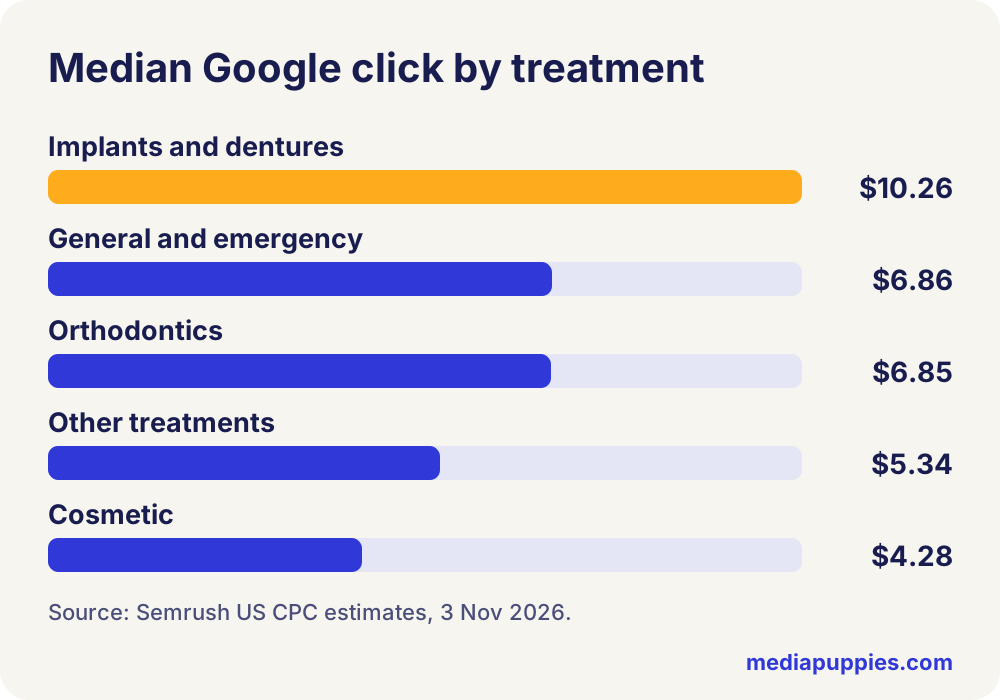
General and orthodontic searches were effectively tied, and the order of the middle groups depends on how many "near me" and price searches each contains. Only implants at the top and cosmetic at the bottom hold up either way. The cheapest keyword was "gum disease treatment" at $1.53.
Dental clicks are cheap next to the other fields we have priced: the median was $17.62 in our home services study and $13.68 in our law firm study, where personal injury keywords reached $156. Only 5 of the 37 dental keywords cost $10 or more, and 11 cost under $5. The most expensive were "same day dental implants" at $19.34 and "dental implants near me" at $17.88, which is 2.15 times the estimate for "dentist near me".
Our read: implants are where dental advertising earns its keep, because one case is worth many cleanings, and the click prices suggest practices know it. A general family practice can run Google Ads on a small budget; an implant practice should expect to pay noticeably more per click and plan its follow-up accordingly.
"Near me" costs more for treatments
In our home services study, adding "near me" made no consistent difference to the click price, and general dentistry looks much the same here. Treatment searches are different.
| Keyword | CPC | With "near me" | Change |
|---|---|---|---|
| invisalign | $4.68 | $10.78 | +130% |
| dental implants | $9.80 | $17.88 | +82% |
| dentures | $4.62 | $6.76 | +46% |
| teeth whitening | $2.95 | $4.27 | +45% |
| braces | $5.83 | $7.86 | +35% |
| dental cleaning | $6.67 | $7.33 | +10% |
| dentist | $8.06 | $8.30 | +3% |
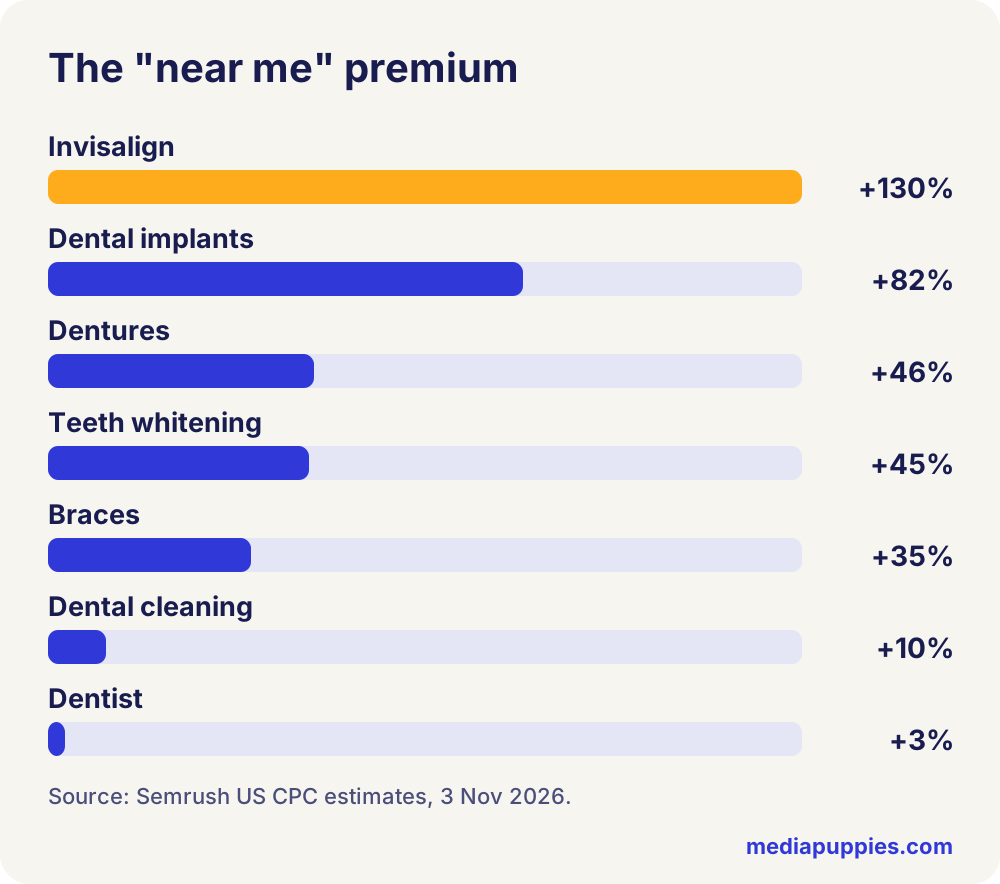
"Near me" added between 35% and 130% for braces, whitening, dentures, implants and Invisalign, while "dentist" moved by 3%, and emergency and pediatric dentist were slightly cheaper with it. Our read is that the plain treatment searches include a lot of people researching or, for "invisalign", looking for the brand itself, while the "near me" versions are people choosing a practice, and advertisers pay for that. If budget is tight, we would rather pay the premium on fewer high-intent treatment searches than spread it across research terms. Your location targeting and address asset matter too, because Google answers "near me" searches using where the searcher is.
Price searches cost less than the treatment itself
Searches about cost were cheaper than the treatment search in all 5 pairs with a Semrush estimate (2 of our 7 price searches had none).
| Treatment | CPC | "... cost" CPC |
|---|---|---|
| dental implants | $9.80 | $6.14 |
| dental crown | $6.39 | $3.98 |
| root canal | $5.64 | $4.36 |
| invisalign | $4.68 | $3.23 |
| veneers | $4.28 | $2.60 |
Our read is that people asking what something costs are early in their decision, and advertisers bid less for them. That makes them cheap to reach for a practice willing to answer the question honestly on its website. A clear pricing or "what to expect" page for implants and Invisalign can win those visits through organic search, and the paid budget can go to people ready to book.
What dental advertisers run on Facebook and Instagram
From our Facebook Ad Library study we took the 192 live US dental ads. One implant chain ran 73 of them, almost all video, so averages across all 192 are heavily skewed by that one advertiser. Here is what the other 98 advertisers ran (almost all US practices, plus one Turkish clinic and one dentist-finder app), with all ads alongside for comparison.
| Measure | Other 98 advertisers (119 ads) | All 192 ads |
|---|---|---|
| Single image | 42% | 26% |
| Video | 26.9% | 53.6% |
| Dynamic creative | 26.1% | 17.2% |
| Learn more button | 24.4% | 53.1% |
| Book now button | 21.8% | 13.5% |
| Phone number in the copy | 24.4% | 15.1% |
| A dollar figure (price, value or discount) | 16% | 9.9% |
| Something free (exam, x-rays, consultation) | 10.9% | 6.8% |
| Live a year or more | 71.4% | 52.6% |
80.6% of these 98 advertisers had just one ad in our sample, and their median ad had been live for 456 days. Single images were the most common format at 42%, and buttons were split, with Learn more on 24.4% and Book now on 21.8%. 18.5% of their ads had no website link at all, only a call or message button, and 6.7% used an instant form.
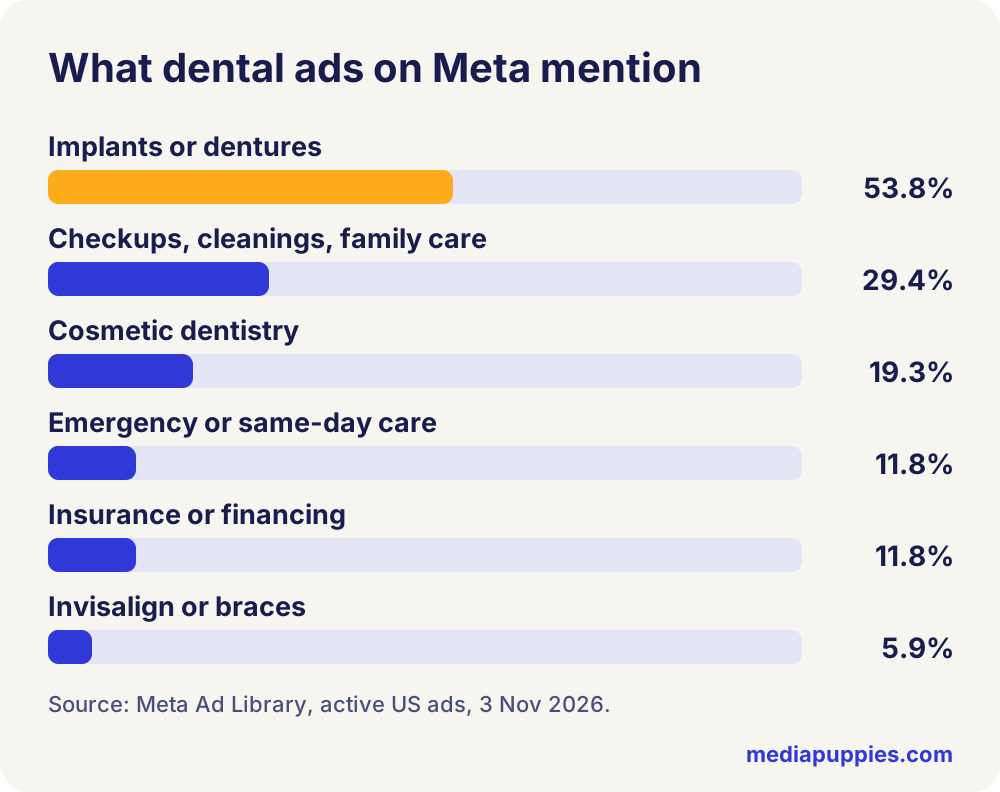
Implants came up most (53.8%), partly because one of our two searches was "dental implants". Checkups, cleanings and family care followed at 29.4%, cosmetic dentistry at 19.3%, and emergency or same-day care at 11.8%, three of which were same-day implant ads. Invisalign and braces appeared in only 5.9% of ads, but orthodontists whose ads use neither "dentist" nor "dental implants" are largely missing from this sample, so this data cannot tell you how many aligner ads run on Meta.
The implant chain itself is worth a look. 71 of its 73 ads were video, all 73 used a Learn more button, 19 talked about payment plans, and only 1 ran on Audience Network. Most of its ads repeat a few messages, many pointed at city-specific landing pages, so it looks like one campaign rolled out across many locations. Our view is that a single-location practice gets more from a few clearly different ads than from many near-copies of one.
Placements are worth a check too. 56.3% of the other advertisers' ads were eligible for Audience Network, Meta's network of third-party apps, which usually means Advantage+ placements were left on. For instant-form campaigns we usually switch it off, because in our experience it brings accidental form fills.
What agencies pay to reach your practice
Semrush estimates $32.41 a click for "dental practice marketing", 3.9 times its estimate for a "dentist near me" click ($8.30), and $27.65 for "dental marketing agency". Even the broad term "dental marketing" is $19.34. Practice owners are an expensive audience for agencies, so when you compare proposals, ask who runs your account day to day and what written report you will get each week.
How we would plan a dental practice's paid media
- Lead with your most valuable treatment. If you place implants or aligners, give them their own campaigns and budget; general dentistry can run alongside on less.
- Bid on "near me" for your high-value treatments. In our view the premium buys people choosing a practice now, and in dentistry, unlike home services, the data shows a real premium for implants and aligners.
- Answer the price question on your site. Cost searches are cheaper and early; a good page can win them without ad spend.
- Use Meta for treatments people do not search for yet. In our view aligner and smile results shown on Meta can reach people before they ever search, as long as before-and-after ads are targeted to adults, as Meta's health policy requires.
- Refresh the creative. 71.4% of these practices' ads had been live for a year or more, so a new patient story or a dentist on camera stands out.
- Track booked appointments. A form fill is not a patient until they sit in the chair, so record bookings in your practice software and keep patient health details out of ad pixels.
If you run a dental practice in the US, UK, Canada or Australia and already advertise, we will do a free written audit of your Meta and Google ad accounts, usually delivered in two working days and yours to keep. If you have not advertised yet, the same page gets you a free plan instead. Our Google Ads and Meta ads teams work month to month, with a named buyer on every account and a written report every week. For the Google side in more depth, read our guide to dental PPC.
How we did this
- Source
- Semrush Keyword Overview (US) and Meta Ad Library
- Country
- United States
- Collected
- 3 November 2026
- Sample
- 48 keywords (45 with a CPC estimate, 37 of them patient keywords) and 192 ads from 99 dental advertisers
- Keyword groups
- general and emergency, implants and dentures, orthodontics, cosmetic, other treatments (root canals, crowns, extractions, sedation, gum disease)
- Meta searches
- dentist, dental implants
We wrote 48 keywords: 40 that patients type, grouped by treatment, and 8 marketing terms a practice types when looking for help. On 3 November 2026 we looked each one up in Semrush's Keyword Overview for the US database, in US dollars. Three patient keywords had no CPC estimate (dentures cost, cosmetic dentist and wisdom teeth removal cost), which leaves 37.
CPC is Semrush's estimate of what advertisers pay on average for one click on that keyword in Google Ads, as a national US figure. Real prices move with the city, the time of day, Quality Score and local competition, so treat these as planning estimates.
The Facebook and Instagram figures come from our Meta Ad Library study collected the same day: 192 ads shown in the US from 99 advertisers whose Facebook page category is a dentist, oral surgeon, orthodontist or similar (one is a clinic in Turkey advertising to US patients, another a dentist-finder app). Our two searches were dentist and dental implants, each returning at most 150 ads, so this is a sample: implant ads are over-represented and orthodontists whose ads use neither word are largely missing. One implant chain ran 73 of the ads, so we report the other 98 advertisers separately. Topics were tagged from the ad text with keyword rules.
"Days live" counts from the start date the Library shows for ads live on 3 November 2026. Because we sampled ads live on one day, long-running ads are over-represented, and days live says nothing about how well an ad performs.
Download the data (CSV). Free to reuse with a link to this page.
Questions about dental marketing costs
How much does Google Ads cost for dentists?
Across 37 US patient keywords we checked on 3 November 2026, the median estimated cost per click was $6.39. Implant and denture keywords had the highest group median, at $10.26.
What is the most expensive dental keyword on Google?
Among patient searches in our data it was same day dental implants, at an estimated $19.34 a click, followed by dental implants near me at $17.88. Marketing terms aimed at practices cost more, up to $32.41 for dental practice marketing.
Does adding near me make dental keywords more expensive?
For treatment searches, yes: it raised the estimate by 82% for dental implants and 130% for Invisalign. For general searches such as dentist it barely moved.
Do dentists advertise on Facebook?
Yes. We found 192 live US dental ads from 99 advertisers on one day. Leaving out one large implant chain, single images were the most common format (42% of the other 119 ads), and the median ad had been live for 456 days.
What should a dental practice advertise first?
In our view, the treatment worth the most to the practice, usually implants or aligners, with general dentistry alongside on a smaller budget.
Can I use this data?
Yes. Download the CSV from this page and reuse it with a link back to the study.