

Key findings
- In single-image ads, the format Meta's 50 to 150 character recommendation covers, the median primary text ran 256 characters and only 27.2% of 301 pieces of copy fell within the range. Across all formats the median was 298.
- Med spas wrote the longest copy (a 413-character median across formats) and used the most emojis: 65.8% of their copy had at least one, against 30.8% for law firms.
- 59.2% of the English copy told the reader what to do next, such as call, book or contact the business. Med spas did it most (72.1%) and real estate least (45.2%).
- 45% of the English copy mentioned an offer such as a free consultation, a price or a discount, and 60.8% of those put it within the first 150 characters.
- 19.8% of the copy opened with a question, and 22.3% of the English copy had an offer in its first line. Law firms opened with a question most often, in 26.3% of their copy.
- "You" outnumbered "we" in 51.6% of the English copy; "we" came out ahead in 19.7%.
Meta Ad Library (ad text) · 904 distinct pieces of copy from 712 advertisers (1,098 ads) · 3 November 2026 (analysed 7 November 2026) · How we did this · Download the data (CSV)
Facebook ad copy is the part of an ad a local business can change in five minutes, so we wanted to see what businesses actually write. We took the live ads shown in the US from our two Ad Library studies, covering law firms, dentists, med spas, home service firms and real estate agents, kept the 1,098 with readable text, counted each advertiser's distinct copy once, and measured the 904 pieces of copy that remained.
Most of this Facebook ad copy runs past Meta's recommendation. For single-image ads Meta suggests 50 to 150 characters of primary text; the median single-image copy here was 256 characters, and only 27.2% fell inside the range. A little under six in ten pieces of English copy told the reader what to do, about one in five opened with a question, and "you" outnumbered "we" in about half. Med spas wrote the longest copy and used the most emojis. The full dataset is free to download at the end.
What we measured in the Facebook ad copy
Each row is one trade. Distinct copy counts each advertiser's words once, so a firm that ran the same text in ten ads counts once.
| Trade | Ads with text | Distinct copy | Median length, all formats (characters) | Single-image copy within 50 to 150 | At least one emoji | Tells the reader what to do (English copy) |
|---|---|---|---|---|---|---|
| Law firms | 265 | 224 | 247 | 25.5% | 30.8% | 48% |
| Dentists | 191 | 123 | 216 | 34.7% | 36.6% | 50.9% |
| Med spas | 439 | 365 | 413 | 17.1% | 65.8% | 72.1% |
| Home services | 114 | 106 | 194 | 36.8% | 38.7% | 55.7% |
| Real estate | 89 | 86 | 193 | 34.3% | 33.7% | 45.2% |
| All | 1,098 | 904 | 298 | 27.2% | 46.9% | 59.2% |
The median copy is well past Meta's recommended length
Meta's Ads Guide recommends 50 to 150 characters of primary text for Facebook Feed image ads. Among the 301 pieces of copy from single-image ads, a quarter were under 131 characters, the median was 256 and a quarter ran past 508. Across all formats the median was 298 characters.
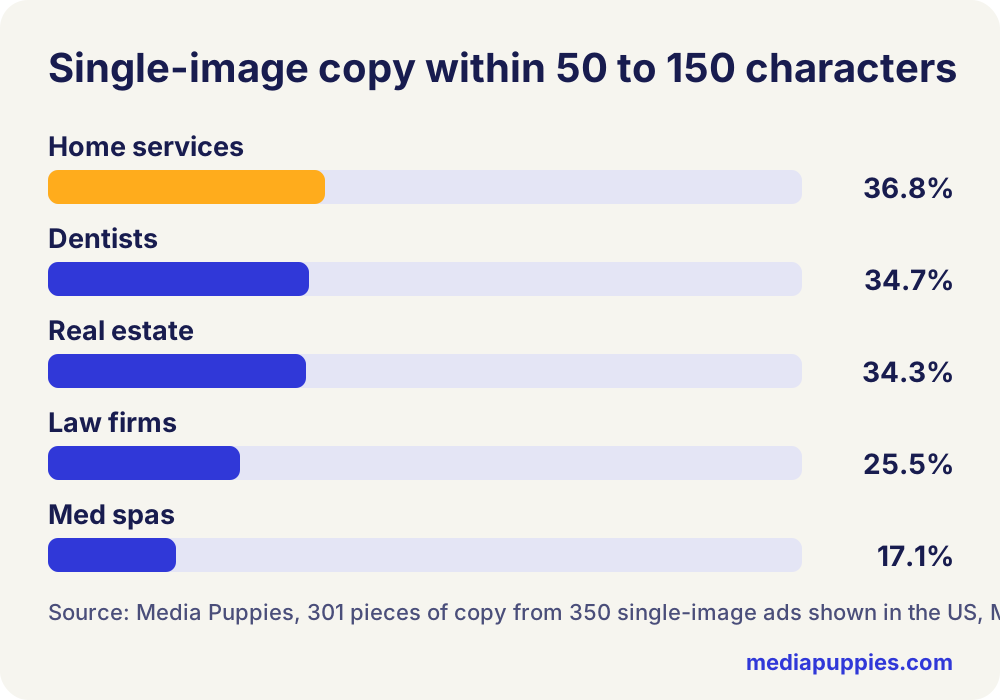
Med spas wrote the most: a 413-character median across formats, with 42.5% of their copy past 500 characters and 42.2% laid out as a list with an emoji, tick or bullet at the start of three or more lines. Home service firms, dentists and real estate agents came closest to the guide.
Long copy has its place: a law firm explaining an injury claim or a dentist explaining implants may need the words. The part we check is the start. Of the 390 pieces of English copy that mentioned an offer, 60.8% put it within the first 150 characters and the rest placed it later. Law firms were least likely to lead with it (40% of their offers came that early), and dentists most likely (77.8%).
How the copy opens
19.8% of the copy opened with a question, and 22.3% of the English copy had an offer or price in its first line. The trades split clearly:
| Trade | Opens with a question (all copy) | Offer in the first line (English copy) | Mentions an offer anywhere (English copy) |
|---|---|---|---|
| Law firms | 26.3% | 12.8% | 30.6% |
| Dentists | 22% | 25% | 38.8% |
| Med spas | 14% | 25.2% | 56.7% |
| Home services | 22.6% | 27.4% | 46.2% |
| Real estate | 20.9% | 21.4% | 34.5% |
| All | 19.8% | 22.3% | 45% |
Law firms asked the most questions, such as "Injured in an accident?" or "Hurt at work?", and put an offer first least often. Med spas mentioned an offer in 56.7% of their copy and led with it in 25.2%. We also tried to sort first lines into finer types, such as a problem, a result or a credential, but our keyword rules got about a fifth of them wrong, so we have left that breakdown out.
Emojis, lists and exclamation marks
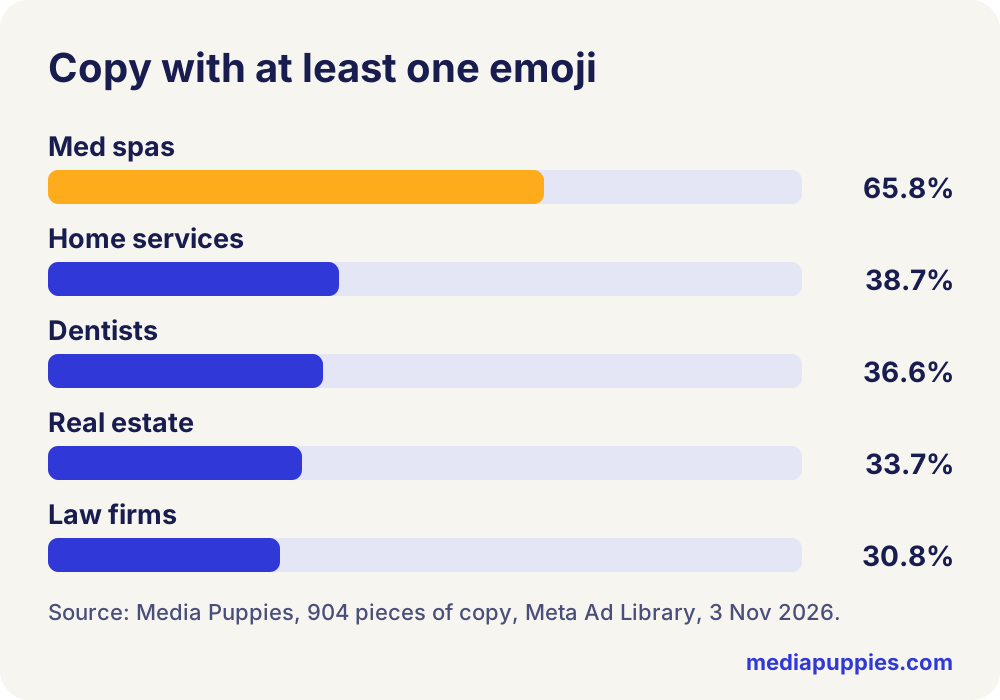
46.9% of the copy used at least one emoji, and 15.4% started with one. Med spas used emojis in 65.8% of their copy; law firms in 30.8%. A quarter of the copy (25.7%) was laid out as a list.
Exclamation marks appeared in 47.3% of the copy, and 11.5% used three or more. Dentists used them most, in 71.5% of their copy. 27% had at least one word of four letters or more in capitals, and 14.9% used hashtags, which we leave out of paid ads.
Does the copy tell people what to do?
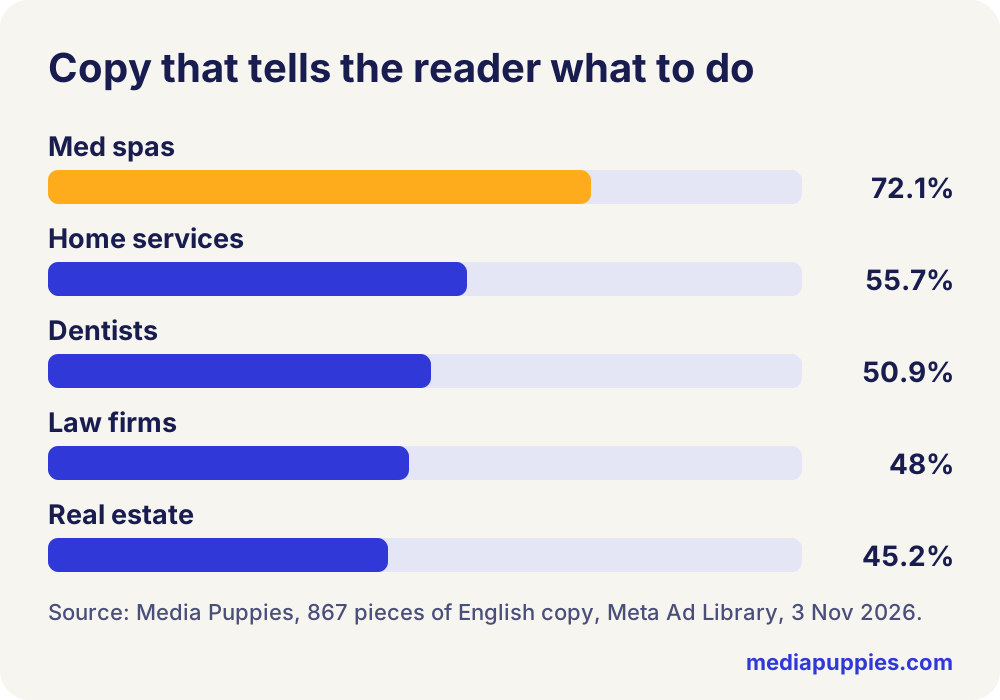
59.2% of the English copy contained a clear instruction such as call, book, schedule, contact, visit or learn more. Med spas did it most, 72.1%. Real estate did it least, 45.2%, and law firms were close behind at 48%. 19.8% of the copy included a phone number.
Most ads already have a button, so an instruction in the copy is optional. We still write one, because the button label is fixed and short, and the copy can say exactly what happens next, such as "book a free 15-minute consult".
Who the copy talks about
In 51.6% of the English copy, "you" and "your" outnumbered "we" and "our". "We" came out ahead in 19.7%, and 28.7% were level. Med spas were the most reader-focused: "you" led in 60.5% of their copy and "we" in 14.5%. Law firms talked about themselves most, with "we" ahead in 28.6% of their copy. Our habit is to write the first two lines about the reader and save the firm's record for further down.
Reading level and headlines
The English copy read at about an eighth-grade level on the Flesch-Kincaid scale. We give it only roughly, because the exact figure moves by a grade or more depending on how sentences and syllables are counted.
Headlines depended on the format. Among single-image ads, 274 had a headline; the median was 26 characters and 47.4% ran past Meta's recommended 27. Video and dynamic creative headlines ran longer: 61% of video headlines and 70.1% of headlines in dynamic creative ads with several assets were over 27 characters. 84 of the 261 pieces of copy from video ads showed no headline in the Library at all.
The same words from different businesses
We expected a lot of shared template copy, since agencies and franchise programmes reuse it. There was less than we thought. 7 texts were run word for word by two or more different advertisers, covering 20 advertisers (2.8%). The largest was shared by 6 dental practices whose ads linked to the same implant marketing company's pages, and 12 of the 20 advertisers were dentists. Shared copy is a normal agency shortcut. We would still avoid two practices in one town running the same words.
What we would change after reading this copy
- Put the offer and the instruction in the first 150 characters. Longer copy can follow.
- Test an opening the reader recognises. A question about their situation or a clear offer is what we would test first.
- Write the first lines about the reader. In a fifth of the copy the business talked about itself more than about the reader.
- Keep sentences short and words plain. The copy we read sits at about grade 8, and we see no reason to go higher.
- Keep image-ad headlines near 27 characters. Nearly half already run over.
- Use one or two emojis to mark a list. Strings of them crowd the words out.
For what these ads look like beyond the words, see our Facebook Ad Library study and our med spa ads study; for where the clicks go, see our landing page statistics. If you run Meta ads in the US, UK, Canada or Australia, give us read access to the account. A senior buyer will write a free audit of where the spend goes, whether your tracking counts real results, how your creative is holding up, and the three things we would fix first. It takes about two working days and the document is yours. Our Meta ads management runs month to month with a named buyer. More studies are on our research page.
How we did this
- Source
- Meta Ad Library (ad text)
- Country
- United States (ads shown)
- Collected
- 3 November 2026 (analysed 7 November 2026)
- Sample
- 904 distinct pieces of copy from 712 advertisers (1,098 ads)
- Trades
- law firms, dentists, med spas, home services (mostly roofers and plumbers), real estate
- Benchmark
- Meta Ads Guide, Facebook Feed image ads: primary text 50 to 150 characters, headline 27
The ads are the 1,112 live ads shown in the US that we included in our two Meta Ad Library studies of 3 November 2026: one of law firms, dentists, real estate and home services, and one of med spas. A few advertisers are based outside the US, for example in Canada, Australia and Mexico, and real estate includes home builders. We left out 14 ads whose text was empty (4) or contained a template placeholder (10); 10 of the 14 were real estate ads, mostly listing ads. That leaves 1,098. Many advertisers run the same words in several ads, so we count each distinct primary text once per advertiser: 904 pieces of copy from 712 advertisers. Only exact repeats are merged, so the same offer with a different city name counts twice. One dental implant chain that ran 73 ads counts as 9 pieces of copy.
Meta's Ads Guide recommends 50 to 150 characters of primary text and a 27-character headline for Facebook Feed image ads (read 7 November 2026). Meta presents these as recommendations, so we compare them with the 301 pieces of copy from single-image ads and report other formats separately. Length is counted in characters, including spaces and emojis, after converting decorative "bold" letters to plain ones. In a few ads the headline field holds a link caption such as a web address.
An instruction means an imperative such as call, book, schedule, contact, visit, learn more, apply, join or get, at the start of a sentence, line or list item, or a fixed phrase such as "book now" or "DM us". It is measured on English copy (867 pieces). Hand checks of about 100 pieces found it right about nine times in ten. An offer covers free consultations, estimates and items, prices, discounts, specials, memberships and financing, matched with English keywords on English copy; dollar figures describing case results are excluded, and a check of 20 pieces found the rule misses some offers, so the offer shares are a floor. An opening question is a question mark in the first 160 characters of the first line, in any language. We also tried sorting first lines into finer types such as problem, proof or benefit, but keyword rules got about a fifth of them wrong, so we do not report that breakdown.
"You" and "we" counts include your, our, us and similar forms, on English copy. Reading level is the Flesch-Kincaid grade on English copy of 20 words or more after removing links, phone numbers and hashtags. The result moves between about grade 7 and grade 9 depending on how sentences and syllables are counted, so we report it only as about grade 8 and do not rank the trades. Identical copy means the same words, ignoring punctuation and emojis, run by two or more different advertisers.
This is text only: the pictures, video and words inside them were not analysed, and for dynamic creative ads our data holds the one version of the text the Library shows on the ad card. The data is one snapshot of ads live on 3 November 2026, and the Library shows no results for these ads, so nothing here says which copy works better. The CSV has one row per piece of copy, with measurements only and no ad text, advertiser names or links; an english column marks the copy used for the English-only figures.
Download the data (CSV). Free to reuse with a link to this page.
Questions about Facebook ad copy
How long should Facebook ad copy be?
Meta's Ads Guide recommends 50 to 150 characters of primary text and a 27-character headline for Facebook Feed image ads. In our study the median single-image copy ran 256 characters and only 27.2% fell within the range. Some trades need more words; we put the offer and the instruction within the first 150 characters.
How do most Facebook ads open?
In the 904 pieces of copy we measured, 19.8% opened with a question, and 22.3% of the English copy had an offer or price in the first line. Law firms opened with a question most often, in 26.3% of their copy.
Should Facebook ads use emojis?
46.9% of the copy we read used at least one emoji, rising to 65.8% for med spas. We use one or two as signposts, for example to mark a short list.
Should ad copy say what to do next?
59.2% of the English copy in our study did, with med spas highest at 72.1% and real estate lowest at 45.2%. The button already carries a call to action; we add one in the copy because it can say exactly what happens next.
How long should a Facebook ad headline be?
Meta recommends 27 characters for image ads. In our study the median single-image headline was 26 characters, and 47.4% were longer than 27.
Can I use this data?
Yes. Download the CSV from this page and reuse it with a link back to the study. It holds measurements only, with no ad text, advertiser names or links.