

Key findings
- CTR (click-through rate) is clicks divided by impressions, times 100. What counts as good depends almost entirely on where the ad runs.
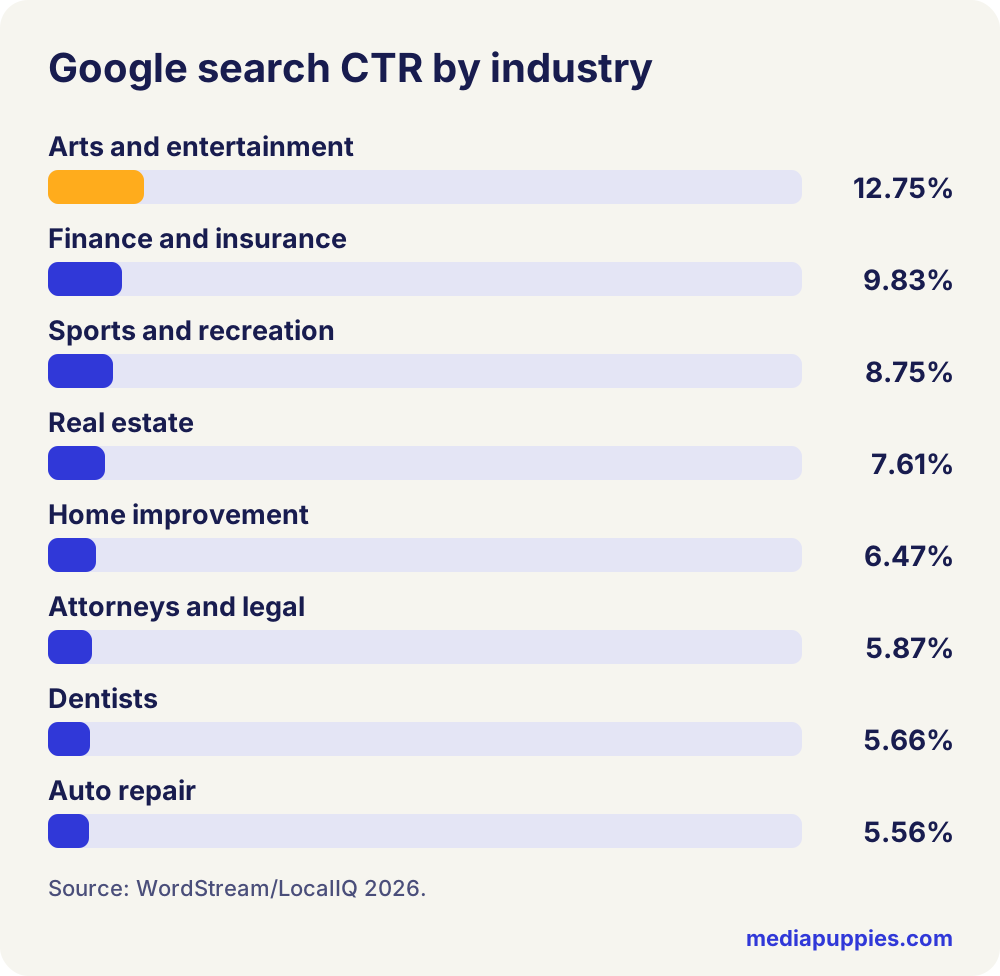
- WordStream's 2026 data on 13,474 US search campaigns puts the median Google search CTR at 6.64%, from 5.56% for auto repair to 12.75% for arts and entertainment.
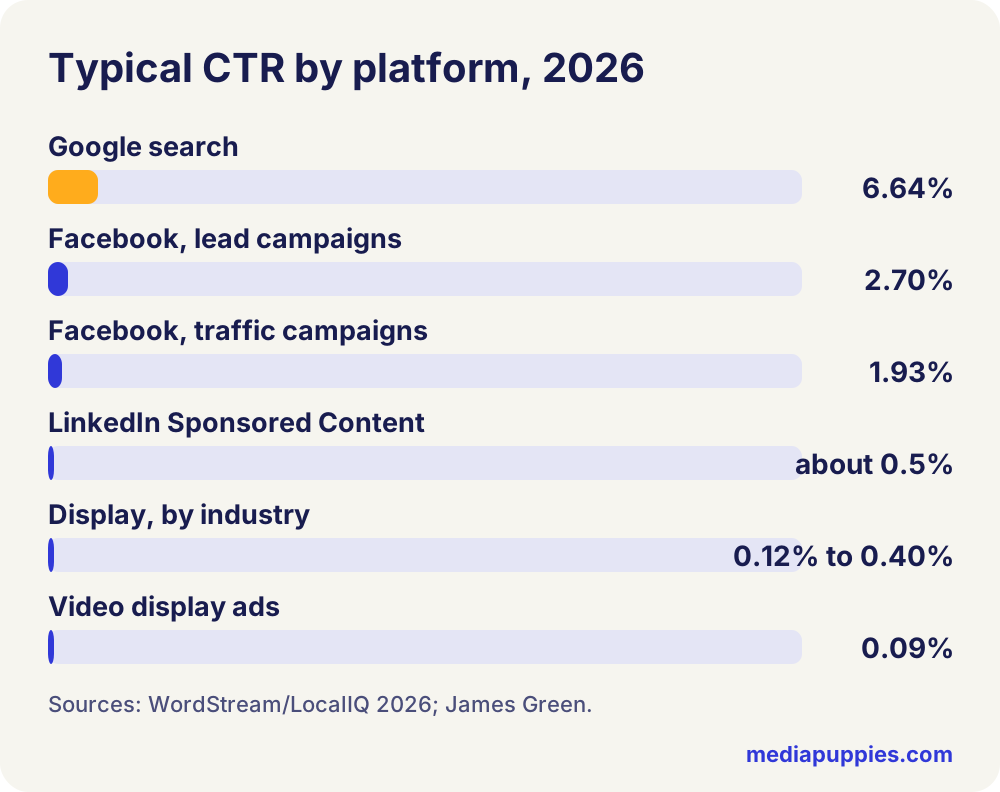
- Facebook traffic campaigns had a median CTR of 1.93% and lead campaigns 2.70%, across 1,829 US campaigns.
- Display ads ran at 0.12% to 0.40% by industry, so a search ad gets roughly 17 to 55 times the clicks per impression of a display ad, depending on the industry.
- Six video creators named 1% as the line for a workable or good CTR, and a seventh said his agency usually sees 1% to 2% on Meta. The real tests we found on ChatGPT and Reddit landed between 0.83% and 1.01%.
- Meta reports more than one CTR. The two most used are CTR (all), which counts every click on the ad, and link CTR, which counts only clicks to your site; one media buyer's benchmarks are 2% and 1%.
English YouTube videos, transcripts read from caption tracks; WordStream/LocalIQ 2026 reports; OpenAI ads help · 26 videos from 23 channels with concrete numbers (23 of 80 screened, plus 3 from our earlier studies); 134 numbers · 6 November 2026 · How we did this · Download the data (CSV)
CTR, or click-through rate, is the share of people who click your ad after seeing it: clicks divided by impressions, times 100. Show an ad 10,000 times, get 150 clicks, and your CTR is 1.5%. The hard part is knowing whether 1.5% is good, because the answer changes completely from one platform to the next.
So we put the 2026 numbers side by side. We read WordStream and LocalIQ's 2026 reports on Google search, Facebook and display ads, then searched YouTube for advertisers and media buyers talking about CTR, screened 80 videos, and kept the 23 recent ones with concrete numbers, plus 3 from our earlier studies. They gave 39 CTR numbers: 18 rules of thumb, 9 cited benchmarks, 7 worked examples and 5 from real accounts.
Search, social and display are different worlds
A median Google search ad gets clicked 6.64% of the time, a Facebook traffic ad 1.93%, and a display ad somewhere between 0.12% and 0.40% depending on the industry. That is roughly 17 to 55 times more clicks per impression on search than on display. People searching are already looking for something; people scrolling or reading are not. Comparing your Facebook CTR with a search benchmark, or your display CTR with Facebook's, will tell you nothing useful.
Google search CTR by industry
WordStream's 2026 search report covers 13,474 US campaigns on Google and Microsoft Ads from April 2025 to March 2026, and every figure is a median. The overall CTR was 6.64%, against 1.91% in its first report in 2016.
| Industry (15 of 23) | Median search CTR, 2026 |
|---|---|
| Arts and entertainment | 12.75% |
| Finance and insurance | 9.83% |
| Sports and recreation | 8.75% |
| Shopping, collectibles and gifts | 8.28% |
| Real estate | 7.61% |
| Education | 7.56% |
| Personal services | 7.16% |
| Physicians and surgeons | 6.61% |
| Home and home improvement | 6.47% |
| Business services | 6.10% |
| Attorneys and legal services | 5.87% |
| Health and fitness | 5.81% |
| Dentists | 5.66% |
| Auto repair | 5.56% |
WordStream says CTRs were fairly stable year on year, with education up 31.71% and health and fitness down 19.08%. B2B software runs lower: GrowthSpree, citing its own data from more than 300 SaaS accounts, puts developer tools at 4.1%.
Facebook and Instagram CTR
WordStream's Facebook report covers 1,377 US traffic campaigns and 452 lead campaigns. The median CTR was 1.93% for traffic campaigns, up from 1.71% a year earlier, and 2.70% for lead campaigns.
| Campaign type | Highest | Lowest |
|---|---|---|
| Traffic (median 1.93%) | Beauty 2.73%, arts 2.71%, restaurants 2.68% | Finance 1.46%, cars for sale 1.47%, education 1.50% |
| Leads (median 2.70%) | Physicians 4.18%, real estate 4.17%, furniture 3.78% | Beauty 1.35%, dentists 1.62%, education 1.74% |
Before comparing yourself with those numbers, check which CTR you are looking at. Meta's help pages define CTR (all) as every click on the ad, including likes, comments and profile clicks, and link CTR as clicks that go to your site. Jason Gan uses 2% as his benchmark for CTR (all) and 1% for link CTR, and treats a big gap between them as a sign the ad is attracting the wrong people.
Most rules of thumb we heard put the line at 1%; Gan and Jim's say they mean link CTR. Jim's Digital Marketing calls under 1% bad and 3% or more really good. Máté Hunyor uses 1% as his benchmark and calls 3% to 4% exceptional. Blake Bauer says his agency usually sees 1% to 2% on Meta.
CTR is higher than it was
The benchmarks have gone up. WordStream's first search report, in 2016, had a median CTR of 1.91%; the 2026 one has 6.64%. On Facebook, traffic campaigns went from 1.71% to 1.93% in a year and lead campaigns from 2.59% to 2.70%. WordStream credits its own optimisation for the stable search figures and says the wider market has seen lower click rates, so treat those as figures from managed accounts. Either way, a 2% search CTR that might have passed in 2016 would now sit far below the median in every industry.
Small changes in CTR also matter more than they look. Gan's example: lifting link CTR from 0.3% to 0.6% doubles the clicks you get for the same spend, which halves your cost per click if CPM stays the same.
Display, YouTube and Demand Gen
WordStream's display report, from 7,074 campaigns across Google, YouTube, Meta and other networks, has industry medians from 0.12% for restaurants to 0.40% for education, with real estate at 0.18% and home improvement at 0.19%. On the USA TODAY Network it measured video ads at 0.09% and native ads at 0.28%. Shri Kanase shows an ecommerce client's Demand Gen ad at 0.23% that still drives conversions after people see it. Low click rates are normal here; display and video are mostly bought to be seen.
LinkedIn, TikTok, Reddit and ChatGPT ads
James Green, who runs B2B ads, cites a global LinkedIn Sponsored Content average of about 0.5% and calls 1% decent for a niche audience. He warns about the 20% "CTR" some marketers quote for thought leader ads, which counts clicks to read more and to view a profile. For TikTok, Nathan Nazareth calls 1% workable and 2% or more very strong.
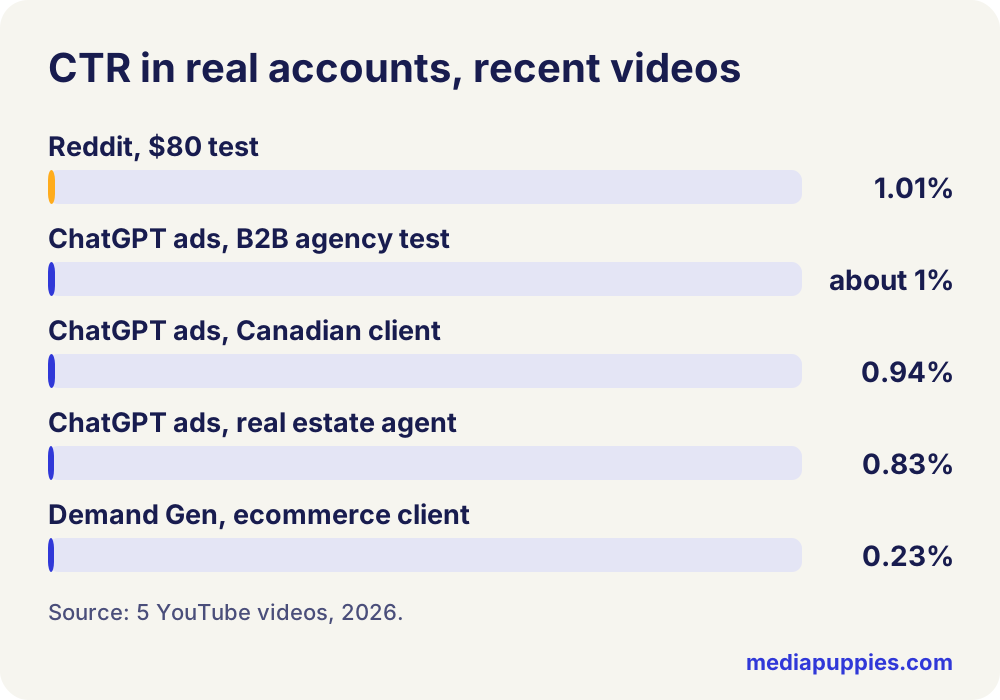
Most of the real-account numbers came from the newest platforms. A presenter on HubSpot Marketing's channel tested Reddit with $100 of her own money and got 93 clicks from 9,244 impressions, 1.01%. On ChatGPT ads, a Canadian client got 1,592 clicks from 170,000 impressions, 0.94%; Grow My Ads got about 1% on a B2B test; and an Austin real estate agent, William Zhang, got 0.83%. All three ChatGPT tests landed close to the 1% that the social media rules of thumb treat as the line. None of them produced cheap customers: the B2B test spent about $1,200 for 0 conversions.
Hook rate and hold rate for video ads
For video, the creators look at two numbers before CTR. Hook rate is the share of impressions that watch the first 3 seconds; hold rate is the share of those who keep watching. Jim's Digital Marketing grades them like this, as his rules of thumb.
| Grade | Hook rate | Hold rate |
|---|---|---|
| Bad | under 20% | under 25% |
| Average | about 25% | 30% to 40% |
| Good | 30% or more | 40% to 50% |
| Elite | 40% or more | 50% or more |
He says a talking-head video with no cuts often holds only about 10%. Hunyor uses 25% for both as his benchmark, and Nazareth wants about 70% of TikTok viewers to watch at least 2 seconds. A video that loses people in the first seconds rarely gets the click.
What a good CTR is
A good CTR is one above the median for your platform, campaign type and industry, and one that holds up when you look at what the clicks do next. six of the creators we logged named 1% as the line for social ads; for Google search the median is 6.64%; for display, anything near 0.3% is normal.
- Compare like with like. Use the benchmark for your platform and campaign type, and on Meta make sure you are reading link CTR.
- Watch the trend. Gan's example is a drop from 1% to 0.5% over three days; he first asks whether something outside the account, such as a public holiday or an election, distracted people.
- Follow the click. In WordStream's 2026 webinar, the presenter tells low-CTR industries not to fret, because their leads may be worth more. Judge the campaign on cost per lead or sale.
- Fix the first seconds of video. If hook rate is under 20%, change the opening before you touch the audience or the bid.
Our CPM study for 2026 shows what those impressions cost, our CPC study covers Google click prices, and our guide to ad hooks covers the creative side. If your click rates have dropped on Meta or Google and you advertise in the US, UK, Canada or Australia, give us read access to the account. A senior buyer will write a free audit of where the spend goes, whether your tracking counts real results, and the three things we would fix first. It takes about two working days and the document is yours. More studies are on our research page.
How we did this
- Source
- English YouTube videos, transcripts read from caption tracks; WordStream/LocalIQ 2026 reports; OpenAI ads help
- Country
- Mostly United States (where stated); one Canadian ad account
- Collected
- 6 November 2026
- Sample
- 26 videos from 23 channels with concrete numbers (23 of 80 screened, plus 3 from our earlier studies); 134 numbers
- Upload window
- 1 November 2025 to 6 November 2026
- Benchmarks read
- WordStream/LocalIQ 2026 search, Facebook and display reports; Meta and OpenAI help pages
We found videos through web searches of YouTube for CPM, CTR and CPC on Meta, Google Search, Display and Demand Gen, YouTube ads, TikTok, LinkedIn, Reddit and ChatGPT ads. Of 80 videos screened, we left out 28 uploaded before 1 November 2025, 24 with no CPM, CTR, CPC or CPV number, 3 that were private or unavailable, and 2 not in English. We added 3 videos from our earlier studies that gave CPM or CTR numbers.
We logged every CPM, CTR, CPC and CPV once, with its timestamp, and labelled it as a result from a real account, a platform figure or reported price, a cited benchmark, a rule of thumb, or a worked example. We dropped two numbers: an unsourced 1994 banner CTR, and a legal-services CPC that the captions give as $5.87 where the written WordStream report says $9.87.
Some figures are our arithmetic on numbers the videos or reports give. CPM equals CPC times CTR times 1,000, so WordStream's median CPC and median CTR give a rough implied CPM; medians do not multiply exactly, so treat those as approximations. The ChatGPT client account is in Canadian dollars. The Reddit test had a $100 budget but spent $80, which is what we used.
These are creators who chose what to show, the real-account figures are few, and none of this is our own client data. The CSV lists every number with a link to its video and timestamp.
Videos used, oldest first: Jerad Larkin, Chicago Title (16 Nov 2025), Epom (20 Nov 2025), Máté Hunyor (21 Nov 2025), LYFE Marketing (7 Jan 2026), QuHarrison Terry (27 Jan 2026), Nathan Nazareth (9 Feb 2026), Amazon Seller School (11 Feb 2026), Chris Shupe, Dominate Marketing (24 Feb 2026), Anthony Eclipse (19 Mar 2026), James Green, Ads for B2B (25 Mar 2026), Shri Kanase (27 Mar 2026), TrueProfit (1 Apr 2026), HubSpot Marketing (4 May 2026), GrowthSpree (16 May 2026), Jason Gan (19 May 2026), GrowthSpree (28 May 2026), Blue Sense Digital (31 May 2026), Grow My Ads (1 Jun 2026), Antonio Ventre (8 Jun 2026), WordStream (11 Jun 2026), Blake Bauer Business (22 Jul 2026), Jason Gan (11 Aug 2026), Guaranteed PPC (24 Aug 2026), William Zhang, AI for Realtors (1 Sep 2026), Jim's Digital Marketing (5 Sep 2026), WordStream (16 Oct 2026).
Download the data (CSV). Free to reuse with a link to this page.
Questions about CTR
What is CTR?
CTR, or click-through rate, is clicks divided by impressions, times 100. An ad shown 10,000 times that gets 150 clicks has a 1.5% CTR.
What is a good CTR for Google Ads in 2026?
WordStream's 2026 median for search ads is 6.64% across 13,474 US campaigns. By industry it runs from 5.56% for auto repair to 12.75% for arts and entertainment. Display ads are far lower, 0.12% to 0.40%.
What is a good CTR for Facebook ads?
WordStream's 2026 medians are 1.93% for traffic campaigns and 2.70% for lead campaigns. Several media buyers in our videos treat 1% as the line, and two call 3% or more very good.
What is the difference between CTR (all) and link CTR?
On Meta, CTR (all) counts every click on the ad, including likes, comments and profile clicks. Link CTR counts only clicks to your website. One media buyer's benchmarks are 2% for CTR (all) and 1% for link CTR.
What CTR do ChatGPT ads get?
The three real accounts in our videos got 0.83%, 0.94% and about 1%, close to typical social ads. One B2B test spent about $1,200 for 92 clicks and no conversions.
Is a high CTR always good?
No. A high CTR with clicks that do not convert costs you money. Judge CTR against your platform's median, then judge the campaign on cost per lead or sale.