

Key findings
- Of 142 US local businesses with live Facebook or Instagram ads, 64.1% had also shown Google ads in the US in the last 30 days, and 66.2% at any time. 33.8% showed no Google ads pointing to their website.
- Home service firms and law firms were the most likely to run both: 86.2% and 82.8% had shown Google ads at any time, and 75% of dentists. Med spas were at 50% and real estate businesses at 34.6%.
- Businesses whose landing page carried the Meta pixel were more likely to have run Google ads in the last 30 days (70.7%) than those where we saw no pixel (52%), though med spas went the other way.
- Of those with two or more Facebook ads in our sample, 78.3% had run Google ads in the last 30 days, against 61.3% of those with one.
- For 11 of the 94 businesses with Google ads, the first advertiser account shown was a marketing agency, a web design firm, a broadcaster or an ad platform.
Google Ads Transparency Center and our Meta Ad Library and landing page studies · 142 US local businesses with live Facebook or Instagram ads (26 to 30 per trade) · 12 November 2026 (Google lookups); 3 and 7 November 2026 (Facebook ads and pages) · How we did this · Download the data (CSV)
Google Ads vs Facebook ads is a choice many owners ask us about, so we checked what businesses already on Facebook actually do. We took 142 US law firms, dentists, med spas, home service firms and real estate businesses that were running Facebook and Instagram ads in early November 2026, and looked each one up in Google's Ads Transparency Center. 64.1% had also shown Google ads in the US in the last 30 days.
Results differed by trade. About four in five law firms and home service firms ran both, while most real estate businesses ran Facebook alone, so the Google Ads vs Facebook ads answer depends on what you sell. The full dataset is free to download at the end.
How many Facebook advertisers also run Google ads
Of the 142 businesses, 94 (66.2%) had shown Google ads in the US at some point, and 91 (64.1%) had done so in the last 30 days. The other 48 (33.8%) showed no Google ads pointing to their website. Among the businesses with Google ads, the median had 16.5 ads on record. In the last 30 days, the median home service firm on Google had shown 15 ads, against 13 for law firms and 7 for dentists.
| Trade | Businesses | Google ads at any time | Google ads, last 30 days | Median Google ads on record |
|---|---|---|---|---|
| Law firms | 29 | 82.8% | 82.8% | 21 |
| Home services | 29 | 86.2% | 82.8% | 17 |
| Dentists | 28 | 75% | 75% | 10 |
| Med spas | 30 | 50% | 46.7% | 12 |
| Real estate | 26 | 34.6% | 30.8% | 44 |
| All five trades | 142 | 66.2% | 64.1% | 16.5 |
14 businesses had about 100 or more Google ads on record. Most of them were chains, national brands or lead generation sites rather than single local businesses, which is why we report medians.
Google Ads vs Facebook ads by trade
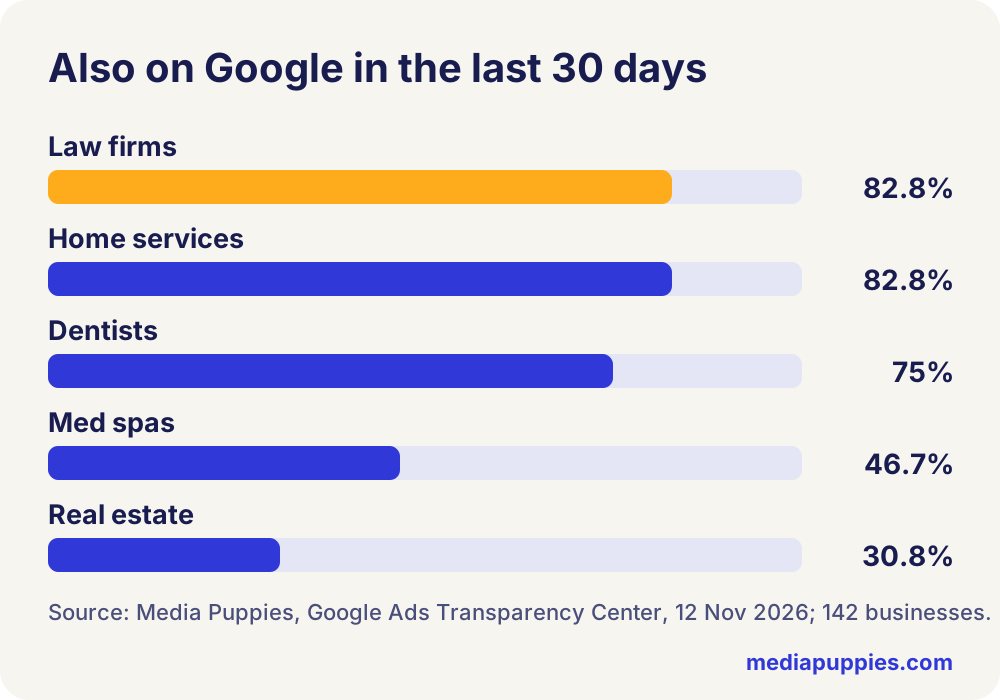
24 of the 29 law firms, 24 of the 29 home service firms and 21 of the 28 dentists had been on Google in the last 30 days, against 14 of 30 med spas and 8 of 26 real estate businesses. Our reading: law, home services and dentistry sell to people with an immediate need who search for it, while med spas and real estate sell more on looks and lifestyle. The data itself shows only who advertised where.
The real estate businesses that did use Google had more ads on record, with a median of 44 against 10 for dentists. By the account names, 5 of those 9 were home builders, a community operator, a large brokerage or an agent-matching company rather than a single agent. 3 businesses across all trades had run Google ads before but none in the last 30 days.
The pixel, ad volume and the second channel
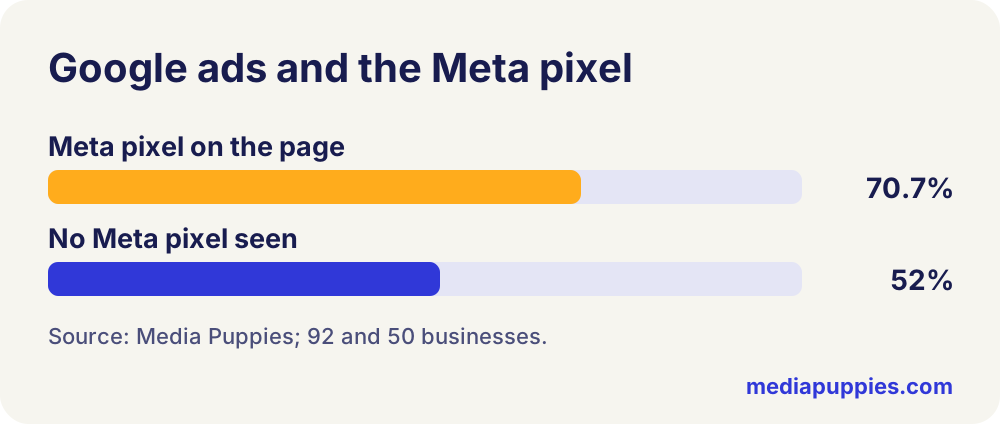
Businesses whose Facebook landing page carried the Meta pixel were more likely to have run Google ads in the last 30 days: 70.7% of the 92 with a pixel, against 52% of the 50 where our visit saw none. Part of that gap is trade mix, and it did not hold everywhere. Among dentists the pattern was the same (14 of 17 with a pixel against 7 of 11 without), but among med spas it went the other way (7 of 19 with a pixel against 7 of 11 without).
Ad volume pointed the same way as the pixel overall. Of the 23 businesses with two or more Facebook ads in our sample, 78.3% were on Google in the last 30 days, against 61.3% of those with one. Our reading is that all of these point to how organised a business's marketing is, but this data cannot show cause.
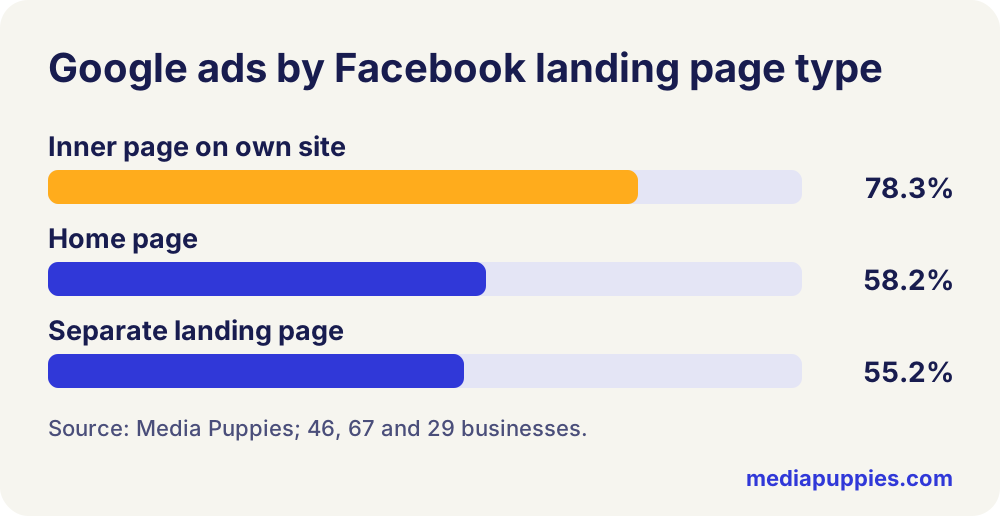
The type of page the Facebook ad linked to also lined up with Google use. 78.3% of businesses sending Facebook clicks to an inner page of their own site were on Google, against 58.2% of those using the home page and 55.2% of those using a separate landing page.
The businesses on Facebook alone
48 of the 142 businesses (33.8%) showed no Google ads pointing to their website. 17 of them were real estate businesses and 15 were med spas, against 5 law firms, 4 home service firms and 7 dentists. They also differed on the Facebook side. 54.2% of the Facebook-only businesses had the Meta pixel on their landing page, against 70.2% of those that also ran Google ads, and 56.3% sent Facebook clicks to their home page, against 42.6%.
For a law firm, a home service firm or a dentist, being on Facebook alone was unusual in this sample. For a real estate business it was the norm. Our view is that a search-led business on Facebook alone is missing the people who are already looking, and a lifestyle business on Google alone may be missing the people who are not looking yet.
Who runs the Google account
The Transparency Center names the advertiser account behind the ads. For 11 of the 94 businesses with Google ads (11.7%), the first account shown was a marketing agency, a web design firm, a broadcaster or an ad platform. Ads pointing to two dental practices' sites, one ad each, ran under the same agency's account, and ads pointing to a roofing company's site ran under a TV broadcaster's account. Most of the others matched the business, its owner or a parent company; about four we could not place. We did not check the Facebook side the same way, so we cannot say how many used one agency for both.
How to check a competitor yourself
The method is free. Open Google's Ads Transparency Center, set the country and type the competitor's website domain. You will see how many ads point to that site and the advertiser names. "Last 30 days" shows recent activity. Ads pointing to other sites will not appear. Do the same in the Meta Ad Library by searching the business name, with active ads selected.
What this means for a local business
- Treat it as a sequence. Most businesses in this sample ran both. In our view, the useful question is which channel comes first and how budget moves between them; our guide on Google or Meta first covers how we decide.
- Search-led trades start on Google. In our view, if people search for your service when they need it, as with lawyers, plumbers and dentists, Google is usually the first channel and Facebook the second.
- Set up tracking before adding a channel. In our view, tracking on both channels is what lets you compare them.
- Check your competitors in both libraries. The Meta Ad Library and Google's Ads Transparency Center are free, and a domain search shows whether a rival runs Google ads pointing to its site.
If you run Google or Meta ads in the US, UK, Canada or Australia, give us read access to the account. A senior buyer will write a free audit of where the spend goes, whether your tracking counts real results, how your creative is holding up, and the three things we would fix first. It takes about two working days and the document is yours. Our Google Ads management and Meta ads management run month to month with a named buyer. More studies are on our research page.
How we did this
- Source
- Google Ads Transparency Center and our Meta Ad Library and landing page studies
- Country
- United States
- Collected
- 12 November 2026 (Google lookups); 3 and 7 November 2026 (Facebook ads and pages)
- Sample
- 142 US local businesses with live Facebook or Instagram ads (26 to 30 per trade)
- Google lookup
- Ads Transparency Center, region United States, searched by website domain, any time and last 30 days
The businesses come from our landing page study. On 3 November 2026 we collected live Facebook and Instagram ads shown in the US from law firms, dentists, med spas, home service firms and real estate businesses in the Meta Ad Library, and on 7 November we opened each advertiser's most-used link. For this study we took advertisers whose ad linked to their own website and whose page loaded, and drew 30 per trade at random with a fixed seed, one per website domain: 150 in all. We then left out three on shared domains (a brokerage network and two dental implant sites that host many practices' pages, where ads pointing to the domain come from many practices or agents) and five with Canadian or Australian websites, because the Google lookup used the US region. That leaves 142.
The trade groups came from keyword searches, so they include lead generation sites, national chains and brands as well as single local businesses; these raise the ad counts. Two pairs of sites shared one Google account. The sample covers businesses already advertising on Facebook and says nothing about local businesses in general.
On 12 November 2026 we searched each domain in Google's Ads Transparency Center with the region set to the United States, and read the number of ads shown for "Any time" and, where that was above zero, for "Last 30 days". We also noted the first advertiser account the Center listed, and marked it by hand as an agency, web design firm, broadcaster or ad platform when the name was clearly one of those. The Center counts ads from any account that pointed ads at the domain, and rounds large counts (for example "~200"). The lookups ran one at a time; when Google answered with a "too many requests" error we stopped, waited and continued more slowly.
The Meta pixel and page type come from our 7 November page visit, where the pixel check saw only what loaded without a consent click. "Two or more Facebook ads" means two or more in our 3 November sample, which came from keyword searches, so a business may run more ads than we saw.
Limits. A business can run Google ads that point to another domain, or ads the Transparency Center does not list against its website, and those are not counted here. "Any time" depends on how far back the Center's records go, and ad counts are not spend. With 26 to 30 businesses per trade, one business moves a trade's share by about 3.3 to 3.8 points. Neither source shows spend or results, so nothing here says which channel works better. The CSV has one row per business with no names or domains.
Download the data (CSV). Free to reuse with a link to this page.
Questions about Google Ads vs Facebook ads
Do local businesses use Google Ads or Facebook ads?
Among local businesses already running Facebook ads, most also ran Google ads. Of 142 US businesses we checked in November 2026, 64.1% had shown Google ads in the last 30 days.
Which local businesses run both Google and Facebook ads?
In our sample, 86.2% of home service firms, 82.8% of law firms and 75% of dentists with Facebook ads had shown Google ads at any time. Med spas were at 50% and real estate businesses at 34.6%.
Is Google Ads or Facebook ads better for a local business?
The data shows who uses each channel. It does not show which works better. In our view, trades that customers search for when they need them, such as lawyers, plumbers and dentists, usually start with Google and add Facebook.
How can I see if a competitor runs Google ads?
Search the competitor's website domain in Google's Ads Transparency Center with your country selected. It shows how many ads point to that site and the advertiser names. Ads pointing to other sites will not appear.
Can I use this data?
Yes. Download the CSV from this page and reuse it with a link back to the study. It has one row per business with no names or domains.