

Key findings
- Of the 363 pages that loaded, 39.1% were the advertiser's home page and 25.6% a separate landing page with no menu into a wider site. Home service firms used the home page most, at 55.8%.
- Of the 353 pages on advertisers' own sites, 112 (31.7%) loaded no Meta pixel during our visit: 47.2% of home pages against 12.9% of separate landing pages.
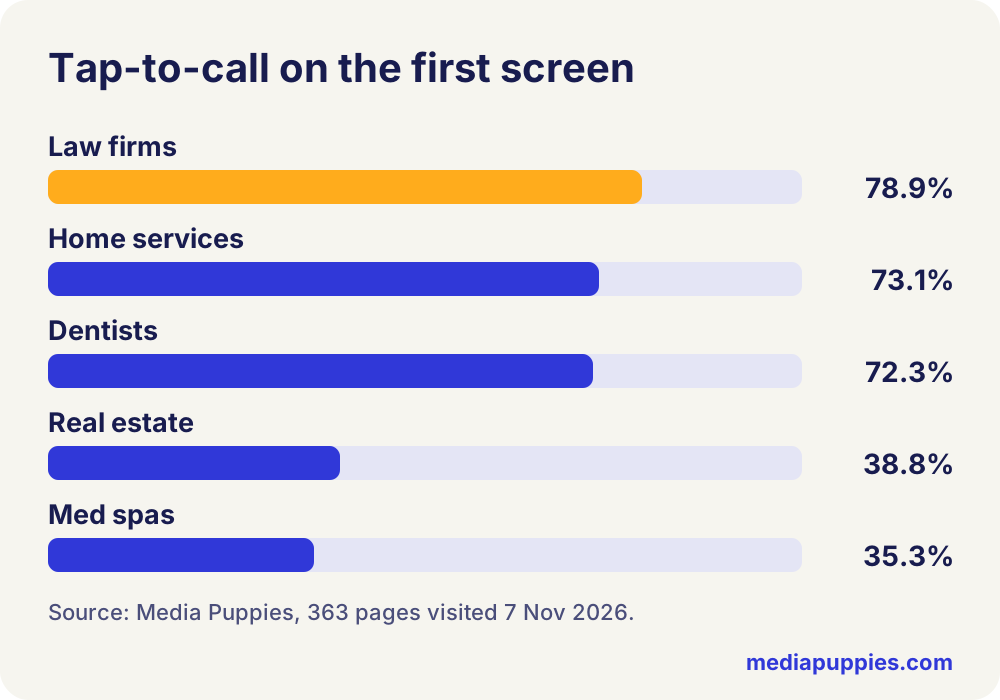
- 74.4% of pages had a tap-to-call link, but only 55.1% showed one on the first screen of a phone. Law firms led at 78.9%; med spas were at 35.3%.
- 120 pages (33.1%) had a form asking for contact details. Where nothing covered the screen, only 17 of 107 forms (15.9%) were on the first screen. The median form asked 5 questions.
- The median page transferred 2.5 MB, close to the 2.56 MB median for mobile home pages across the web. 17.1% were over 5 MB.
- 13 of the 420 advertisers' links (3.1%) were broken: dead domains, error pages, unusable certificates or a parked domain.
Landing pages linked from live Meta ads shown in the US (Meta Ad Library) · 420 advertisers, 513 links, 363 pages analysed · 7 November 2026 · How we did this · Download the data (CSV)
Every Facebook ad with a website link sends the visitor to a landing page, and what happens next depends on that page. We wanted to see what local businesses actually put there. So we took the 677 live ads with a website link from our two Ad Library studies, covering law firms, dentists, med spas, home service firms and real estate agents advertising in the US, opened every link on an iPhone-sized screen on 7 November 2026, and recorded what a visitor gets.
Of the 363 landing pages that loaded, 39.1% were the advertiser's home page and 25.6% a separate landing page. About a third of the pages on advertisers' own sites loaded no Meta pixel, and only 55.1% let a phone visitor tap to call without scrolling. Contact forms were rare on the first screen and usually asked five questions. Separate landing pages were lighter and much more likely to carry the pixel. The full dataset is free to download at the end.
What we checked on each landing page
We counted each advertiser once, on the link its ads used most. That gave 420 advertisers and 513 different links. 86.4% of the pages loaded and could be analysed. The rest were broken, met a security check, or stayed blank for us, and we cover those further down.
| Industry | Advertisers with a website link | Pages analysed | Home page | Separate landing page | Own-site pages with no Meta pixel |
|---|---|---|---|---|---|
| Law firms | 86 | 76 | 43.4% | 15.8% | 24% |
| Dentists | 64 | 47 | 38.3% | 38.3% | 31.1% |
| Med spas | 147 | 139 | 28.8% | 34.5% | 30.4% |
| Home services | 60 | 52 | 55.8% | 21.2% | 42.3% |
| Real estate | 63 | 49 | 44.9% | 8.2% | 37% |
| All | 420 | 363 | 39.1% | 25.6% | 31.7% |
We expected most local businesses to send ad traffic to their website and few to build dedicated pages, and that held for law firms, home service firms and real estate agents. Dentists looked different, and one vendor explains much of it: 12 of the 47 dentist pages (25.5%) were near-identical implant pages hosted on the same marketing company's domain, each for a different practice. Without them, 51.4% of dentist pages were home pages and 17.1% were separate landing pages.
The home page was the most common landing page
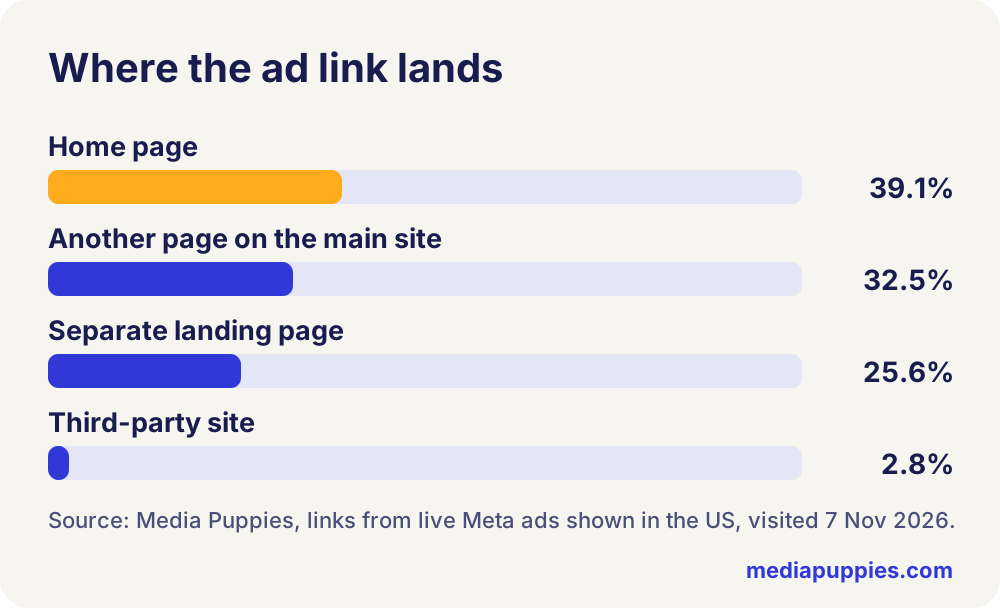
Home service firms sent people to their home page most often, at 55.8%. Among the trades without a single dominant vendor, med spas built the most separate landing pages, 34.5% of their pages. Only 10 pages (2.8%) sat on someone else's site, such as a booking tool, a directory listing or a Google Maps profile.
WordPress ran 41.3% of all pages. GoHighLevel was the platform behind 26 pages (7.2%), mostly med spa landing pages, but its forms, chat or booking calendars loaded on 54 pages (14.9%), many of them ordinary WordPress sites. Six med spa pages were built with AI app builders, four of them on vercel.app addresses.
The page types differed in ways that matter for paid traffic:
| Page type | Pages | Median weight | Median links to other pages on the site | No Meta pixel |
|---|---|---|---|---|
| Home page | 142 | 2.8 MB | 35 | 47.2% |
| Another page on the main site | 118 | 2.4 MB | 39.5 | 28% |
| Separate landing page | 93 | 2.1 MB | 1 | 12.9% |
A home page serves everyone who finds the business, so it carries a menu, service lists and location pages; the median one in our sample linked to 35 other pages on the site. Home pages were also nearly four times as likely as separate landing pages to have no Meta pixel. We think a home page can work for a local firm whose ad simply says "call us", as long as the phone number is at the top. When an ad sells one offer, we send the click to a page about that offer.
About a third of own-site pages loaded no Meta pixel
Of the 353 pages on advertisers' own sites, 112 (31.7%) loaded no Meta pixel during our visit. These advertisers were paying Meta to send visitors, but nothing on the page told Meta what those visitors did next. We leave out the 10 third-party pages here, because an advertiser usually cannot add a pixel to a booking tool or directory.
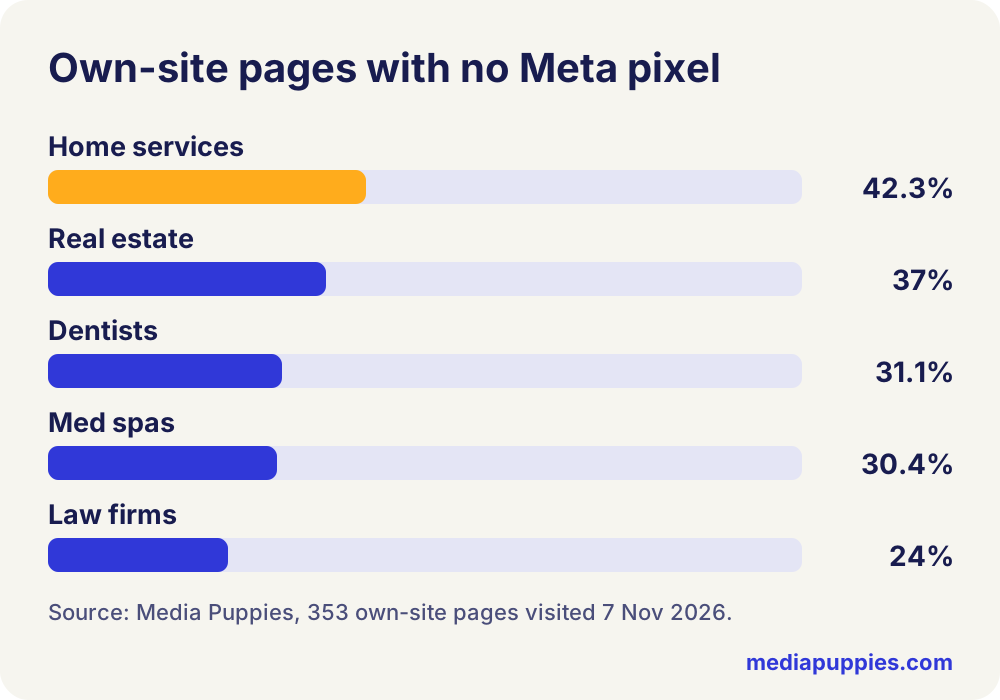
Home service firms were the most likely to have no pixel, at 42.3% of their own-site pages. The implant vendor's dentist pages all had one; without them, 42.4% of dentist pages had none. Law firms had the fewest gaps, and even there 24% had no pixel. GoHighLevel pages stood out the other way: 88.5% loaded the pixel.
Two limits matter here. 64 of the 112 pages loaded Google Tag Manager, which can hold a Meta tag that waits for a trigger or a cookie choice, so a few of them may have a pixel we could not see. And a business can send events to Meta from its server through the Conversions API, which no visitor can see. Another 32 pages had pixel code that did not send a page view during our visit, some of them behind a cookie banner. 18 own-site pages (5.1%) had neither a Meta pixel nor a Google tag.
Without the pixel or the Conversions API, a campaign cannot be set to optimise for leads on the website, so it is usually set to optimise for link clicks. Our guide to the Conversions API for lead businesses covers setting up both.
Can a phone visitor call from the first screen?
74.4% of pages had a tap-to-call link somewhere, but only 55.1% showed one on the first screen without scrolling. The first-screen share varied between trades more than almost anything else we measured: 78.9% for law firms against 35.3% for med spas.
| Industry | Tap-to-call anywhere | On the first screen | Stays on screen while scrolling | Call-tracking script | Chat widget |
|---|---|---|---|---|---|
| Law firms | 89.5% | 78.9% | 53.9% | 50% | 43.4% |
| Dentists | 91.5% | 72.3% | 61.7% | 27.7% | 17% |
| Med spas | 59% | 35.3% | 23% | 11.5% | 15.1% |
| Home services | 84.6% | 73.1% | 44.2% | 38.5% | 11.5% |
| Real estate | 67.3% | 38.8% | 26.5% | 14.3% | 8.2% |
| All | 74.4% | 55.1% | 38% | 25.9% | 19.8% |
Law firm pages put the phone first. 78.9% had a call link on the first screen, half loaded a call-tracking script, and 43.4% ran a chat widget, most often Ngage (13 pages) or Intaker (9). Med spas were at the other end, with a call link on the first screen of 35.3% of pages; 13.7% of their pages loaded an online booking widget instead.
Home services surprised us. Their pages had a call link on the first screen 73.1% of the time, yet only 38.5% loaded one of the call-tracking tools we checked for. Without call tracking it is hard to tell which calls came from the Facebook ad and which came from the van on the street.
Contact forms sit below the first screen
120 pages (33.1%) had a form asking for an email address or phone number. On the 107 of those where nothing covered the screen, only 17 (15.9%) put the form on the first screen; on the rest the visitor had to scroll to find it.
| Industry | Pages with a contact form | Forms checked for position | Form on the first screen | Median questions |
|---|---|---|---|---|
| Law firms | 53.9% | 36 | 13.9% | 5 |
| Dentists | 19.1% | 9 | 22.2% | 6 |
| Med spas | 21.6% | 25 | 20% | 4 |
| Home services | 44.2% | 21 | 14.3% | 6 |
| Real estate | 34.7% | 16 | 12.5% | 5 |
| All | 33.1% | 107 | 15.9% | 5 |
The median form asked 5 questions, and 42.5% asked 6 or more. 97.5% asked for an email address and 82.5% for a phone number; 65% had a message box. For a business that calls every lead back, the email field is one more box between the visitor and the call.
The share of pages that collect details is higher than 33.1%, because these counts leave out quiz pages that start with buttons and booking widgets loaded from other sites. Our rule for a first enquiry on a phone is name, phone and one question that sorts serious leads from the rest, with everything else left for the call.
How heavy the pages were
The median page transferred 2.5 MB during our phone-sized visit. HTTP Archive's 2025 Web Almanac puts the median mobile home page at 2.56 MB, so ad landing pages were about as heavy as the web in general. A quarter were over 4.1 MB, 17.1% were over 5 MB and 6.3% were over 10 MB. Images made up more than half the data on 47 of the 62 pages over 5 MB.
The median page made 93 requests, loaded 1.11 MB of JavaScript and contacted a median of 11 outside domains. HTTP Archive's median mobile home page makes 75 requests and loads 632 KB of JavaScript. Real estate pages were the heaviest at a 3.8 MB median, and law firm pages the lightest at 2 MB. We did not time the loads, because our visits came from India and the distance would distort them. In our view, anything much over 2 MB is worth trimming for paid traffic, because the visitor is on a phone and may be on mobile data.
Does the page repeat the ad's offer?
46 of the advertisers whose page loaded had ads promising something free, such as a consultation, an estimate or a case review. 38 of them (82.6%) mentioned a free offer on the page. Among law firms it was 21 of 25.
20 pages (5.5%) had an offer, sign-up or announcement pop-up covering the middle of the screen when we read the page, and 18 of them were med spas (12.9% of med spa pages). 43.8% of pages mentioned reviews, testimonials or star ratings, rising to 63.5% for home service firms.
Broken and blocked links
13 of the 420 advertisers' links (3.1%) were broken. They led to domains that no longer resolved, error pages, certificates browsers reject, a site set to private, or a parked domain showing a fake search page. Any of these ads still running are buying visits to a page that does not work.
Another 33 links (7.9%) returned a security check or an access-denied page. A US visitor on a phone may well get through, so we do not count these as broken. Still, it is worth opening your own ad on your own phone, from inside the Facebook app, to see what your visitors see.
What we would change after opening 513 ad links
- Put a tap-to-call button on the first screen. Just over half the pages already do. Make it stay on screen while the visitor scrolls.
- Check the pixel on the page your ads actually use. About a third of own-site pages loaded none. Open the page with Meta's test events tool and confirm a page view arrives.
- Match the page to the offer. If the ad sells one thing, send the click to a page about that thing, with the offer in the headline and few links out.
- Shorten the form and move it up. Ask for a phone number, put the form on the first screen or one tap away, and save the rest for the call.
- Track calls. If calls are your main lead, you need to know which came from the ad.
- Open your own ad once a month. Broken links, heavy pages and pop-ups covering the offer are easy to miss from a desktop.
For what the ads themselves look like, see our Facebook Ad Library study and our med spa ads study; for a quick page check, use our landing page checklist. If you run Meta ads in the US, UK, Canada or Australia, give us read access to the account. A senior buyer will write a free audit of where the spend goes, whether your tracking counts real results, and the three things we would fix first. It takes about two working days and the document is yours. Our Meta ads management runs month to month with a named buyer. More studies are on our research page.
How we did this
- Source
- Landing pages linked from live Meta ads shown in the US (Meta Ad Library)
- Country
- United States (ads shown)
- Collected
- 7 November 2026
- Sample
- 420 advertisers, 513 links, 363 pages analysed
- Ads
- 677 live ads shown in the US with a website link, collected 3 November 2026
- Pages analysed
- 363 of 420 advertisers (86.4%)
- Screen
- iPhone size, 390 x 844, iPhone Safari browser identity
The ads come from our two Meta Ad Library studies of 3 November 2026: one of law firms, dentists, real estate and home services, and one of med spas. We took every included ad whose destination was a website: 677 ads with 513 different links from 420 advertisers. Each advertiser counts once, on the link its ads used most, so a chain that ran dozens of links counts the same as a single practice. The ads were shown in the US; a few advertisers are based in Canada, Australia or elsewhere, and some are national brands.
On 7 November 2026 we opened each link once in Google Chrome running without a window on our own computer, set to an iPhone screen of 390 by 844 pixels with an iPhone Safari browser identity, a browser profile used only for this crawl, the cache switched off and no cookie banners accepted. We waited for the page to load and its network activity to stop, for up to 35 seconds, then moved the mouse, scrolled and pressed a key, because many sites hold scripts back until the visitor moves. We waited up to 8 more seconds, scrolled back to the top and read the page. 40 pages were still busy at the 35-second limit and were read as they stood. We never filled in or submitted a form and did not try to get past security checks. Real ad clicks open inside the Facebook or Instagram app's own browser, which we did not reproduce.
Page types: a separate landing page has three or fewer links to other pages on its own site, or sits on an offer subdomain or path (such as lp. or /offer) with ten or fewer; a home page is the root of a site with a fuller menu; everything else on the advertiser's site is another page on the main site; third-party sites are booking tools, directories, portals and link pages the advertiser does not own. The first screen means anything whose top edge sat within the first 844 pixels. A contact form asks for an email address or phone number plus at least one more question, or a phone number on its own; search boxes, property searches, logins and one-box email sign-ups do not count, hidden spam-trap boxes and consent tick boxes are dropped, and a run of radio buttons or tick boxes counts as one question. Fields built without a form tag, quiz pages that start with buttons, and booking or form widgets loaded from another site are not counted as contact forms. Tap-to-call means a visible tel: link.
The Meta pixel counts as loaded if its code was in the page, its fbq function existed or the browser called facebook.com/tr. A pixel held in Google Tag Manager behind a trigger or a consent choice would not show, and tracking that runs only on a server (the Conversions API without the pixel) cannot be seen from outside. Page weight is the data transferred while we were on the page. Platforms are the first match in a fixed list of builders and systems, with site builders checked before funnel tools. Call tracking means a script from a fixed list of call-tracking tools, including Google's own. The free-offer and review checks read the first 6,000 characters of page text. Every element that covered the middle of the screen was read and sorted by hand.
We visited from India, so we do not report load times, and location may change both what a site lets in and how its cookie banner behaves. 33 visits met a security check or an access-denied page that a US visitor might not see. Those 33, the 13 broken links and 11 links that did not load or showed a blank screen for us are left out, so the page figures cover 363 pages. The ads were collected four days before the visits, so a few may have ended. The advertisers are the ones Meta returned for our searches, which cover part of each trade. The CSV has one row per advertiser in a neutral order, with no names or links, and page fields left blank where the page did not load.
Download the data (CSV). Free to reuse with a link to this page.
Questions about ad landing pages
Should Facebook ads go to a home page or a landing page?
Of the 363 pages in our study that loaded, 39.1% were the advertiser's home page and 25.6% a separate landing page. The separate pages were lighter (2.1 MB median against 2.8 MB), had a median of 1 link to other pages on the site against 35, and were missing the Meta pixel far less often (12.9% against 47.2%). If the ad sells one offer, we send it to a page about that offer.
How many fields should a landing page form have?
The median contact form in our study asked 5 questions, and 42.5% asked 6 or more. For a first enquiry from a phone we keep it to name, phone and one qualifying question, and ask the rest on the call.
How heavy is a typical ad landing page?
The median page in our study transferred 2.5 MB on a phone, close to the 2.56 MB median for mobile home pages that HTTP Archive reported for 2025. 17.1% of pages were over 5 MB and 6.3% were over 10 MB, mostly because of large images.
Do I need the Meta pixel on my landing page?
If you want Meta to find people who book or fill in a form on your site, it has to see those actions through the pixel, the Conversions API or both. 31.7% of the own-site pages we checked loaded no pixel during our visit, and another 32 had pixel code that did not send a page view.
How did you check the landing pages?
We opened each ad link once on 7 November 2026 in Chrome set to an iPhone screen, waited for the page to settle, scrolled once and read the page. We never submitted a form. Pages that met a security check or failed to load are left out, leaving 363 pages from 420 advertisers.
Can I use this data?
Yes. Download the CSV from this page and reuse it with a link back to the study. It has one row per advertiser and no names or links.