

Key findings
- Of 43 US, UK and Australian PPC agency home pages we requested on 22 November 2026, 41 loaded and 2 refused our client. Google Tag Manager was in the raw HTML of 29 of 41 (70.7%) and a Google tag of some kind on 39 (95.1%).
- A Google Ads AW- tag was visible in the HTML on only 9 of 41 (22.0%), a Meta pixel on 10 (24.4%), LinkedIn Insight on 4 (9.8%) and Microsoft UET on 1 (2.4%). Tag Manager can load more after the page opens, so these are floors.
- The median home page shipped 236.7 KB of HTML and 41 script tags, before any image, stylesheet or script file. 8 of 41 (19.5%) passed 500 KB of HTML, and the largest was 51.5 times the smallest. WordPress sites (26 of 41) had a median of 370.4 KB against 140.3 KB for the rest.
- The main button asked for a contact or quote on 17 of 41 (41.5%), a booked call on 12 (29.3%), an audit, review or proposal on 11 (26.8%) and a phone call on 1. Only 1 of the 12 "book a call" sites loaded a scheduling tool in the page.
- A phone number was visible on 35 of 41 (85.4%), yet call tracking code appeared on only 4 of those 35 (11.4%). Chat widgets were rare at 5 of 41 (12.2%).
- A cookie consent tool was in the HTML on 9 of 41 (22.0%), and a tool or Google consent mode default on 18 (43.9%). UK sites led with 10 of 13. 11 of 14 Australian sites showed neither.
Raw home page HTML of PPC agency websites, fetched with curl and measured with a stdlib Python script · The 43 agencies in our 19 November 2026 sample of PPC agency pricing and terms pages (14 US, 14 UK, 15 AU), found through 33 web searches. 41 home pages loaded; 2 refused our client and are recorded as blocked. · 22 November 2026 · How we did this · Download the data (CSV)
PPC agencies sell tracking, landing pages and lead capture. Their own home pages are the one piece of that work any buyer can inspect for free, so we inspected them. On 22 November 2026 we requested the home pages of 43 PPC agency websites in the US, UK and Australia, the same agencies we used for our study of Google Ads management fees, and measured what the raw HTML shows.
The short answer: almost every PPC agency website loads Google Tag Manager, and far fewer show the ad tags they would set up for a client. 29 of the 41 pages that loaded (70.7%) had Tag Manager in the HTML. A Google Ads tag was visible on 9 (22.0%) and a Meta pixel on 10 (24.4%). The median page shipped 236.7 KB of HTML and 41 script tags. 12 sites led with "book a call", and only 1 of them loaded a scheduling tool.
We expected agency sites to be tag heavy, and many are. The surprise was the gap between the lead ask and the plumbing behind it: phone numbers everywhere, call tracking almost nowhere, and "book a call" buttons that lead to a form. We name no agency below. The full dataset, with one row per site, is linked at the end.
What PPC agency websites load: the tags in the HTML
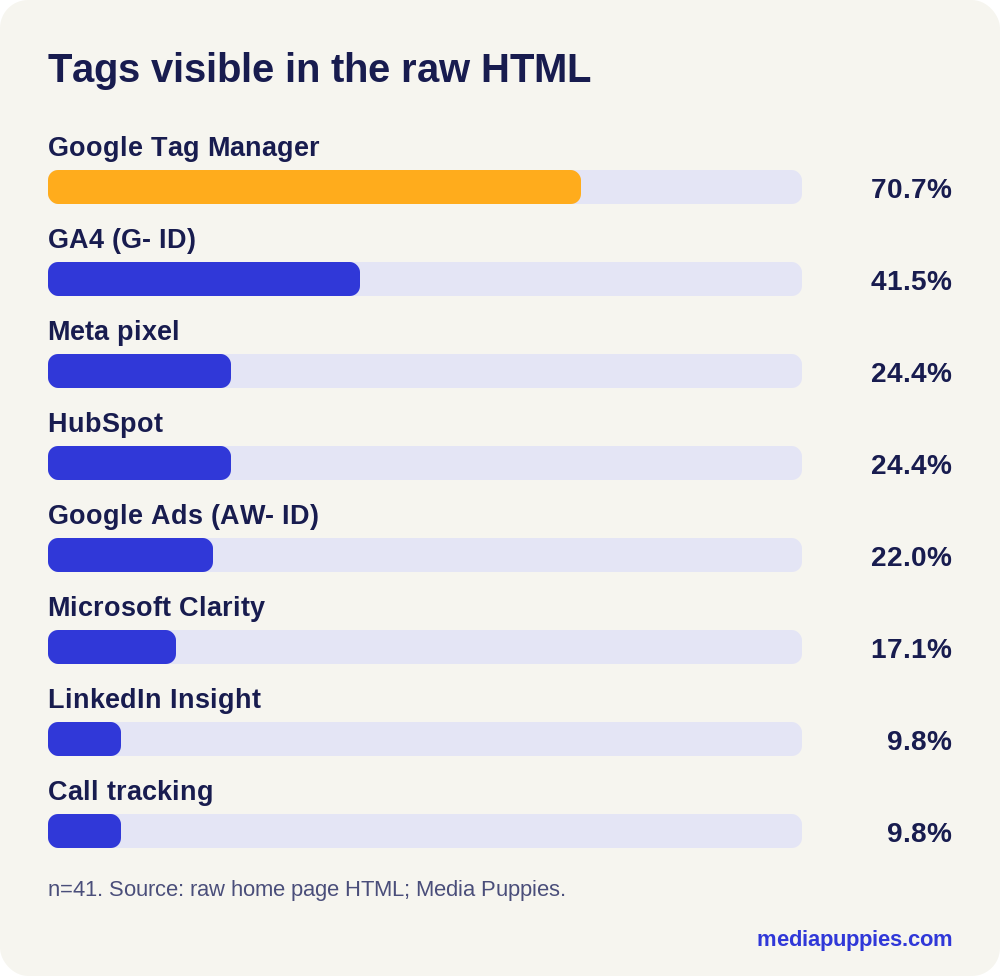
We searched each page's HTML for ten kinds of tag. Google Tag Manager led at 29 of 41 (70.7%). 39 of 41 (95.1%) carried a Google tag of some kind, Tag Manager or a GA4 gtag. The two that showed neither may load their tags from a script bundle, which raw HTML does not reveal.
| Tag in the raw HTML | Sites | Share of 41 |
|---|---|---|
| Google Tag Manager | 29 | 70.7% |
| GA4 gtag (G- ID) | 17 | 41.5% |
| Meta pixel | 10 | 24.4% |
| HubSpot scripts | 10 | 24.4% |
| Google Ads tag (AW- ID) | 9 | 22.0% |
| Microsoft Clarity | 7 | 17.1% |
| LinkedIn Insight | 4 | 9.8% |
| Call tracking (CallRail, WhatConverts and similar) | 4 | 9.8% |
| Hotjar | 2 | 4.9% |
| Microsoft UET | 1 | 2.4% |
Read the low numbers with care. An agency that runs everything through Tag Manager will show only the container in its HTML, and its Google Ads and Meta tags fire later. So 9 of 41 is a floor for the Google Ads tag. What the raw HTML does tell you is that 5 of 41 sites (12.2%) had neither a Google Ads tag nor Tag Manager, so on those pages a Google Ads conversion tag could only come from a script bundle or from GA4.
The country split was sharper than we expected. Australian sites carried Tag Manager on 13 of 14 and a Meta pixel on 8 of 14. No UK site in the sample showed a Meta pixel in its HTML. Microsoft UET appeared once in 41 pages. 20 of the agencies whose page loaded list Microsoft Ads on their services page, and none of those 20 showed the UET tag in their home page HTML.
How heavy are PPC agency home pages?
The PageSpeed Insights API refused keyless requests on the day, so we have no lab speed scores. We measured what the HTML itself costs instead. That is the document alone, before any image, stylesheet, font or script file downloads.
| Measure (n=41) | Median | Middle half | Range |
|---|---|---|---|
| HTML size | 236.7 KB | 138.8 to 488.6 KB | 21.6 to 1,111.9 KB |
| Script tags | 41 | 21 to 51.5 | 3 to 94 |
| External script files | 15 | 4 to 25 | 0 to 51 |
| Third-party script hosts | 1 | 0 to 3.5 | 0 to 10 |
8 of 41 home pages (19.5%) passed 500 KB of HTML and 11 (26.8%) carried more than 50 script tags. The heaviest page was 51.5 times the lightest. Only 4 (9.8%) came in under 100 KB.
The platform explains a lot of it. 26 of 41 sites (63.4%) run on WordPress, and their median HTML was 370.4 KB. The other 15 had a median of 140.3 KB. Page builders and optimisation plugins inline CSS, fonts and delayed scripts into the HTML, which is why many WordPress pages list few third-party hosts while still shipping a lot of markup.
| Platform hint in the HTML | Sites | Share of 41 |
|---|---|---|
| WordPress | 26 | 63.4% |
| Not identified | 7 | 17.1% |
| Next.js | 3 | 7.3% |
| Lovable or Vite build | 3 | 7.3% |
| HubSpot CMS | 2 | 4.9% |
In our view, page weight on an agency home page is a useful signal. An agency that sends paid clicks to landing pages should know what its own page costs a visitor on a phone. Our landing page checklist covers the speed checks we run on client pages.
How PPC agency websites ask for the lead
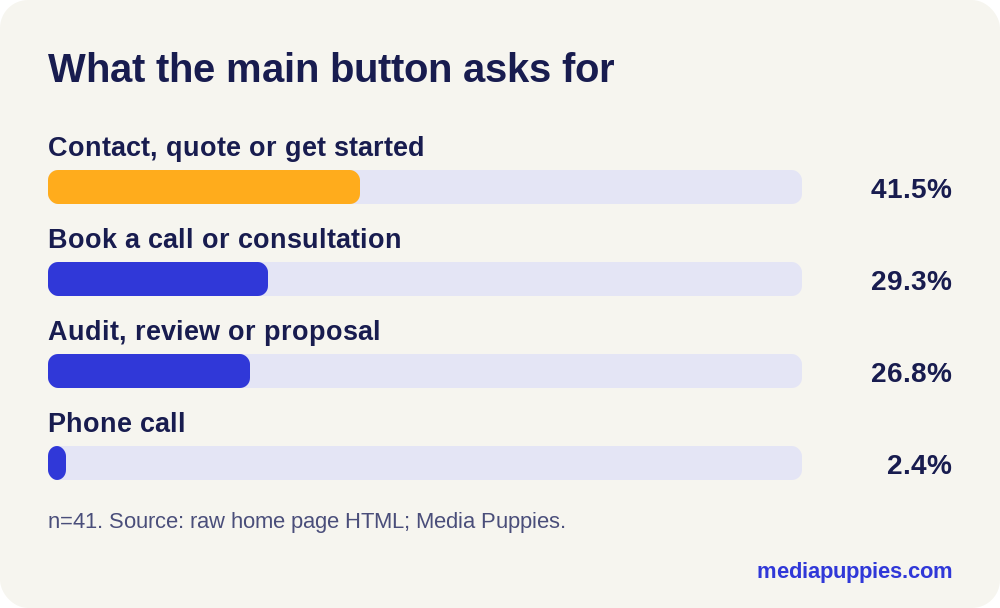
We coded the main button on each page by hand: the first call to action after the headline, or the header button when the hero has none.
| Main button asks for | Sites | Share of 41 |
|---|---|---|
| Contact, quote or get started | 17 | 41.5% |
| Book a call or consultation | 12 | 29.3% |
| Audit, review or proposal | 11 | 26.8% |
| Phone call | 1 | 2.4% |
The "book a call" group is where the plumbing gap shows. Of the 12 sites whose main button promised a call, 1 loaded a scheduling tool such as Calendly or HubSpot meetings in the page. Across all 41, only 2 (4.9%) did. The rest send the visitor to a form and a wait, which is a slower path than the button suggests. A scheduler may still sit on the contact page, which we did not fetch.
Free offers were common. 23 of 41 pages (56.1%) offered a free audit, review, proposal or plan somewhere in the text, and 10 (24.4%) a free consultation or strategy call. 27 (65.9%) offered at least one of the two. 25 pages (61.0%) had a form in the HTML itself.
Phones, call tracking and chat
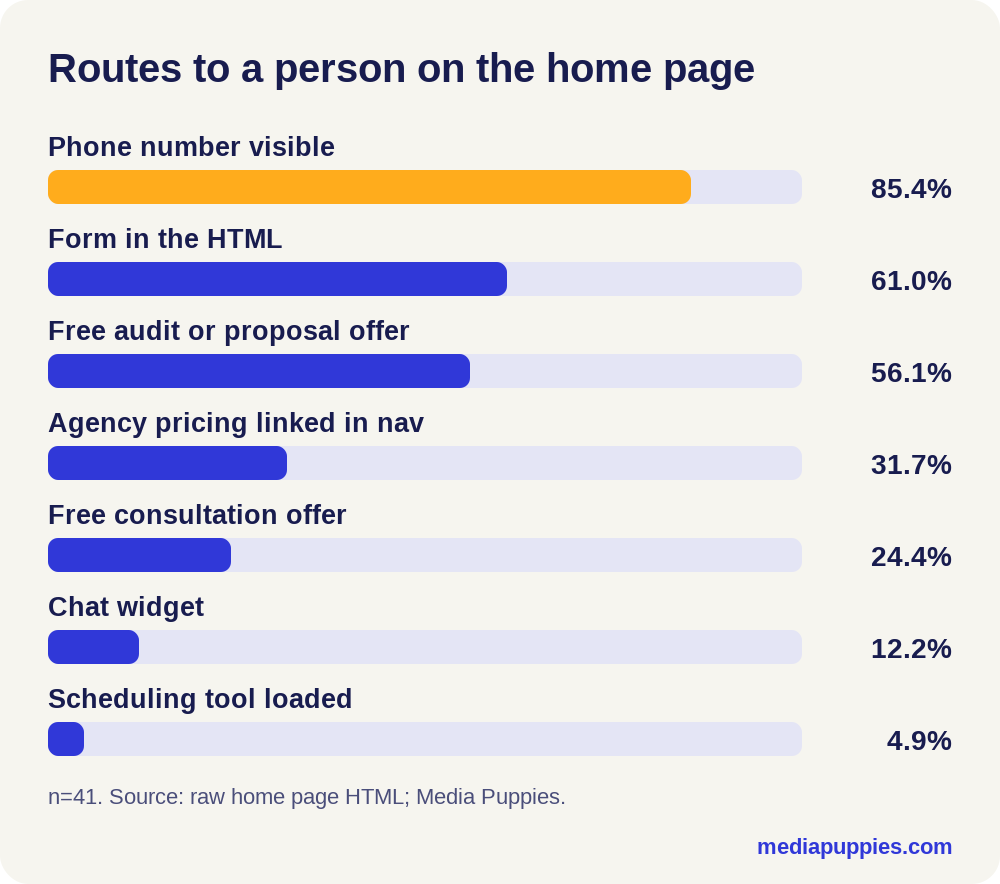
A phone number was visible on 35 of 41 pages (85.4%). Every Australian site in the sample showed one (14 of 14), as did 12 of 13 UK sites. US sites were the exception at 9 of 14. Call tracking code showed on only 4 of the 35 sites with a visible number (11.4%). Some agencies swap numbers through Tag Manager, so this is a floor too. Still, for firms that sell call tracking to clients, it is a low one.
Chat widgets were rare: 5 of 41 (12.2%), split across four tools. Contact routes added up to a median of 2 of the 4 we counted (form, scheduler, phone, chat). 23 sites (56.1%) offered both a form and a phone number.
Pricing links, consent and the SEO basics
20 of 41 pages (48.8%) linked a pricing, packages or plans page from the header or navigation. 7 of those links pointed to another product, such as hosting, SEO packages or web design costs. That leaves 13 (31.7%) linking agency or PPC fees from the navigation. All 43 agencies were chosen because they publish fees or terms somewhere, and of the 28 fee publishers whose home page loaded, 12 (42.9%) linked that pricing from the navigation.
Consent was the weakest area. A cookie consent tool was in the HTML on 9 of 41 (22.0%), and Google consent mode defaults on 12 (29.3%). Counting either, 18 sites (43.9%) showed some consent setup before any script ran.
| Country | Pages loaded | Median HTML | Consent tool or consent mode in HTML | Neither visible |
|---|---|---|---|---|
| US | 14 | 230.3 KB | 5 | 9 |
| UK | 13 | 240.8 KB | 10 | 3 |
| Australia | 14 | 292.5 KB | 3 | 11 |
UK sites, where cookie consent rules are strictest in this sample, led with 10 of 13. 3 UK pages ran tracking with no consent tool or consent mode in the HTML. A banner can load through Tag Manager, so some of these may still ask. In our view, an agency that cannot show consent before its own tags fire will struggle to explain consent mode and lost conversions to a UK client.
The SEO basics were in good shape. Every page that loaded had a title and a meta description.
| SEO basic | Sites | Share of 41 |
|---|---|---|
| Meta description present | 41 | 100% |
| JSON-LD structured data present | 39 | 95.1% |
| Exactly one H1 | 36 | 87.8% |
| Organization schema | 34 | 82.9% |
| LocalBusiness schema | 12 | 29.3% |
| Review or AggregateRating schema | 12 | 29.3% |
| FAQPage schema | 7 | 17.1% |
5 pages (12.2%) had no H1 or more than one. 25 pages (61.0%) carried a SearchAction block, the kind SEO plugins add by default, which fits the near universal Organization and WebSite types.
What we would check on any PPC agency website (our view)
A home page tells you a little about how an agency works. These are the checks we would run before a first call, and each one takes a minute in a browser:
- Open the page source and search for "AW-" and "GTM-". If neither appears, ask how they track their own leads. If only GTM appears, that is normal; ask what it loads.
- Click the "book a call" button. A calendar means you can pick a time now. A form means someone will get back to you. Both are fine, as long as the button tells you which.
- Call the number on the page. See who answers and how fast. Then ask whether the number is tracked.
- Look for consent before tags. In the UK and EU, a site that drops tags before you choose is a site that may set up your account the same way.
- Find the pricing in two clicks or ask for it on the call. Our guide to what PPC management includes lists what the fee should cover.
None of these checks decide the hire. Case studies, references and a free ad account audit of your own account tell you more. For the full process, see how to choose a Google Ads agency, and if you want to know how we run accounts, our Google Ads agency page sets it out.
If you are choosing a white label partner instead of an agency, we ran the same tag and page weight checks on 25 provider sites, plus proof, sample reports and NDAs, in our white label PPC provider websites audit.
How we did this
- Source
- Raw home page HTML of PPC agency websites, fetched with curl and measured with a stdlib Python script
- Country
- PPC and Google Ads agencies based in the United States, United Kingdom and Australia
- Collected
- 22 November 2026
- Sample
- The 43 agencies in our 19 November 2026 sample of PPC agency pricing and terms pages (14 US, 14 UK, 15 AU), found through 33 web searches. 41 home pages loaded; 2 refused our client and are recorded as blocked.
- Fields
- HTML size, script tags, third-party script hosts, 10 tag types, chat, consent tool and consent mode, forms, scheduler, free offers, phone, main button, pricing link, meta description, H1 count, JSON-LD types, CMS
- Hand-coded
- Main button type (hero button, else header button) and what any header pricing link points to
On 22 November 2026 we requested each agency's home page once with curl, a desktop browser User-Agent and a one second pause between requests, and saved the HTML exactly as served. Two sites gave an empty reply on both HTTP/2 and HTTP/1.1. We recorded them as blocked and did not try anything else.
Everything is measured from the raw HTML before any JavaScript runs. Tags that Google Tag Manager or a script bundle loads later do not show up, so the tag and consent counts are floors. HTML size is the document alone; images, stylesheets, fonts and script files are extra.
We tried the keyless PageSpeed Insights API for lab speed scores. It returned a daily quota error on the first request, so this study has no speed scores. Page weight and script counts stand in as the speed signals.
The main button was coded by hand: the first call to action after the H1, or the header button when the hero has none. A pricing link in the header was checked by hand and split into agency fees and other products such as hosting or SEO packages.
Limits. One page per agency, one fetch from one location on one day. The sample comes from agencies that publish fees or terms, which leans toward small and mid-sized firms. We name no agency in this article; the dataset has one row per site.
Download the data (CSV). Free to reuse under CC BY 4.0 with a link to this page.
Questions about PPC agency websites
Do PPC agency websites use Google Tag Manager?
Most do. In our sample of 41 US, UK and Australian PPC agency home pages from 22 November 2026, 29 (70.7%) had Google Tag Manager in the raw HTML and 39 (95.1%) had a Google tag of some kind.
How many PPC agencies show a Google Ads tag on their own site?
In the raw HTML, 9 of 41 (22.0%) showed a Google Ads AW- tag. Tag Manager can load the tag after the page opens, so the real share is higher. 5 sites had neither a Google Ads tag nor Tag Manager in the HTML.
How heavy is a typical PPC agency home page?
The median page in our sample shipped 236.7 KB of HTML and 41 script tags, before images, stylesheets and script files. 8 of 41 passed 500 KB of HTML. WordPress sites had a median of 370.4 KB against 140.3 KB for the rest.
How do PPC agency websites ask for leads?
The main button asked for a contact or quote on 17 of 41 sites, a booked call on 12 and an audit, review or proposal on 11. Only 1 of the 12 booked-call sites loaded a scheduling tool on the home page, and 35 of 41 showed a phone number.
What should I check on an agency's website before hiring?
In our view: search the page source for AW- and GTM-, click the book a call button to see where it goes, call the number, check whether consent comes before tags, and look for pricing. None of these replace case studies or an audit of your own account.