

Key findings
- On Semrush's US estimates of 3 November 2026, "dental implants near me" cost $17.88 a click, 2.15 times "dentist near me" ($8.30). "Same day dental implants" cost $19.34, 2.33 times.
- Implant and denture searches had a median of $10.26 a click, 1.5 times general and emergency dental searches. Price research is cheaper: "dental implants cost" was $6.14.
- Of 353 live US implant ads in the Meta Ad Library on 17 November 2026, 22.4% stated a price. Across 15 US practices that named a per-arch price, the median lowest price was $13,995.
- One advertiser ran 75 of the 353 ads (21.2%), while 71.0% of the 169 advertisers ran a single ad.
- 59 advertisers (34.9%) shared blocks of ad copy with at least two other practices, and 42 sent clicks to subdomains of one shared landing-page domain.
Meta Ad Library (via Apify), Semrush Keyword Overview (US), Google results pages · 353 active US dental implant ads from 169 advertisers (397 returned); 6 implant and 5 other dental keywords priced in Semrush · 3 and 17 November 2026 · How we did this · Download the data (CSV)
Most dental PPC advice treats every patient search alike. Implant searches do not behave like the rest, so we looked at PPC for dentists through implants only. We took Google click prices from our dental marketing study and pulled every active US implant ad we could reach in the Meta Ad Library on 17 November 2026: 353 ads from 169 advertisers.
The short answer. A "dental implants near me" click cost $17.88 on Semrush's US estimates, 2.15 times a "dentist near me" click, and "same day dental implants" cost 2.33 times. The implant group as a whole ran 1.5 times general dental searches, so "twice the price" holds for the high-intent searches only. On Facebook and Instagram, most implant ads sold a same-day result, a free consultation or a low monthly payment; only 22.4% named a price, and a third of the advertisers shared copy with other practices.
PPC for dentists: what an implant click costs
Semrush priced 37 of the 40 dental patient keywords in our earlier study. The median was $6.39, and dental ranked 8th of 11 industries we have priced. Implants are the exception. The 8 implant and denture keywords had a median of $10.26, the highest of the five groups, against $6.86 for general and emergency searches. Five of the 6 most expensive dental keywords were implant searches.
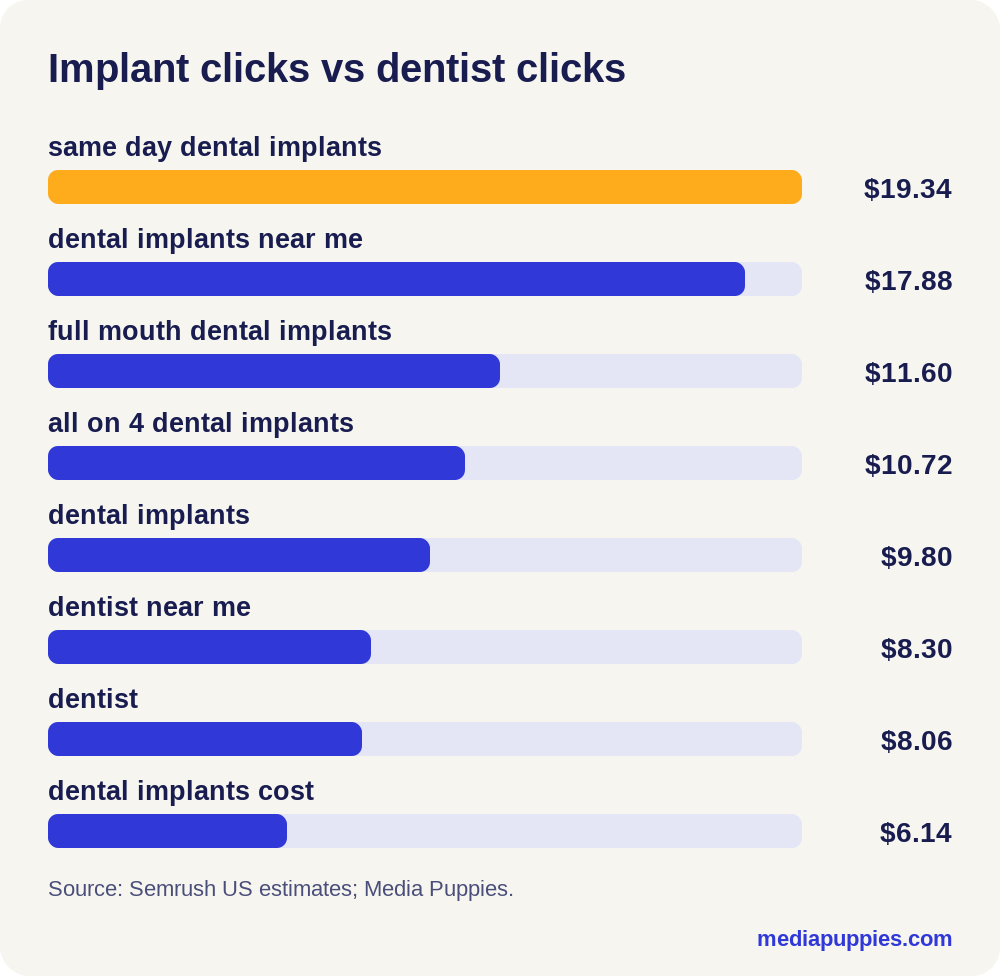
Inside the implant group the spread is wide. "Same day dental implants" was the top keyword at $19.34, though it has only 8,100 US searches a month. "Dental implants near me" cost $17.88 with 135,000 searches, $8.08 or 82% more than plain "dental implants" ($9.80, 450,000 searches). For a general dentist, adding "near me" moved the price by $0.24. People pricing the treatment were cheap to reach: "dental implants cost" was $6.14, 0.63 times the main keyword.
We expected implants to cost about twice a dentist click across the board. They did not. "All on 4 dental implants" ($10.72) and "full mouth dental implants" ($11.60) were 1.29 and 1.4 times "dentist near me". The doubling is a near-me and same-day effect. Our view: if your budget is small, those two searches eat it fastest, so price them on their own before you bid on them.
Google also answers a lot of these searches on the page. On 3 November, 5 of the 6 implant searches we checked showed an AI Overview. The two biggest searches did not: "dental implants" and "dentist near me".
What 353 implant ads on Facebook and Instagram offer
Search ads hide their copy behind an auction. Meta's Ad Library shows it. This sample is the implant end of the dental market: in our 3 November sample of 192 dental ads, 69.3% already named implants or dentures.
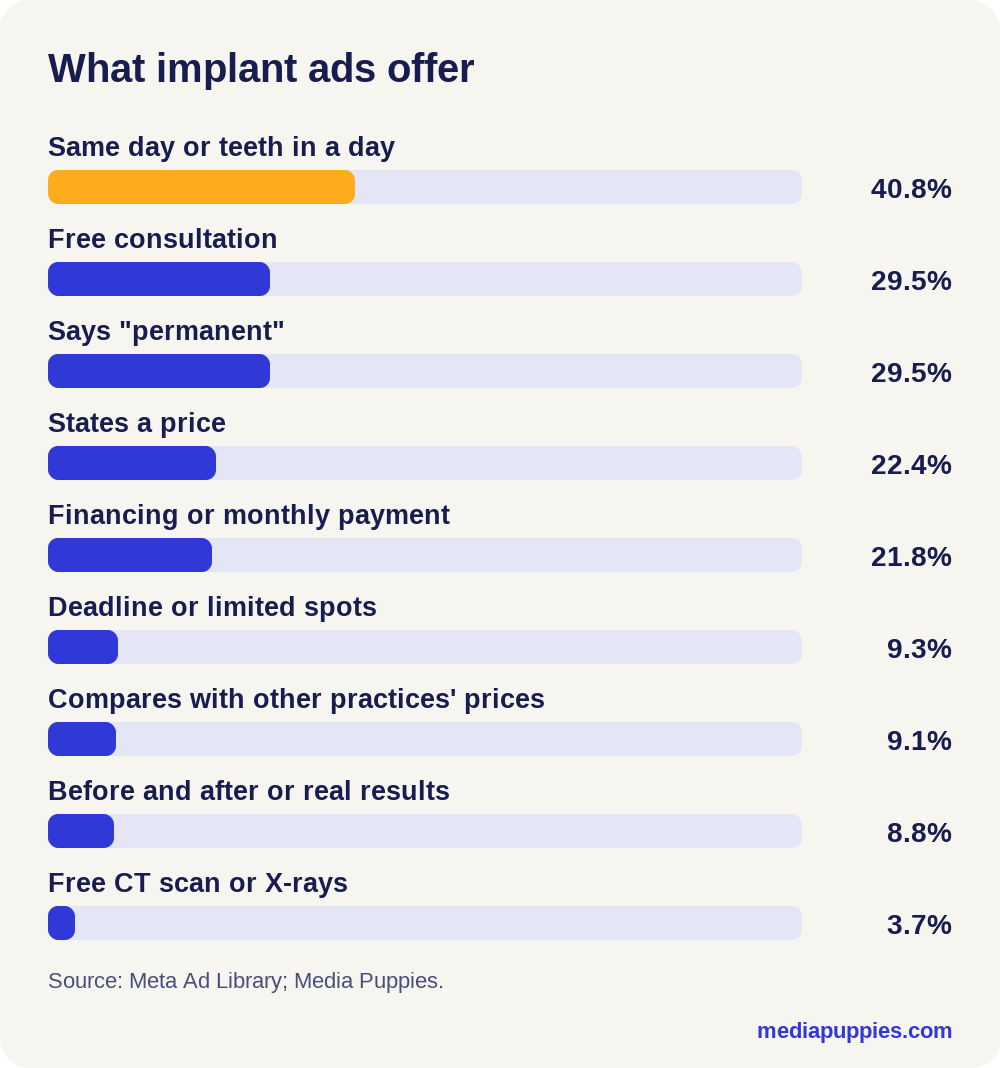
The most common promise was speed. 40.8% of ads said same day, teeth in a day or something close to it, and 29.5% used the word "permanent". One advertiser drives a lot of that: without its ads, the same-day share among US practices falls to 29.2%. These are claims the ads make. We did not check them, and a practice running them should check them against its state dental board's advertising rules.
The second hook was a low first step. 29.5% offered a free consultation, 21.8% mentioned financing or a monthly payment, and only 3.7% offered a free CT scan or X-rays. Urgency was rarer than we expected: 9.3% gave a deadline or a limited number of spots. Only 8.8% mentioned before and after photos or real results in the text, though many videos may show them.
The prices implant ads actually state
Here is what surprised us most. Implants are a five-figure purchase and patients search for the price, yet 77.6% of ads gave none. 32 US practices, 19.6% of them, stated at least one price. Where they did, it looked like this.
| Price stated in the ad | US advertisers | Lowest | Median | Highest |
|---|---|---|---|---|
| Per arch (All-on-4 or full arch) | 15 | $8,995 | $13,995 | $18,995 |
| Full mouth (both arches) | 2 | $29,999 | n/a | $35,000 |
| Single implant | 7 | $500 | $999 | $2,900 |
| Monthly payment | 14 | $117 | $249 | $348 |
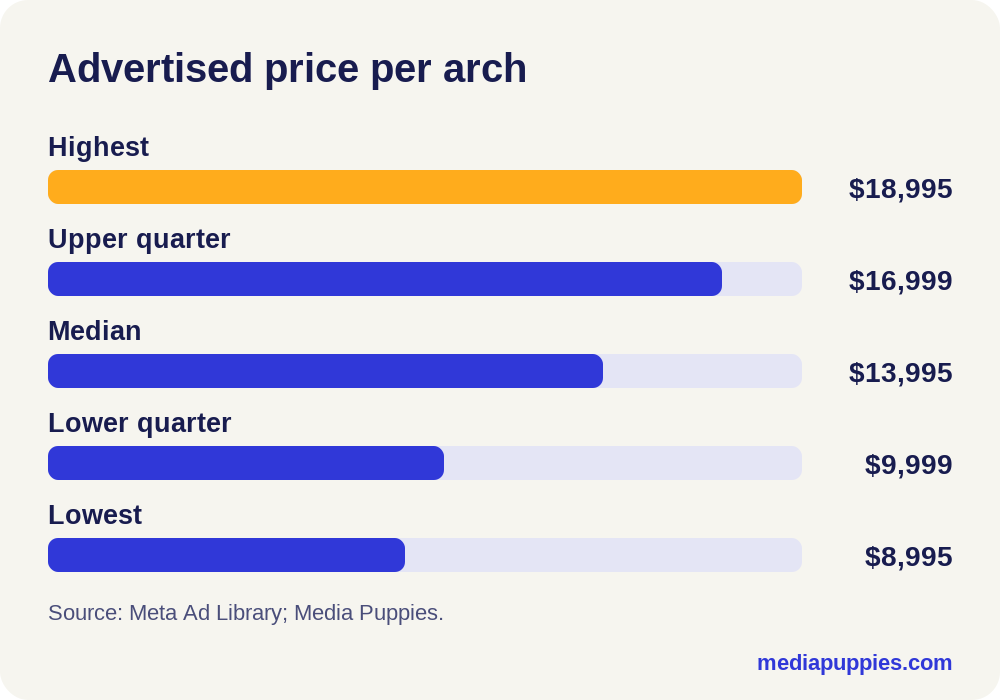
These are "starting at" prices, and many come with an asterisk for credit approval or extra work. Single-implant prices are the least comparable: some include the crown and some say "implant only". 28 ads from 10 advertisers cited $50,000 as what other practices charge for a full arch or both arches, as an anchor for their own price.
Seen through PPC, the numbers explain the click prices. At the median advertised arch price of $13,995, one case equals the cost of about 783 "dental implants near me" clicks, or 1,686 "dentist near me" clicks. A single implant at the median $999 equals about 56 near-me clicks. Advertisers can afford implant clicks because the case is worth so much more than a checkup.
Who runs implant ads: one big buyer and many templates
One advertiser, Nuvia Dental Implant Center, ran 75 of the 353 ads, 21.2% of the sample. All but one of its ads were video, and 71 used a Learn more button. The second biggest, Bionic Smile, ran 22. At the other end, 71.0% of the 169 advertisers ran exactly one ad, and 9 advertisers with 5 or more ads accounted for 38.2% of the sample.
The single-ad practices are less independent than they look. When we compared ad text, 59 advertisers (34.9%) shared long blocks of copy with at least two other practices. The largest group was 34 practices running the same "full mouth dental implants at a price you can afford" script, and 42 advertisers sent clicks to subdomains of one shared landing-page domain. That pattern points to agencies or vendors selling one implant funnel to many practices. Our view: a template is fine as a start, but when 34 practices run the same words, patients in overlapping markets can see the same offer from several clinics.
Outside the biggest advertiser, the ads look different. Video drops to 45.7%, Get quote becomes the top button at 27.7%, and instant forms take 19.9% of ads. Across all 353 ads, 72.2% sent people to a website or landing page, 16.4% used a Meta instant form and 6.8% had no link at all. Eleven ads came from 7 clinics abroad, in Mexico, Turkey and Vietnam, selling dental travel to US viewers.
Implant ads also ran a long time. The median ad had been live 182 days, 27.5% had run a year or more, and the oldest began in July 2021. Days live is not performance: an ad can run for a year and lose money.
What we would change in an implant PPC account
- Split implant searches from the rest. Our view is that implant keywords need their own campaign and budget. At 2.15 times a dentist click, a near-me implant search will take the whole budget if it shares one with checkups.
- Bid on price research on purpose. "Dental implants cost" is $6.14 a click and Google often answers it on the page. If your landing page states a price, it is cheap traffic; if it hides the price, we would cut it.
- Say a price if you can. In our view, with 77.6% of implant ads silent on price, a clear starting price per arch or a monthly figure is one of the few ways left to stand out. Keep it accurate and give the conditions.
- Rewrite the template. If your ads came from a vendor script, check the Ad Library for the same words in your area and change them.
- Judge on consults booked and cases started. Clicks and form fills are easy to count and can mislead. Track each lead to a consultation and a signed treatment plan.
For the full Google setup, read our guide to PPC for dentists, and for Meta, see what our studies found on Facebook ads for dentists. We run Google Ads and PPC management for practices in the US, UK, Canada and Australia. Give us read access and a senior buyer will write a free audit of where your implant budget goes and the three things we would fix first. More studies are on our research page.
How we did this
- Source
- Meta Ad Library (via Apify), Semrush Keyword Overview (US), Google results pages
- Country
- United States
- Collected
- 3 and 17 November 2026
- Sample
- 353 active US dental implant ads from 169 advertisers (397 returned); 6 implant and 5 other dental keywords priced in Semrush
- Sources
- New Meta Ad Library collection, dental marketing study, AI Overviews on high-CPC searches study
The ads come from the Meta Ad Library, collected on 17 November 2026 with the Apify actor automation-lab/facebook-ads-library (run Juyqu1SHnU2ASW9e7). We searched active ads shown in the US, exact phrase, sorted by impressions, up to 150 ads per search. We asked for five searches; the run hit its cost cap after 397 ads, which covered "dental implants", "all on 4" and part of "full mouth dental implants". "Same day implants" and "implant dentist" were not collected.
We kept 353 ads from 169 advertisers. We dropped publisher, referral and clinical-trial pages, ads that named no implant treatment, and ads in languages other than English or Spanish. Eleven ads from 7 clinics abroad that advertise to US viewers stay in the sample but are left out of the price figures. Offers and claims were found with keyword rules on the ad text, so anything said only in an image or video is missed. Prices are the lowest stated by each advertiser in each category; discounts, "value" figures, consultation fees and competitor price comparisons were not counted as prices.
Google click prices come from our dental marketing study: Semrush Keyword Overview, US database, USD, 3 November 2026. They are keyword-tool estimates of a national average; your own auction price will differ. AI Overview checks come from our study of high-CPC US searches on the same day (desktop, no city set). The ratios and clicks-per-price figures are our arithmetic, shown in compile.py.
Limits. This is one day of one ad platform. The Ad Library ranks results by impressions, so big advertisers show up more. Days live is not performance: an ad can run for a year and lose money. None of this comes from our own clients or ad accounts.
Download the data (CSV). Free to reuse with a link to this page.
Questions about implant PPC for dentists
Does PPC for dentists cost more for implants?
Yes, for the high-intent searches. On Semrush's US estimates of 3 November 2026, "dental implants near me" cost $17.88 a click, 2.15 times "dentist near me" at $8.30. Implant and denture searches as a group had a median of $10.26, 1.5 times general dental searches.
What price do dental implant ads show?
Most show none: 22.4% of the 353 US implant ads we read stated a price. Among 15 US practices that stated a per-arch price, the lowest was $8,995, the median $13,995 and the highest $18,995. These are advertised starting prices, not what patients pay.
Should implant ads use Meta instant forms or a landing page?
Most implant advertisers use a landing page: 72.2% of the ads we read linked to a website, and 16.4% used an instant form. In our view, judge either by consultations booked and cases started, since form fills alone can mislead.
Are same-day implant claims common in ads?
Yes. 40.8% of the ads we read said same day, teeth in a day or similar, and 29.5% used the word permanent. We report what ads claim and did not check the claims; practices should check their own against their dental board's advertising rules.
Is this data from your own clients?
No. Click prices are Semrush estimates and the ads are public Meta Ad Library records collected on 17 November 2026. None of it comes from our clients or ad accounts.