

Hospital marketing in India is the work of helping patients find a hospital's services when they need them: search ads and maps listings for emergencies and diagnostics, clear department and doctor information online, educational content, and a call centre that turns enquiries into appointments. Since the National Medical Commission's ethical advertising guidelines of 6 October 2026, it also means doing all of that with factual, verifiable information instead of testimonials, offers and claims.
The short version: hospital marketing still works, and search is its strongest channel. People type "MRI scan near me", "paediatrician in Kothrud" or "24 hour emergency hospital" when they have a need. A hospital that shows up with accurate services, location, timings and a phone that is answered quickly wins those patients. The rest of this guide sets out how, and what to avoid. For the rules themselves, read our summary of the NMC advertising guidelines.
What hospital marketing means after the NMC guidelines
Hospitals and medical institutions may advertise objective, verifiable facts: name, location, contact details, departments, diagnostic and emergency services, facilities, accreditation and applicable fees. They may not solicit patients, make comparative superiority claims, guarantee cures, or portray individual doctors promotionally. A doctor directory with qualifications, specialties, registration details and availability counts as patient information.
That shifts hospital marketing from persuasion to findability and service. The hospitals that do well are the ones that are easiest to find, easiest to understand and easiest to reach.
| Old approach | Approach that fits the guidelines |
|---|---|
| Patient testimonial videos | Clear department pages and process explanations |
| "Best hospital in the city" | Accreditation, facilities and services stated factually |
| Free health check camps as lead magnets | Diagnostics and health check information with fees shown |
| Star doctor portraits in ads | Department ads; doctor directory on the website |
| Agency paid per patient | Fixed fee, measured on appointments |
Where patients look for hospitals
Patients usually find a hospital in a few predictable places:
- Google search and Maps, for emergencies, diagnostics and "near me" searches.
- The hospital's own website, to check departments, doctors, timings and fees.
- Listing and appointment platforms, which must now avoid paid rankings of doctors.
- WhatsApp, to ask a question or book without a call.
- Referrals from family, general practitioners and employers.
Paid advertising mostly supports the first three. It cannot replace good referrals and reputation, but it decides whether a patient who is searching right now finds you or the hospital down the road.
Google Business Profile for every location and department
For many patients, the Google Business Profile is the first thing they see. It drives calls and directions from Maps without any ad spend.
- One profile per location, with the correct category, address, phone number and opening hours, including emergency hours.
- Department profiles where Google's guidelines allow them, for departments with their own entrance or phone number.
- Accurate services lists and photos of the building, entrances, parking and facilities. Avoid identifiable patients in photos.
- Questions and answers filled in with practical information: parking, visiting hours, insurance and cashless facilities.
- Reviews: reply politely and factually, without disclosing any patient information. Do not offer incentives for reviews; Google prohibits it, and it sits badly with the NMC guidelines on inducements.
Search ads for departments, diagnostics and emergency care
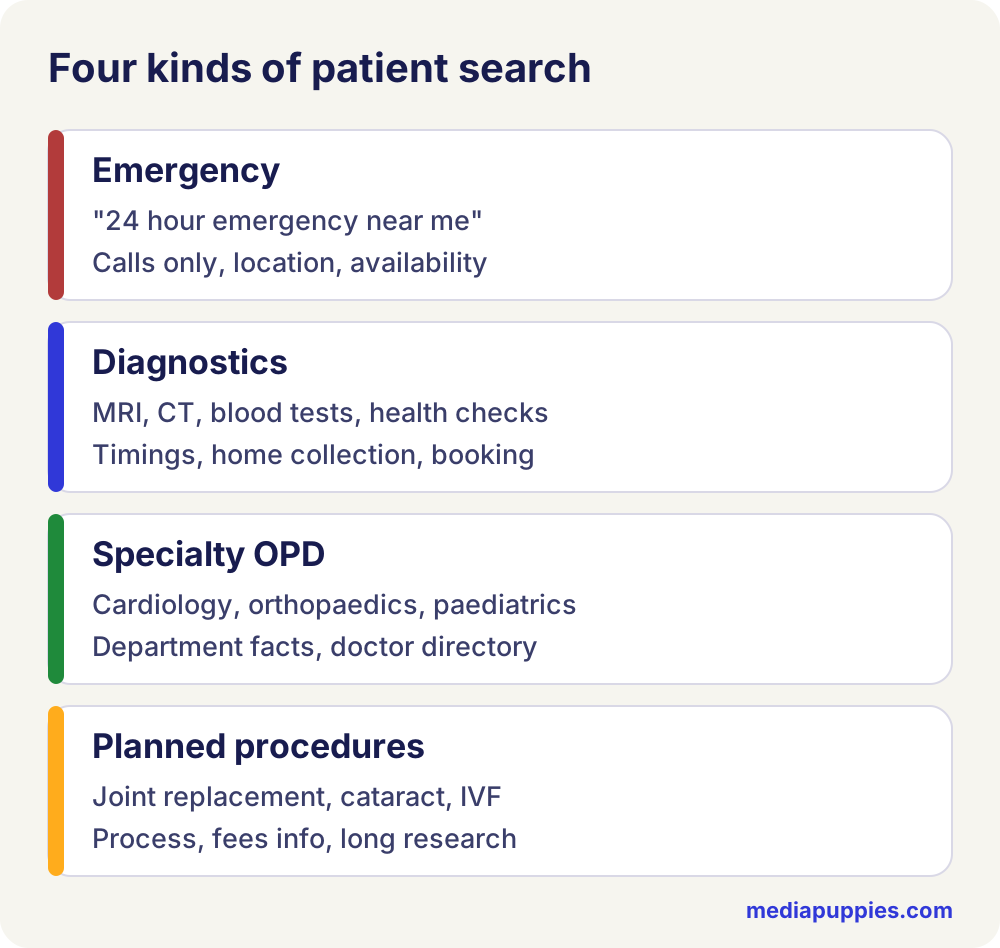
Search ads fit the guidelines well because they answer a stated need with facts. Build campaigns around the four kinds of patient search.
- Emergency: "emergency hospital near me", "24 hour hospital", "ambulance service". Use call assets and location assets, run all hours if the emergency department is staffed, and keep ad copy to services, availability and location.
- Diagnostics: "MRI scan in Andheri", "CT scan near me", "full body check up". State timings, home sample collection if offered, report turnaround if it is reliable, and the booking route. Fees may be shown if factual and not framed as a limited-time deal.
- Specialty OPD: "cardiologist in Gurgaon", "orthopaedic hospital in Jaipur". Advertise the department and its services, and link to the department page with the doctor directory, rather than advertising an individual doctor.
- Planned procedures: "knee replacement hospital", "cataract surgery", "IVF centre". Long research cycles. Link to pages that explain the process, preparation, recovery and fee information, without success rates or guarantees.
Use phrase and exact match to start, add negatives for jobs, courses, nursing admissions, medicine names and home remedies, and read the search terms report weekly. The structure follows our guide to structuring Google Search ads, and the negative list method is in the negative keywords audit.
Google's healthcare and medicines policy also applies. Some treatments are restricted, some need certification, and prescription drugs cannot be advertised to consumers in India. Check the policy for each service before building its campaign.
Meta ads for hospitals
Facebook and Instagram are harder for hospitals now. Testimonials, before-and-after content, offers and doctor portraits were the usual creative, and all of them are out for promotion. What remains:
- Service awareness for a new facility, department or diagnostic centre, stated factually, to people in the catchment area.
- Educational content about prevention, screening and when to seek care, without implying the viewer has a condition. Meta's own policies already bar ads that assert or imply personal health attributes.
- Practical information such as new OPD timings, a new branch, parking, or insurance and cashless tie-ups.
Judge Meta campaigns on calls, appointments and searches for the hospital's name over the following weeks, not on likes or cheap form fills. Our earlier guide to clinic marketing in India covers the platform restrictions in more detail.
Department pages and the doctor directory
Every ad should land on a page that answers the patient's question in seconds.
- One page per department or service, with what it treats, the tests and procedures it offers, OPD timings, how to book, and fees where you publish them.
- A doctor directory listing each doctor's name, qualifications, specialty, registration details and availability. This is treated as patient information, which makes it the right way to show who the patient will see.
- Clear booking routes: a phone number that is answered, a WhatsApp button and a short booking form.
- Accessibility and speed: many patients search on basic phones with slow data. Keep pages light and readable, and offer the main pages in the languages your patients speak.
Remove testimonial sections, before-and-after galleries and unverifiable "best" claims from these pages; they now create risk for the hospital and its doctors. Form design matters for conversion as well; see form design for conversion.
Call centre and WhatsApp: where enquiries are won or lost
In hospital marketing, the phone matters as much as the ad. A patient who calls about an MRI and waits on hold will call the next centre.
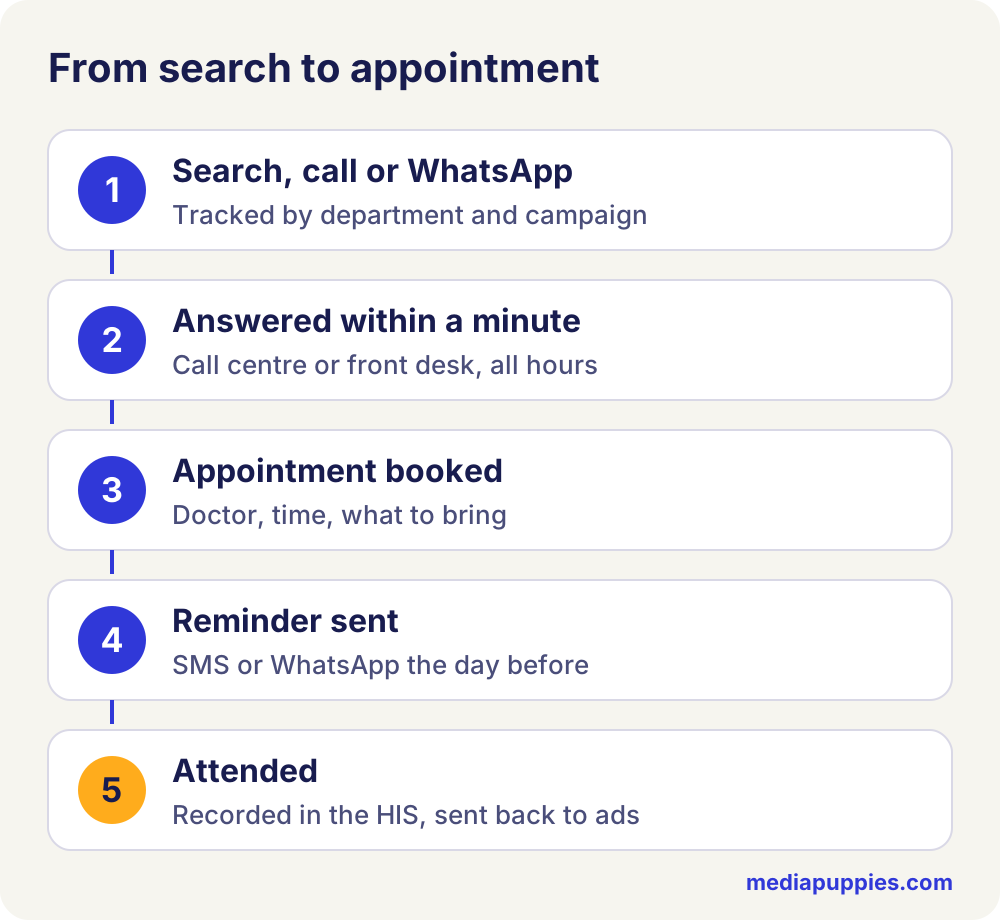
- Answer within a minute during OPD hours and around the clock for emergency lines.
- Track missed calls by hour and call them back within minutes.
- Use the WhatsApp Business Platform with a shared inbox, not staff phones, so no enquiry is lost.
- Send reminders the day before an appointment, with location and preparation instructions.
- Protect privacy: collect only what is needed to book, and never share patient details outside the care team.
Many hospitals that think their ads are not working have an answering problem. Why leads don't answer calls covers the other side: patients who enquire and then go quiet.
Measuring appointments, not leads
Clicks and form fills are inputs. The number that matters is attended appointments by department, and for planned procedures, procedures booked.
- Track every contact route as a separate conversion: calls from ads, calls from the website, WhatsApp clicks and booking forms.
- Record outcomes in the hospital information system or CRM: appointment booked, attended, procedure scheduled.
- Import attended appointments back into Google Ads as offline conversions where privacy rules and your systems allow, sending only the click identifier and the conversion, never clinical details.
- Report by department, since a diagnostic enquiry and a joint replacement enquiry are worth very different amounts of effort and capacity.
A worked example for one department
All numbers here are hypothetical, to show the arithmetic. Say a hospital's diagnostics department spends 1.5 lakh a month on search ads for MRI and CT scans.
- The ads bring 1,000 clicks.
- 12% call, message or book: 120 enquiries.
- The call centre answers 85% of calls promptly and books 60% of answered enquiries: about 61 appointments.
- 90% attend: about 55 scans.
Now say the hospital fixes call handling so 95% of calls are answered promptly, and moves to a booking script that confirms preparation instructions. With 70% of answered enquiries booked, the same spend brings about 80 appointments and 72 attended scans. Nothing changed in the ads. The lead funnel calculator runs these numbers for any department.
International patients
Many Indian hospitals treat patients from abroad, often from neighbouring countries, the Gulf, Africa and Central Asia. The same factual approach applies.
- Country-specific search campaigns in the languages patients use, with schedules set to their time zones.
- International patient pages that explain the process: sending reports for review, visas, travel, accommodation, interpreters and payment methods.
- A dedicated contact route by WhatsApp and email, staffed at hours that suit those countries.
- Care with facilitators: arrangements that pay agents per referred patient deserve review against the NMC guidelines and your legal advice.
SEO and content for hospitals
Search ads buy visibility for today. Organic search builds it for years, and it fits the guidelines naturally because it rewards clear, accurate information.
- Department and service pages written around what patients search: the service name plus the locality, with real detail on tests, procedures, timings and preparation.
- Condition explainers reviewed by the relevant department: symptoms that need urgent care, how a diagnosis is made, treatment options and recovery, without promises or success rates.
- Local signals: consistent name, address and phone number across the website, Google Business Profile and directories, and location pages for each branch.
- Technical basics: fast mobile pages, structured data for the hospital and its departments, and no thin duplicate pages for every doctor and locality combination.
Content should carry the reviewing doctor's name and qualifications as information, and be labelled where any part is AI-generated. Our SEO services page explains how we approach organic search more broadly.
Insurance, cashless and corporate tie-ups
For many patients, the first question is not which doctor but whether their insurance works at the hospital. That makes insurance information one of the most useful things a hospital can publish and advertise.
- List the insurers and third-party administrators you work with, and keep the list current.
- Explain the cashless and reimbursement process in plain steps, with the documents patients need.
- Show government scheme empanelment where it applies, factually.
- Give corporate tie-ups their own page and contact route for HR teams.
Search ads that mention cashless facilities for specific insurers, where accurate, often earn high click-through because they answer the question patients are asking.
Seasonal demand and capacity
Demand for some services rises and falls through the year. Monsoon months bring more fever and infection cases in many cities, winter brings respiratory illness, and planned procedures often cluster around school holidays and the end of the financial year. Use this to plan capacity and budgets, not to frighten people.
- Raise search budgets for the departments that see seasonal demand, so patients who are already searching find you.
- Add staff to the call centre ahead of busy periods.
- Publish factual information about when to seek care, testing availability and timings.
- Avoid fear-based messages, which the NMC guidelines treat as unethical and which also run against platform policies.
A 90-day plan for a hospital's digital marketing
- Days 1 to 15: audit live ads, organic posts and landing pages against the NMC guidelines and pause anything that breaches them. Fix Google Business Profiles for every location.
- Days 15 to 30: rebuild department pages and the doctor directory, set up call tracking and WhatsApp in a shared inbox, and define conversions for calls, messages and bookings.
- Days 30 to 60: launch search campaigns for emergency, diagnostics and two or three priority departments. Review search terms weekly and fix call handling as the data comes in.
- Days 60 to 90: import attended appointments, shift budget to the departments with the best cost per attended appointment, and start the content plan for organic search.
By day 90 the hospital should know, by department, how many attended appointments its digital marketing produced and at what cost.
Reviews, complaints and reputation
Patients read reviews before choosing a hospital, and an unhappy patient's review can cost more enquiries than a month of ads brings in. Reputation work fits the guidelines when it is honest and private.
- Respond to every review politely, without confirming that the reviewer was a patient or discussing any clinical detail.
- Move complaints offline with a named contact and a phone number, and follow up until they are resolved.
- Fix the patterns: if reviews keep mentioning billing delays, parking or waiting times, those are operational problems that marketing cannot solve.
- Never buy, script or incentivise reviews, and never post reviews from staff accounts. Google removes them, and they mislead patients.
- Do not reuse reviews in ads as testimonials; the guidelines treat promotional testimonials as unethical even with consent.
Track review volume and rating by location monthly, next to appointments. A falling rating usually shows up in conversion rates before anyone notices it in reports.
Paying for hospital marketing
The NMC guidelines prohibit payment or commission tied to individual patient referrals, and agency or platform arrangements that pay per patient. That affects how hospitals buy marketing.
- Agencies: a fixed monthly fee for managing campaigns, unconnected to the number of patients, is the safer structure. We explain the general models in agency fee models.
- Listing platforms: avoid any arrangement where payment buys ranking or is charged per patient or appointment.
- Lead sellers: buying patient leads per lead is hard to reconcile with the guidelines.
Common hospital marketing mistakes
- Old creative still running with testimonials, offers or doctor portraits from before October 2026.
- One campaign for every department. Diagnostics swallow the budget and planned procedures go unserved.
- Ads to the home page instead of the department page.
- An unanswered phone during peak hours and lunch breaks.
- Judging on cost per lead instead of attended appointments by department.
- WhatsApp enquiries on staff phones, untracked and easily lost.
- Per-patient payment deals with agencies, platforms or facilitators.
Running hospital marketing in-house or with an agency
Larger hospitals often keep a marketing team in-house for brand, content and community work, and use a specialist for paid search and tracking. Smaller hospitals and clinics usually do better with one partner who handles the whole digital side within the rules. Whoever does it should review every creative against the NMC guidelines and platform policies, report attended appointments by department, and work closely with the call centre.
Our lead generation team runs Google Ads and Meta campaigns for hospitals and clinics on a fixed monthly fee, never per patient, starting with a compliance review of live ads and pages. We say the fee on the first call.
Questions people ask before hiring
What is hospital marketing in India?
Helping patients find a hospital's services through search ads, maps listings, clear department pages, educational content and a responsive call centre, using factual information that fits the NMC guidelines.
Can hospitals advertise on Google after the NMC guidelines?
Yes. Hospitals may advertise objective, verifiable facts such as services, departments, location, emergency availability, accreditation and fees. Solicitation, superiority claims and cure guarantees are not allowed.
Can a hospital show its doctors in ads?
Promotional portrayal of individual doctors is not permitted. A directory of doctors with qualifications, specialties, registration details and availability on the website is treated as patient information.
Are free health camps still a good way to get patients?
Free procedures and offers are barred where they could encourage unnecessary consultations, tests or treatment, so they need careful review. Factual information about health checks, with fees shown, is safer.
How should a hospital measure marketing results?
By attended appointments and booked procedures per department, tracked from each contact route, rather than by clicks or form fills.
Can a hospital pay a marketing agency per patient?
Payment tied to individual patient referrals is prohibited under the NMC guidelines. A fixed monthly fee for managing campaigns is the safer structure.
Does Meta advertising still work for hospitals?
It works for factual service awareness and educational content. Testimonials, before-and-after content, offers and doctor portraits are no longer usable for promotion.