

The NMC advertising guidelines are the National Medical Commission's Guidelines on Ethical Advertising and Public Communication, issued by its Ethics and Medical Registration Board in a public notice dated 6 October 2026 and stated to come into force with immediate effect. They apply to registered medical practitioners, to hospitals and medical institutions, and to platforms that list doctors, and they are enforced through state medical councils.
In short, the NMC advertising guidelines allow factual information and ban promotion. Doctors cannot solicit patients directly or indirectly, use testimonials or before-and-after photos, claim cures or success rates, run discounts that push people toward tests or treatment, or pay anyone per patient referred. Hospitals can advertise objective, verifiable facts about their services. This guide explains what that means for anyone running Google or Meta ads for a doctor, clinic or hospital in India. It is a practical summary written by an advertising team, not legal advice; read the notice itself and take legal advice for your situation.
What the NMC advertising guidelines are
Advertising by doctors in India has long been governed by the Indian Medical Council (Professional Conduct, Etiquette and Ethics) Regulations, 2002, which prohibit soliciting patients. The NMC's 2023 professional conduct regulations, which would have replaced them, were put in abeyance, so the 2002 regulations remain the base. The October 2026 guidelines build on those 2002 regulations and spell out, in modern terms, what counts as unethical advertising: social media, platforms, online rankings, AI-generated content and patient privacy are all covered.
Key points about their status, as reported when they were issued:
- They took effect immediately from the date of the notice.
- Doctors' compliance is enforced by state medical councils, with appeals to the NMC's Ethics and Medical Registration Board.
- For hospitals and clinical establishments, where the guidelines conflict irreconcilably with the Clinical Establishments Act or the relevant state law, that law prevails.
Who the guidelines apply to
- Registered medical practitioners (doctors registered under the NMC system), whether they practise alone, in a group or in a hospital.
- Hospitals and medical institutions, for the way they advertise services and portray their doctors.
- Platforms that host doctors, such as appointment and listing apps, which must follow the norms and must not offer paid rankings of doctors.
Dentists are regulated by the Dental Council of India, and AYUSH practitioners by their own national commissions, each with its own code. If you advertise for them, check their council's rules; many of the same principles apply, but the source is different.
Doctors employed by or attached to a hospital are covered as individuals as well. A hospital ad that portrays one of its doctors promotionally can put that doctor at risk with the state council, even though the hospital paid for the ad. Hospitals and doctors therefore need to agree on how doctors appear in any marketing, and the safest default is the factual directory format: name, qualifications, specialty, registration details and timings.
What doctors can no longer advertise
The guidelines list practices treated as unethical. The ones that matter most for paid advertising are:
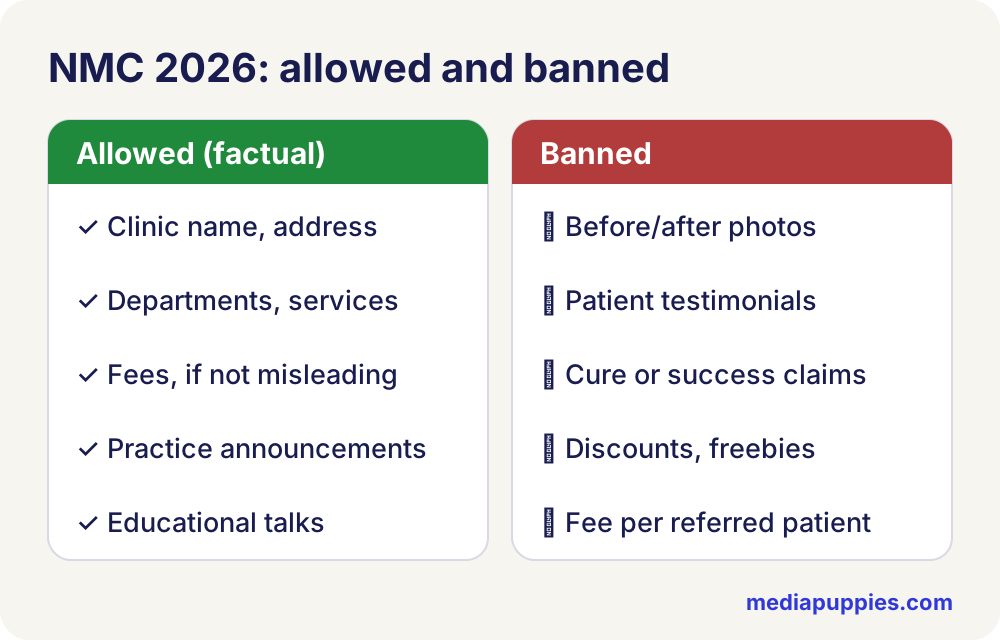
- Soliciting patients, directly or indirectly, including by engaging third parties to market medical services.
- Testimonials and endorsements. Patient consent does not make a promotional testimonial acceptable, and doctors may not lend their name or image to promote products or services.
- Before-and-after photos and promotional case studies. Publishing cases or surgical results to promote a practice is barred; anonymised, consented scientific or educational use is the exception.
- Doctors' photographs used for self-promotion, solicitation or publicity, including self-photos on letterheads and signboards.
- Claims of guaranteed cures, success rates, painless or miracle treatment, and other unverifiable or exaggerated claims, or promotion of unproven therapies.
- Superiority claims that cannot be objectively verified, and rankings or awards that are not independently verifiable.
- Fear-based marketing and advertising that creates unnecessary demand for procedures or diagnostics.
- Discounts, limited-period offers, contests, coupons, gifts, cashback and free procedures where they could encourage unnecessary consultations, tests or treatment.
- Commissions or referral fees for patient referrals, and agency or platform arrangements that tie payment to individual patients.
What doctors can still publish
The guidelines leave room for factual, non-promotional communication:
- Formal announcements of starting a practice, changing address or type of practice, temporary absence and resuming practice.
- Public declaration of consultation fees, and disclosure of charges or packages where it is factual, transparent and not misleading.
- Public health talks and educational content in the doctor's own name.
- Responsible use of social media for information and education.
In practice, that makes educational content the main route for an individual doctor online: explaining conditions, procedures and prevention accurately, without soliciting patients, showing results or making claims.
What hospitals and clinics can advertise
Hospitals and medical institutions may publish objective, verifiable facts:
- Name, location and contact details.
- Departments and specialties, diagnostic services and emergency services.
- Facilities and accreditation.
- Applicable fees.
They may not solicit patients, make comparative superiority claims, guarantee cures, or portray individual doctors promotionally. A website directory of the hospital's doctors with qualifications, specialties, registration details and availability is treated as patient information rather than advertising.
That leaves plenty to advertise. A hospital can run search ads for "24 hour emergency in Sector 62" or "MRI scan centre near me" that state services, location, hours and accreditation. What changes is tone: facts in, persuasion techniques built on results, testimonials and offers out. Our guide to hospital marketing in India turns this into a campaign plan.
Platforms, aggregators and paid listings
Platforms that host doctors must follow the same ethical norms, must not offer paid ranking of doctors, and should keep listing practices transparent. For doctors and hospitals, that affects two common arrangements:
- Paying for a higher position on a listing or appointment platform, where the ranking is sold rather than earned, is ruled out.
- Paying per patient or per appointment to a platform, agency or lead seller is a problem, because payment tied to individual patient referrals is prohibited.
This matters for agencies too. Pay-per-lead and pay-per-patient models are common in other industries; we explain them in pay per lead agencies. For doctors and hospitals in India, a fixed fee for managing advertising, unconnected to the number of patients referred, is the safer structure.
AI-generated content and patient privacy
The guidelines address two newer issues directly:
- AI content: AI-generated promotional content must carry a mark stating that it is AI-generated, and synthetic patient or doctor endorsements are prohibited. That rules out AI avatars posing as doctors or patients in ads.
- Privacy: patient identifiers such as names and faces must not be shared publicly, and where disclosure is permitted, identifying features must be cropped or blurred.
Both apply to organic social media as well as paid ads, so the review process should cover every post, reel and story, not just campaigns.
Penalties for violations
For doctors, state medical councils apply graded action after a show-cause notice, as reported at issue:
- A first violation can bring a warning and ethics training.
- Further violations can bring censure and fines, then suspension of three to six months.
- Serious violations can bring suspension of six to twelve months.
- Repeated violations can lead to removal from the register for one to three years.
Appeals go to the Ethics and Medical Registration Board within 60 days. For a doctor, suspension costs far more than any campaign could earn, which is why compliance has to come before performance in healthcare advertising.
What the NMC advertising guidelines mean for Google and Meta ads
The platforms already had their own healthcare rules. Google's healthcare and medicines policy restricts some treatments and requires certification for others, and Meta's policies bar ads that assert or imply a viewer's health condition ("Struggling with infertility?") and limit before-and-after imagery for some treatments. The NMC guidelines add a professional layer on top.
| Common ad element | Before October 2026 | Under the NMC guidelines |
|---|---|---|
| Patient video testimonial | Widely used | Not permitted for promotion, even with consent |
| Before-and-after photos | Common in aesthetics and dentistry ads | Not permitted for doctors' promotion |
| "Free consultation this week" | Common lead offer | Risky where it encourages unnecessary consultations |
| Doctor's photo in the ad | Standard creative | Not permitted for self-promotion |
| "Best IVF success rate in Delhi" | Frequent headline | Not permitted unless objectively verifiable; success rate claims barred |
| Hospital services, location, hours | Allowed | Allowed, as factual information |
| Agency paid per patient | Common lead deal | Payment tied to individual referrals prohibited |
Ads that still work within the rules are mostly search ads that answer a need factually (service, location, availability, emergency, accreditation, fees), and educational video or carousel content that explains a condition or procedure without claims. Our earlier note on clinic marketing in India covers the platform restrictions that already applied.
A compliance check before any campaign goes live
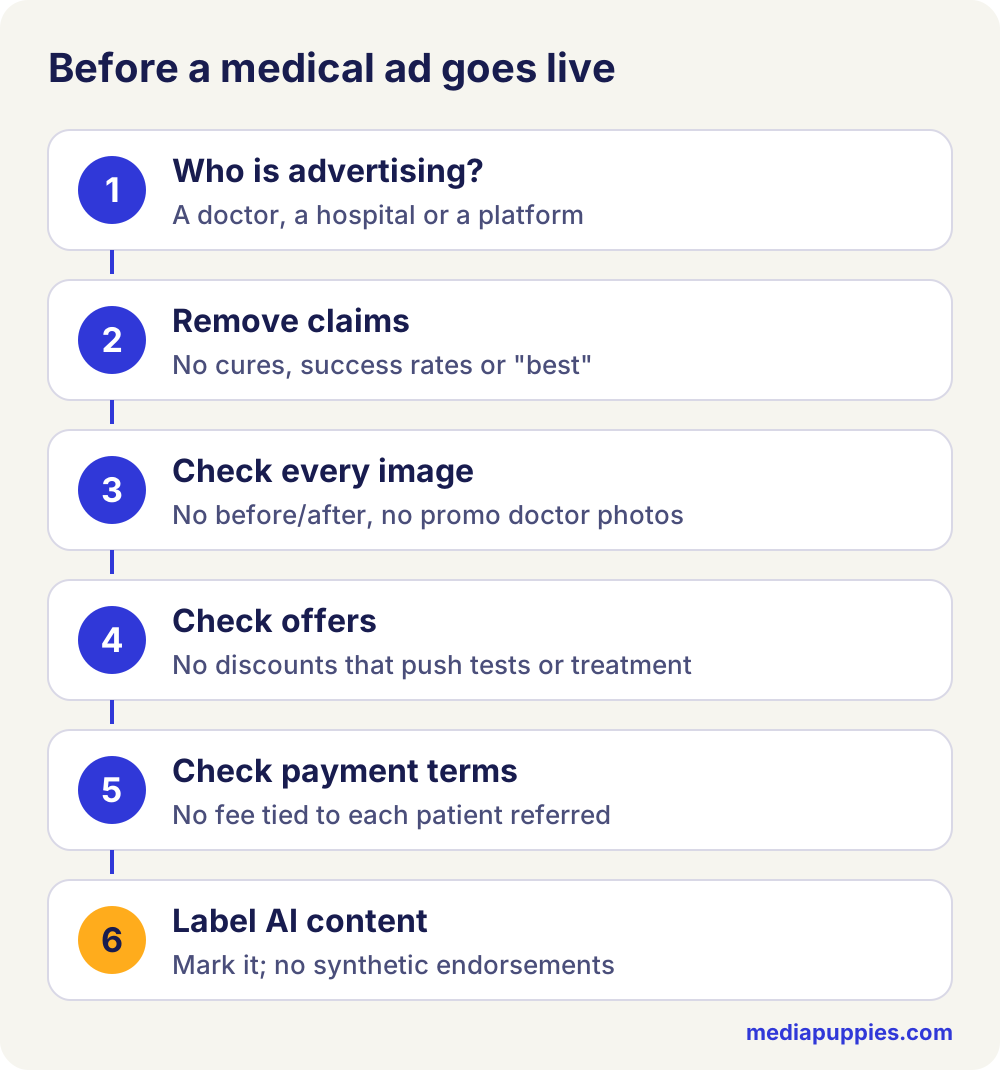
- Identify the advertiser. An individual doctor has much less room than a hospital.
- Remove claims: cures, success rates, painless, best, number one, guaranteed.
- Check every image and video: no before-and-after, no promotional doctor photos, no identifiable patients.
- Check offers: no discounts, freebies or limited-time deals that push consultations, tests or procedures.
- Check payment terms with agencies and platforms: no fee per patient or appointment.
- Label AI-generated material and remove any synthetic endorsements.
- Keep records of what ran and when, in case a council asks.
Rewriting common healthcare ads to fit the rules
Most existing healthcare ads can be rewritten rather than switched off. The pattern is the same each time: replace persuasion built on results, offers and faces with clear facts that help someone choose.
| Typical ad today | A factual alternative |
|---|---|
| "Best knee replacement surgeon in Pune, 99% success rate" | "Orthopaedics department, knee and hip surgery. OPD Monday to Saturday. NABH accredited hospital, Baner." |
| "Free dental check-up this week only" | "Dental clinic in Andheri West. Consultation fee shown on our website. Book an appointment online." |
| "See how Priya lost 20 kg in 3 months" with photos | "Nutrition and weight management clinic. Consultations with qualified dietitians and physicians. Location and timings." |
| Doctor's portrait with "Meet Dr Sharma, the city's top cardiologist" | "Cardiology department: ECG, echo, TMT and OPD. 24 hour cardiac emergency." |
| "Painless IVF, guaranteed results" | "Fertility centre: consultations, diagnostics and treatment information. Read about the process and fees." |
The factual versions often perform better on Google search than expected, because they answer the searcher's actual questions: where, when, which services, how to book. On Meta, educational content about a condition or procedure takes the place of offers and results.
Websites and landing pages under the guidelines
Ads send people to pages, and the pages need the same review.
- Doctor directories are fine when they list qualifications, specialties, registration details and availability as patient information.
- Testimonial pages and video reviews used for promotion need to come down or be reworked; consent alone does not make them acceptable.
- Before-and-after galleries should be removed from promotional pages.
- Fee and package pages are allowed if they are factual, clear about what is included, and not framed as limited-time deals.
- "Best", "number one", "top-rated" and award badges need to go unless the claim or award is objectively and independently verifiable.
- Booking forms are fine; they should collect only what is needed to book, and handle health information carefully.
Check old blog posts and landing pages built for past campaigns too. They often keep running in the background long after the campaign ended.
Educational content doctors can still publish
For an individual doctor, education is the main remaining route online. It also tends to build trust better than promotion did. Content that fits the guidelines usually:
- Explains a condition, test or procedure accurately, including risks and alternatives.
- Answers common questions patients ask in clinic, in plain language and in the languages patients speak.
- Covers prevention and when to see a doctor, without implying the viewer has a condition.
- Avoids results, success rates, testimonials and calls to book with the doctor.
- Is published in the doctor's own name, with qualifications stated, and labelled if any part is AI-generated.
Whether a hospital may promote such content with paid budget is a separate question from whether a doctor may publish it. Treat paid amplification of an individual doctor's content as advertising and review it against the solicitation rules first.
Questions to ask your agency or platform
- Have you reviewed our live ads, organic posts and landing pages against the October 2026 guidelines?
- How is your fee calculated? Is any part tied to the number of patients, appointments or leads?
- Do you use AI-generated people or voices in any creative, and how is AI content labelled?
- How do you handle patient data from forms, and where is it stored?
- For listing platforms: is my position ever influenced by payment?
Clear answers to these protect the doctor or hospital, whose registration is at stake, more than the agency.
A four-week plan to bring a practice into line
For a clinic or hospital with campaigns already running, a short, ordered plan avoids both panic and drift.
- Week 1: pause the obvious problems. Switch off ads with testimonials, before-and-after images, doctors' promotional photos, success rates and discount offers. Unpublish the matching landing pages. Check organic social posts from the last year, starting with the most viewed.
- Week 2: rewrite. Turn each paused ad into a factual version: service, location, hours, accreditation, fees where appropriate. Rebuild landing pages around departments and services, with the doctor directory as patient information.
- Week 3: relaunch and measure. Restart search campaigns first, since factual search ads match the rules most naturally. Track calls, bookings and appointments, not clicks.
- Week 4: fix contracts and process. Move any per-patient or per-lead arrangements to fixed fees, set up a review step so no creative goes live without a compliance check, and write down who signs off.
After that, review every new creative before launch and audit the whole account once a quarter. Councils act on complaints, and a complaint can be about an ad that has been running quietly for months.
Common mistakes we expect to see
- Treating the guidelines as hospital-only. Individual doctors carry the most risk.
- Keeping old creative running. Ads approved months ago may now breach the guidelines. Audit live ads and organic posts.
- Moving testimonials to reviews widgets on ads or landing pages and assuming that changes their nature.
- Using "patient stories" with actors. Synthetic or staged endorsements are prohibited.
- Keeping pay-per-patient deals with lead sellers or platforms.
- Doctors' photos on every ad, because that was the agency's template.
Running healthcare ads under the new rules
Healthcare advertising in India now needs a compliance review before every creative and offer, a fixed-fee relationship with any agency, and measurement built on appointments and patient enquiries rather than on clicks. The campaigns themselves do not disappear: people still search for hospitals, scans, specialists and emergency care, and they still need clear, accurate information to choose.
If we run healthcare campaigns for a hospital or clinic, we start with a review of live ads, organic posts and landing pages against the NMC guidelines and the platform policies, then rebuild what needs changing before adding budget. Our lead generation team works on a fixed monthly fee, never per patient, and we say the fee on the first call.
Questions people ask before hiring
What are the NMC advertising guidelines?
The National Medical Commission's Guidelines on Ethical Advertising and Public Communication, issued in a public notice dated 6 October 2026, which set out what doctors, hospitals and doctor platforms may and may not advertise.
Can doctors in India run ads on Google or Facebook?
Individual doctors cannot solicit patients directly or indirectly. They can publish factual announcements, fee declarations and educational content. Hospitals can advertise factual information about services.
Are patient testimonials allowed under the NMC guidelines?
No. Patient consent does not make a promotional testimonial or endorsement permissible, and synthetic endorsements are prohibited.
Can a clinic show before and after photos?
Not for promotion. Before-and-after photos and promotional case publication are barred, with an exception for anonymised, consented scientific or educational use.
Can hospitals offer discounts or free consultations in ads?
Discounts, limited-period offers, freebies and free procedures are barred where they could encourage unnecessary consultations, tests or treatment.
Can a doctor pay an agency per patient or per lead?
Payment or commission tied to individual patient referrals is prohibited. A fixed fee for managing advertising is the safer arrangement.
What happens if a doctor breaks the NMC advertising guidelines?
State medical councils apply graded action after a show-cause notice, from a warning and ethics training up to suspension or removal from the register for repeated violations.
Do the NMC guidelines apply to dentists?
Dentists are regulated by the Dental Council of India and follow its code. Many principles are similar, but check the council's own rules.