

Google Ads for real estate in India means paying to appear when buyers search for a project, a builder, a locality or a type of home, and sending those searchers to a page built to turn them into site visits. It works best for developers and channel partners selling specific projects, because property buyers in India research heavily on Google before they ever call: project names, RERA numbers, possession dates, locality reviews and floor plans.
The short answer to whether Google Ads for real estate works: yes, when the account is split by search intent, has a long negative keyword list, and is judged on cost per site visit instead of cost per lead. Google leads usually cost more than Facebook leads. In many accounts they turn into site visits at a far higher rate, which is the comparison that matters.
How Google Ads for real estate works in India
A property campaign on Google can use several campaign types. Each catches the buyer at a different point.
| Campaign type | Where ads show | Best use in real estate | Watch out for |
|---|---|---|---|
| Search | Google results for chosen keywords | Project names, localities, configurations, builder brand | Broad property terms burn budget fast without negatives |
| Performance Max | Search, YouTube, Display, Maps, Gmail | Extra reach once Search is tracked and converting | Takes credit for brand searches unless excluded; little visibility |
| Demand Gen | YouTube, Discover, Gmail | Walkthrough videos and launch awareness | Lower intent; judge it on site visits, not form fills |
| Display remarketing | Websites and apps | Reminding visitors of a project they viewed | Needs placement exclusions; mobile app placements waste money |
Search does most of the work. A buyer searching "godrej project sector 150 possession date" or "3 bhk ready to move in gurgaon" has already decided what they want. Our wider guide to real estate digital marketing in India shows how Search fits next to Meta, portals and SEO.
Project-name, locality and generic searches
Property searches fall into three groups, and mixing them in one campaign lets Google spend where clicks are cheapest, which is rarely where buyers are.
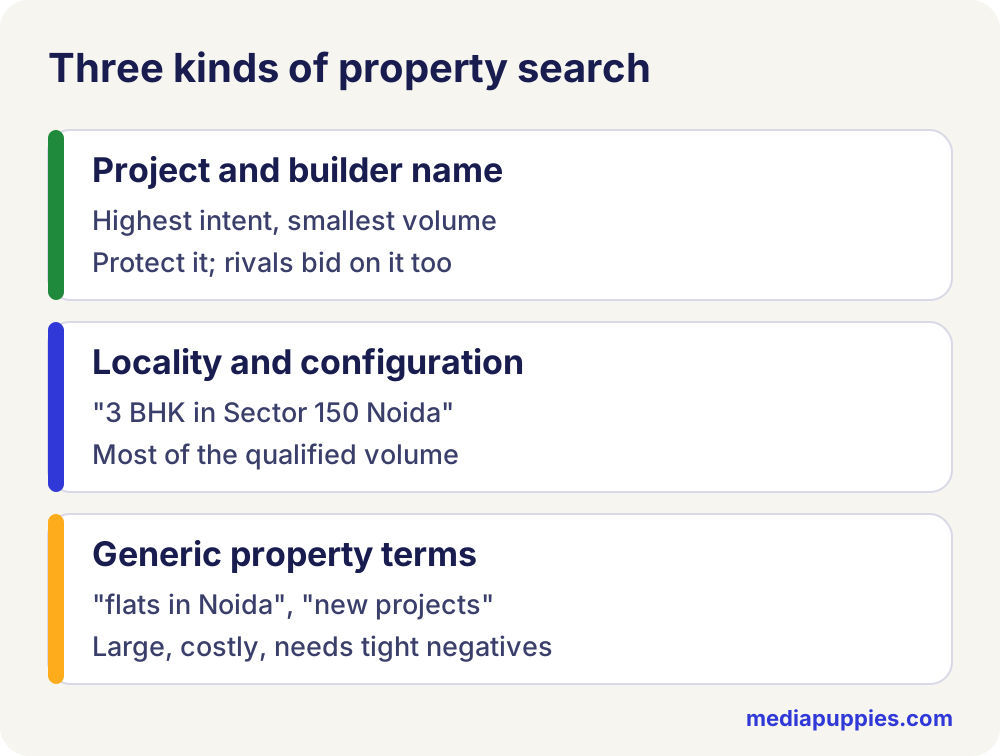
Project and builder names. The buyer has already heard of the project, from a hoarding, a portal, a friend or a Facebook ad. These searches are the cheapest site visits you will ever buy. Competing developers and channel partners bid on them too, so a project that does not bid on its own name hands those buyers to someone else.
Locality and configuration. "2 BHK in Whitefield", "flats near Hinjewadi phase 1", "ready to move flats in Noida Extension". These carry most of the qualified volume. Buyers here know where and what, but not yet which project.
Generic property terms. "Flats in Pune", "new projects in Mumbai", "property in Bangalore". High volume, high cost, mixed intent: renters, students, people checking rates and brokers looking for listings all search like this. Run them only with a tight budget and a long negative list.
Building the campaign structure
A sound starting account for one project looks like this:
- Brand campaign: the project name, the builder name and their common misspellings. Cheap, high converting, kept separate so it does not flatter the other numbers.
- Locality campaign: ad groups by locality and configuration ("3 BHK Sector 150", "flats near Noida Expressway"), each with its own ads and landing page section.
- Competitor campaign: nearby competing projects, if you choose to bid on them. Do not use competitor trademarks in ad text.
- Generic campaign: broader city terms, on a capped budget, only once the first three are tracked and converting.
Start with phrase and exact match. Broad match with Smart Bidding can work later, once the account records enough site visits for bidding to learn from. Set location targeting to "Presence: people in or regularly in your included locations". For most projects, target the city and its commuter belt rather than a small radius, because buyers often live across town from the project. The general method is in how to structure Google Search ads.
Keywords and negative keywords for property searches
Real estate attracts more irrelevant searches than almost any category. A negative list on day one saves a large share of the budget.
- Renting: rent, rental, lease, PG, paying guest, hostel, room.
- Resale and owners: resale, owner, no broker, by owner (unless you sell resale).
- Jobs and careers: jobs, salary, vacancy, career, hiring, internship.
- Research only: news, case, complaint, fraud, court, RERA complaint (watch these; some indicate a reputation issue to address separately).
- Wrong product: plot, villa, commercial, shop, office, land, if the project does not sell them.
- Wrong budget band: words like "cheap", "lowest", "affordable" for a luxury project, or "luxury", "penthouse" for an affordable one.
Then read the search terms report every few days in the first month and weekly after that. Add every irrelevant search as a negative and every converting one as a keyword. Our negative keywords audit explains the routine.
Ads and assets that earn the right click
A responsive search ad should filter as much as it attracts. Every click from someone who cannot buy costs money.
- Name the configuration and locality in headlines: "3 BHK in Sector 150", "Ready to Move, Noida Expressway".
- State possession status clearly: under construction, possession date, or ready to move.
- Use trust signals that are true and verifiable: RERA registered, builder track record, bank approvals.
- Call the action plainly: book a site visit, download the brochure, see floor plans.
- Add assets: sitelinks to floor plans, location, amenities and site visit booking; a call asset during sales office hours; a location asset if the sales office is near the project; and image assets of the actual project.
Avoid vague superlatives such as "best project in the city". They do not filter anyone, and claims you cannot back up create trouble under RERA and consumer law.
Landing pages built for site visits
Most real estate ads send people to a generic home page or a portal-style listing. A dedicated project page converts better and lets you match each ad group to a section of the page.
- First screen: project name, locality, configurations, possession status, RERA registration number, and two actions: book a site visit and call.
- Floor plans and sizes: carpet area stated clearly, because RERA requires it and buyers compare it.
- Location: a map with travel times to the places buyers care about: metro, offices, schools, hospitals, airport.
- Progress: recent construction photos or video, dated.
- A short form: name, phone, configuration and preferred visit date. Each extra field lowers volume and raises quality; test the balance.
- Speed: most property searches happen on mobile, often on patchy connections. Compress images and keep the first screen light.
A WhatsApp button helps in India, where many buyers prefer to message first. Track WhatsApp clicks as a separate conversion so you can compare them with calls and forms.
Tracking enquiries through to site visits and bookings
An enquiry is not a buyer. If Google only sees form fills, Smart Bidding optimises for people who fill in forms, including brokers, renters and the merely curious.
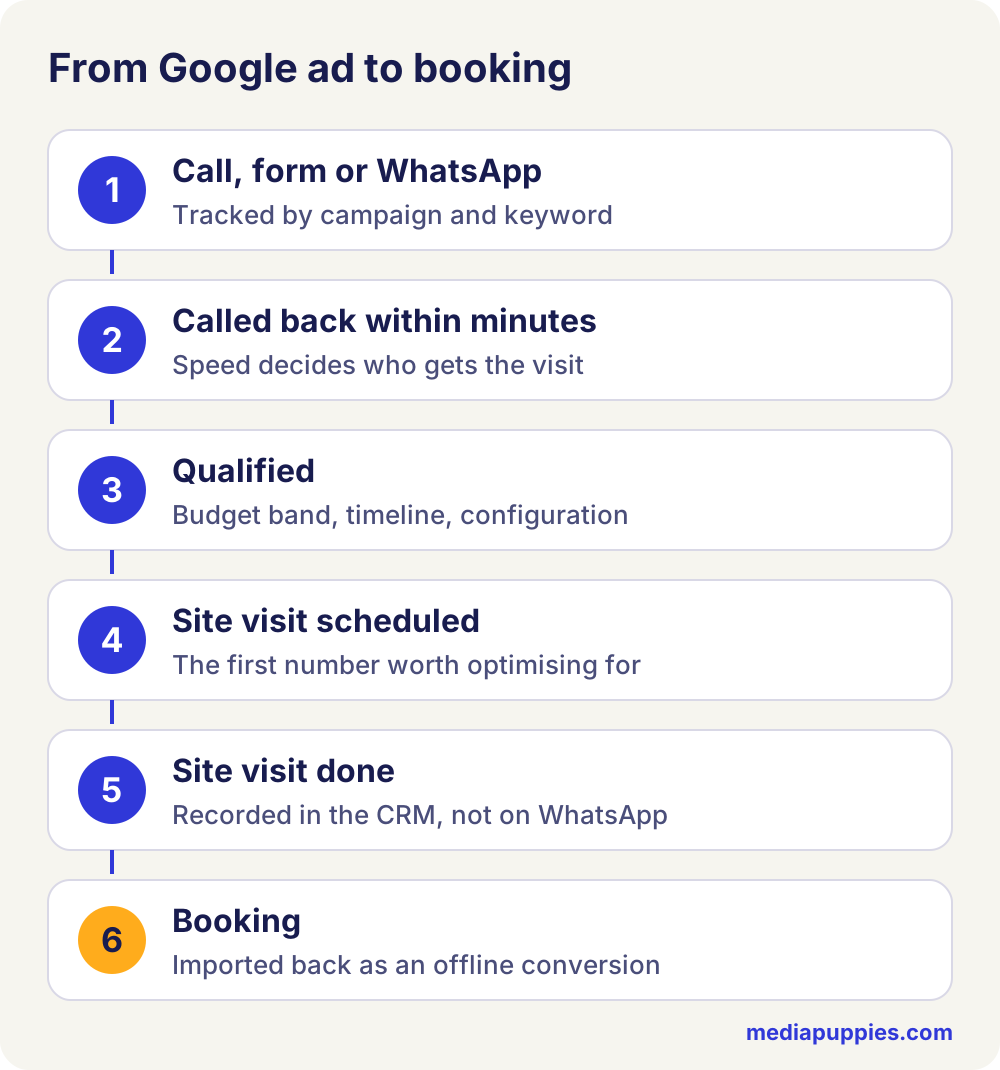
- Track every contact route: forms, calls from ads, calls from the website, and WhatsApp clicks, each as its own conversion action.
- Record outcomes in a CRM: qualified, site visit scheduled, site visit done, booking. A spreadsheet works if it is filled in daily.
- Capture the click ID: store the GCLID with each lead so outcomes can be matched back to the ad click.
- Import site visits and bookings into Google Ads as offline conversions, and make site visits the primary goal once you have enough of them each month.
Speed matters as much as tracking. A buyer who enquires about three projects usually visits the first one that calls back. The fixes for slow follow-up are in real estate lead generation in India.
A worked example: cost per lead vs cost per site visit
All numbers here are hypothetical, to show the arithmetic. Say a developer spends 4 lakh in a month on Google Ads for one project, and the same amount on Facebook lead ads.
| Google Search | Facebook instant forms | |
|---|---|---|
| Spend | 4 lakh | 4 lakh |
| Leads | 200 | 500 |
| Cost per lead | 2,000 | 800 |
| Site visits | 30 (15%) | 25 (5%) |
| Cost per site visit | About 13,300 | 16,000 |
| Bookings | 3 | 2 |
On cost per lead, Facebook looks two and a half times cheaper. On cost per site visit and per booking, Google wins in this example. Neither result is universal: a sales team that calls every Facebook lead within five minutes can lift its visit rate a long way. The point is to compare channels on visits and bookings, never on leads. Our lead funnel calculator runs the numbers, and the lakh and crore converter helps when reporting to teams abroad.
Performance Max and Demand Gen for real estate
Performance Max can bring extra site visits once Search is tracked properly, because it reaches YouTube, Maps and Discover as well as Search. Three rules keep it honest:
- Exclude brand terms so it does not take credit for project-name searches that Search would have caught anyway. The method is in Performance Max brand exclusions.
- Feed it real outcomes. Optimising for form fills teaches it to find form fillers. Optimising for imported site visits teaches it to find buyers.
- Give it real assets: project photos, walkthrough videos and floor plan images, not stock imagery.
Demand Gen suits project launches, where a walkthrough video can reach people in the right localities before they start searching. Judge it on site visits over several weeks, since buyers often see the video, then search the project name later. More on how Performance Max behaves in Indian accounts is in Performance Max in India.
Bidding and budgets through a project's life
A project's marketing has phases, and the bidding approach should change with them.
- Pre-launch and launch. Search volume for the project name is small at first and grows as outdoor, portal and social campaigns run. Start Search with Maximise clicks and a maximum CPC limit, or manual CPC, so a few expensive clicks do not drain the budget while there is no conversion data.
- Steady selling. Once the account records enough conversions each month, move to Maximise conversions, then to Target CPA set from your allowable cost per site visit. Change targets in small steps, about 10 to 20% at a time.
- Last inventory. With only a few units left, narrow targeting to the configurations still available and remove ad groups for sold-out types, so the budget does not keep buying enquiries the sales team cannot serve.
Google can spend up to twice the average daily budget on a busy day and balances it over the month, so a weekend surge in searches can move spend quickly. Review pacing weekly, especially around launches and festive periods such as Navratri, Dussehra and Diwali, when many buyers plan purchases.
Lead form, call and WhatsApp assets
Google offers ways to collect enquiries without a landing page visit. They help on mobile, with trade-offs.
- Lead form assets let a searcher submit details inside the ad. Volume rises and quality usually falls, so add one or two qualifying questions, such as configuration and expected purchase timeline, and send the leads straight to the CRM through a webhook or a connector so nobody has to download them by hand.
- Call assets put a tap-to-call button on the ad. Schedule them for the hours the sales team answers, and count only calls longer than about a minute as conversions.
- WhatsApp can be added as a message option in some formats and as a button on the landing page. Many Indian buyers prefer it to a call, but chats are easy to lose track of. Log every WhatsApp enquiry in the CRM with its source.
Compare each route on site visits per enquiry after a month. Many accounts find calls bring fewer enquiries and more visits, while lead forms do the reverse.
RERA rules for real estate ads
The Real Estate (Regulation and Development) Act, 2016 requires promoters to include the project's RERA registration number and the state authority's website address in advertisements for registered projects. State authorities add their own rules; Maharashtra, for example, requires a QR code linking to the project's registration details on advertisements. Agents and channel partners must be registered with the state authority too.
In practice, put the registration number on the landing page and in an ad asset where space allows, keep carpet area figures accurate, and avoid promises about returns, possession dates or approvals you cannot back up. Google's own policies also apply: claims must be accurate, and financial offers such as assured returns attract extra scrutiny.
Reaching NRI buyers in the US, UK and Gulf
Many Indian projects sell a meaningful share of units to non-resident Indians. Google Ads can reach them where they live.
- Separate campaigns per country (UAE, Saudi Arabia, US, UK, Canada, Singapore), each with its own budget and an ad schedule set to that country's evenings and weekends.
- Search terms differ: "property in Pune for NRI", "flats in Kerala for NRI", "invest in Hyderabad property from Dubai", plus project names.
- Landing pages answer NRI questions: home loans for NRIs, power of attorney, video site visits, and repatriation basics in plain language, without promising tax or legal outcomes.
- Follow-up fits the time zone: a callback at 11am IST is 5:30am in London. Offer WhatsApp and scheduled video calls.
Common mistakes in real estate Google Ads
- Judging the account on cost per lead. The cheapest leads are usually the least likely to visit.
- No brand campaign. Competitors and channel partners collect the project's own searches.
- Generic city terms from day one. They eat the budget before the account has learned anything.
- A thin negative list. Rent, PG, resale and jobs searches quietly take a large share.
- Sending ads to a portal listing or home page. Message match and conversion rates both suffer.
- Leads left in WhatsApp chats. Without CRM records, nobody knows which campaign produced visits.
- Same budget through the launch and after. Launch weeks deserve more; plan budgets by phase, as covered in real estate digital marketing.
Running Google Ads for real estate in-house or with an agency
A developer's marketing team can run Search well if someone owns the account daily, reads search terms, and works closely with the sales team on lead outcomes. An agency helps when several projects run at once, when Performance Max and Demand Gen join Search, or when offline conversion imports need setting up. Ask any agency how they report site visits and bookings by campaign, how quickly they expect leads to be called, and how they handle brand and competitor bidding. Creative matters for the Display and video side too; see real estate ad creative, and for the Meta side, Facebook ads for real estate.
Our real estate lead generation team runs Google and Meta campaigns for projects, with site visit tracking set up in the first month and reporting on cost per site visit and per booking. Fees depend on the number of projects and channels, and we say it on the first call.
Questions people ask before hiring
Does Google Ads work for real estate in India?
Yes, especially for specific projects. Buyers search project names, localities and configurations on Google, and those searches usually turn into site visits at a higher rate than social media leads.
Which keywords work best for real estate Google Ads?
Project and builder names first, then locality and configuration terms such as 3 BHK in a sector or ready to move flats near a metro line. Generic city terms come last, on a capped budget.
What negative keywords should real estate ads use?
Common ones are rent, rental, PG, hostel, resale, owner, jobs, salary, and product types you do not sell such as plot, shop or office.
Is cost per lead a good measure for property ads?
Not on its own. Compare campaigns on cost per site visit and cost per booking, because cheap leads often never visit.
Do real estate ads in India need a RERA number?
For registered projects, the RERA Act requires the registration number and the state authority's website address in advertisements, and some states add rules such as Maharashtra's QR code.
Should real estate developers use Performance Max?
It can add site visits once Search is tracked, as long as brand terms are excluded and it optimises for imported site visits rather than form fills.
How can Google Ads reach NRI property buyers?
Run separate campaigns for each country with schedules set to local evenings and weekends, landing pages that answer NRI questions, and follow-up by WhatsApp or scheduled video calls.