

Facebook ads for real estate are Facebook and Instagram campaigns that generate enquiries for property projects, usually through instant lead forms, click-to-WhatsApp ads or a landing page. In India they are the cheapest way to fill a CRM with names and numbers. Done well, they also produce site visits and bookings at a reasonable cost; done badly, they produce thousands of leads who never pick up the phone.
The short answer to whether Facebook ads for real estate work: yes, when the form filters, the sales team calls within minutes, and Meta is told which leads became site visits. Without those three, the campaign optimises toward people who like filling in forms, and cost per lead looks great while bookings stay flat.
How Facebook ads for real estate work in India
Meta's delivery system shows ads to people it predicts will take the action you optimise for. That is the heart of the problem in real estate: if you optimise for leads, it finds people who submit forms easily, which is not the same as people who buy flats.
Three things change that:
- The objective and conversion event you choose, ideally moving from leads to qualified leads or site visits as data builds.
- Friction in the form that screens out casual browsers without blocking real buyers.
- Outcome data sent back from the CRM, so Meta learns from site visits instead of form fills.
Facebook works best as the demand-creation side of a property plan, with Google catching people who already search for the project. Our guide to Google Ads for real estate covers that side, and real estate digital marketing in India shows how the channels fit together.
Choosing the campaign objective
| Objective and destination | What you get | Strength | Weakness |
|---|---|---|---|
| Leads, instant form | Name and phone inside Facebook | Volume, low cost per lead | Lowest intent; many forget they applied |
| Leads, website | Form submissions on your page | Buyers see the project before enquiring | Fewer leads; needs pixel and Conversions API set up |
| Engagement or leads, WhatsApp | A chat started with your number | Natural for Indian buyers; easy to send brochures | Chats get lost without a CRM process |
| Awareness or video views | Reach and views in chosen localities | Builds familiarity before a launch | No direct enquiries; judge on later searches and visits |
Most projects start with instant forms or WhatsApp for volume, then add website leads once the pixel and Conversions API are reliable. Our comparison of lead form ads vs landing pages goes deeper into the trade-off.
Targeting in India: location, audience and NRI buyers
Meta has removed many detailed targeting options over the years, and its delivery now leans on broad audiences and creative to find buyers. For a property project, that means:
- Locations where buyers live, not just around the site. A project in Noida Extension sells to families across Delhi, Ghaziabad and Noida; a project in Whitefield sells to people working across east Bangalore.
- Broad age and gender, with a sensible minimum age, letting creative do the filtering.
- Advantage+ audience with interest suggestions where you want to guide delivery, rather than stacking narrow interests.
- Exclusions of existing customers and recent leads, uploaded from the CRM.
- NRI campaigns in separate ad sets for the UAE, Saudi Arabia, Qatar, the US, UK, Canada and Singapore, with copy and forms that mention NRI services such as home loans, video site visits and power of attorney help.
Meta asks advertisers to declare a special ad category for housing in the countries where its rules require it. Ads Manager prompts for this when you choose the campaign, and the rules differ by country. Check the current requirement for each country you target, especially for NRI campaigns aimed at the US, Canada and Europe, where housing ads face limits on age, gender and location targeting.
Instant forms that filter out browsers
The form is where most real estate campaigns win or lose. A one-tap form with name and phone prefilled brings volume and very little intent.
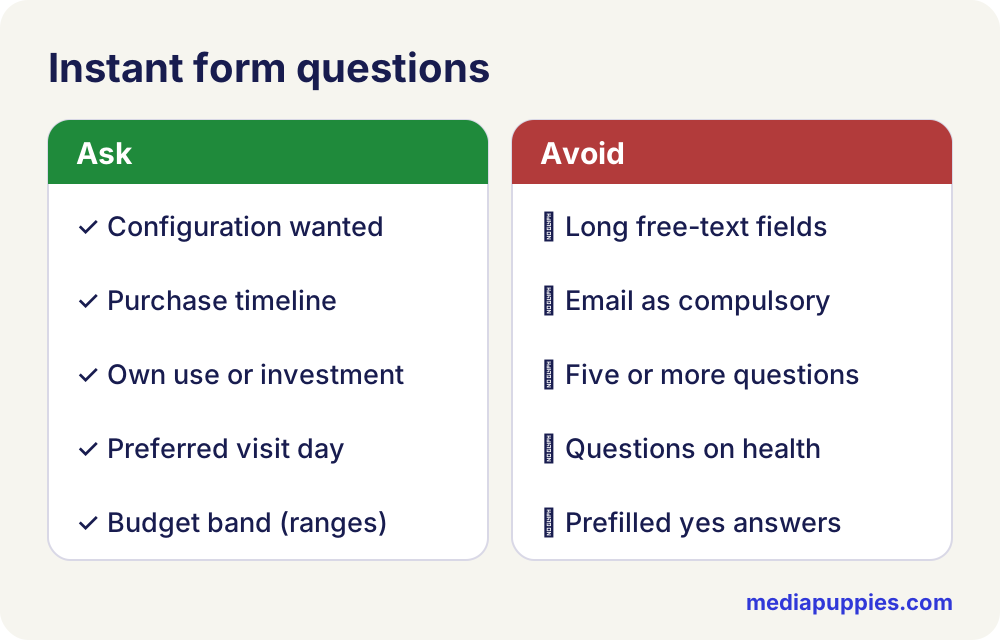
- Use the "Higher intent" form type, which adds a review screen before submission.
- Ask two or three questions that sales actually uses: configuration (2 BHK, 3 BHK), purchase timeline (within three months, three to six, later), and own use or investment.
- Offer budget bands as multiple choice if price fit is a common problem, without stating the project price in the ad if your sales process discourages it.
- Add a context card that repeats the project, locality and possession status, so people know what they are enquiring about.
- Put a clear thank-you screen with a WhatsApp button and the expected callback time.
Each question lowers volume and raises quality. Test one change at a time and judge it on site visits per hundred leads after two to three weeks.
Creative that gets site visits
Creative now does much of the targeting work on Meta. What the ad shows decides who stops scrolling.
- Walkthrough video of the sample flat or show apartment, shot on a phone with natural light, beats glossy renders for many buyers.
- Location stories: drive time to the metro, the office hub, schools and hospitals, shown on a map or filmed from the road.
- Construction progress, dated, for under-construction projects; it answers the biggest buyer fear directly.
- Floor plan carousels with carpet area for each configuration.
- A known face from the sales team explaining the project in Hindi or the local language often outperforms a voiceover.
Run three to five clearly different creatives at once. Meta's delivery rewards variety; five versions of the same render teach it little. More ideas and testing methods are in real estate ad creative.
Click-to-WhatsApp ads and follow-up speed
WhatsApp is how many Indian buyers prefer to start. A click-to-WhatsApp ad opens a chat with your business number and a prefilled message, and the sales team can reply with the brochure, location pin and visit slots.
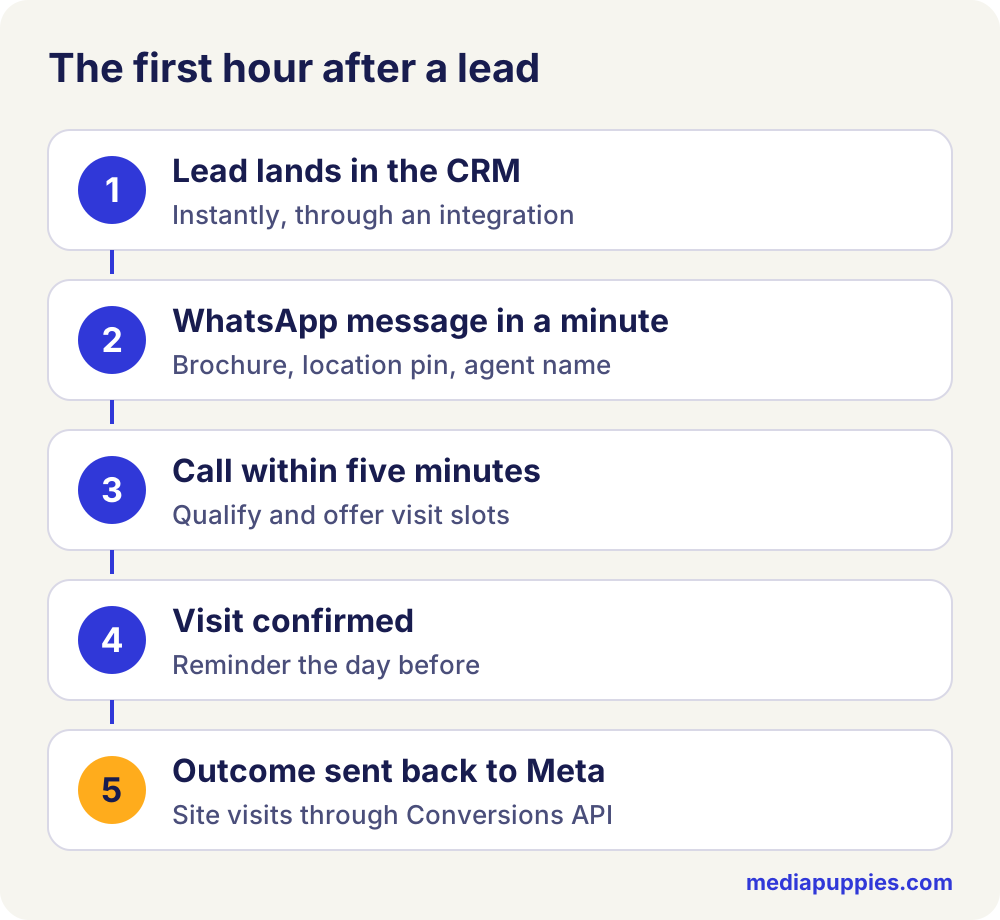
The catch is process. Chats spread across personal phones are impossible to track and easy to forget. Use the WhatsApp Business Platform through a provider that logs every chat in the CRM, tags the campaign it came from, and alerts the team. Set a rule for first response, ideally within a minute by automated message and within five minutes by a person during working hours.
The same speed rule applies to form leads. A buyer who enquires about three projects usually visits the first one that calls back. If leads go cold before anyone calls, why leads don't answer calls covers the fixes.
Sending site visits back to Meta with the Conversions API
Meta learns from whatever you tell it is a success. If the only signal is a submitted form, it finds more people who submit forms. Sending later outcomes back changes what it looks for.
- Record each lead's outcome in the CRM: contacted, qualified, site visit scheduled, site visit done, booking.
- Send those events back to Meta through the Conversions API for CRM, matched by the lead ID Meta provides with each instant form lead.
- Once site visits reach a steady weekly volume, optimise campaigns for the site visit event, or for qualified leads as a step in between.
Our guide to the Meta Conversions API for leads covers setup. Even before you optimise for site visits, sending them back gives you reporting by campaign and ad that shows which creative brings buyers.
Budgets and the learning phase
Meta needs roughly 50 optimisation events per ad set per week to leave the learning phase. That shapes real estate budgets in a simple way.
- If you optimise for leads, 50 a week is easy, which is why lead campaigns stabilise fast and look efficient.
- If you optimise for site visits, 50 a week needs a large budget or several projects pooled. Few single projects get there, so a qualified-lead event is often the practical middle step.
- Fewer ad sets, more budget each. Splitting a modest budget across ten ad sets keeps every one in learning. Consolidate.
- Avoid frequent edits. Big budget jumps, new creative in the same ad set and targeting changes can reset learning. Plan changes weekly, not daily.
The learning phase calculator shows the budget a given event and cost needs.
A worked example: what a lead is really worth
All numbers here are hypothetical, to show the arithmetic. Say a developer spends 3 lakh in a month on Facebook ads for a mid-segment project and tests two forms.
| One-tap form | Higher intent form, 3 questions | |
|---|---|---|
| Spend | 1.5 lakh | 1.5 lakh |
| Leads | 300 | 150 |
| Cost per lead | 500 | 1,000 |
| Connected on the phone | 120 (40%) | 105 (70%) |
| Site visits | 9 | 15 |
| Cost per site visit | About 16,700 | 10,000 |
The harder form doubles the cost per lead and cuts the cost per site visit by 40% in this example. A team judging on cost per lead would switch it off. A team judging on site visits would move the whole budget to it. Our lead funnel calculator runs these numbers for any project.
Retargeting video viewers, page visitors and old leads
Property is a slow decision. Most buyers see a project several times over weeks before they visit. Retargeting keeps the project in front of the people most likely to buy.
- Video viewers: people who watched at least half of a walkthrough video are a strong, cheap audience. Show them floor plans, progress updates and visit invitations.
- Website visitors: people who viewed the project page or floor plans in the last 30 days, with a site visit offer.
- Instagram and Facebook engagers: people who saved, shared or messaged about a post.
- Old leads who never visited: upload them from the CRM and show new information, such as a price revision, a new tower, a show flat opening or a possession update. Do not simply repeat the original ad.
Keep frequency in check. A buyer who sees the same render twelve times in a week learns nothing new and starts ignoring the brand. The ad frequency calculator helps set sensible limits.
Launch weeks and festive campaigns
Real estate demand in India clusters around launches and festive periods. Navratri, Dussehra, Dhanteras and Diwali, Akshaya Tritiya and Gudi Padwa are traditional times to book a home in many families, and developers often time launches and offers to them.
- Build the audience before the launch. Two to three weeks of video and location content in the target localities makes launch-week lead ads cheaper and better.
- Raise budgets in steps rather than one large jump, to avoid resetting the learning phase in the busiest week.
- Prepare the sales team for the volume. Festive leads go cold fast if callbacks take a day.
- State offers precisely, with real end dates and terms, and keep them consistent with what sales will honour at the site.
Developer accounts and channel partners
Many projects are advertised by the developer and by several channel partners at the same time. On Meta, that means several advertisers bidding for the same people with near-identical creative, which raises costs for everyone and confuses buyers who get five calls about one flat.
- Developers usually get the cleanest results by running the main campaigns themselves and giving channel partners clear rules: which localities or audiences each may target, which creative they may use, and how leads are attributed.
- Channel partners do better competing on service than on the same render: local knowledge, multiple projects compared honestly, and help with loans and paperwork.
- Everyone should keep the RERA registration number on every ad, since partners advertising registered projects carry the same obligations.
A weekly lead quality check
Numbers in Ads Manager say nothing about whether leads are real. A short weekly check with the sales team does.
- Pull the last week's leads by campaign and ad.
- For each, record whether the number connected, whether the person remembered enquiring, and whether they fit the configuration and budget.
- Count site visits scheduled and done by ad.
- Pause ads with high volume and no visits, even if their cost per lead is the lowest in the account.
- Note the reasons for bad leads (wrong city, renter, broker, wrong budget) and change the form or creative to filter them.
Ten minutes a week of this changes more than any targeting setting.
What a monthly real estate ads report should show
A useful monthly report fits on one page and answers one question: how many buyers did the ads bring, and at what cost?
- Spend, leads, site visits and bookings by campaign, with cost per site visit and cost per booking next to cost per lead.
- Contact rate: the share of leads the sales team actually reached, which shows whether a drop in visits is an ads problem or a follow-up problem.
- Best and worst ads by site visits, with the creative shown, so the next month's creative is based on evidence.
- Lead quality reasons from the weekly check, summarised.
- Changes made and planned, including form, creative, budget and audience changes.
If a report leads with reach, impressions and cost per lead and never mentions site visits, ask for them. Without visits and bookings, nobody can tell whether the budget is selling flats.
RERA and Meta advertising rules
Real estate ads in India must follow the RERA Act: for registered projects, include the RERA registration number and the state authority's website address in advertisements, and follow state additions such as Maharashtra's QR code requirement. On Meta, the registration number fits in the ad text, the form's context card and the landing page. Avoid promising returns, rental yields or possession dates you cannot back up; those claims create risk under RERA and consumer law, and Meta's policies also restrict misleading financial claims.
Common mistakes with Facebook ads for real estate
- Optimising for the cheapest lead. It trains Meta to find form-fillers.
- One-tap forms with no questions. Volume rises and sales teams stop calling.
- Slow follow-up. A lead called the next day has usually visited someone else.
- Too many small ad sets. None leave learning.
- Stock renders only. Real footage of the site and sample flat builds trust.
- Leads downloaded by hand from Ads Manager. Delays and lost leads; connect the CRM.
- No outcome data. Without site visits sent back, nobody knows which ads sell.
Most of these show up in the account itself. Our free ad account audit checks forms, structure and tracking for real estate accounts.
Running Facebook ads for real estate in-house or with an agency
A developer or channel partner can run Meta campaigns in-house if someone owns forms, creative and CRM integration, and works daily with sales on lead outcomes. An agency helps when several projects run together, when Conversions API and offline events need building, or when creative needs to be produced every week. Ask any agency how they report site visits by ad, how fast leads reach the sales team, and what they change when lead quality drops.
Our real estate lead generation team runs Meta and Google campaigns for projects, with CRM integration and site visit tracking set up in the first month. Fees depend on the number of projects and channels, and we say it on the first call.
Questions people ask before hiring
Do Facebook ads work for real estate in India?
Yes, when the form filters casual browsers, the sales team calls within minutes, and site visits are sent back to Meta. Judged only on cost per lead, they often look better than they are.
Which Facebook ad objective is best for real estate?
Most projects start with instant forms or click-to-WhatsApp ads for volume, then add website leads once the pixel and Conversions API are reliable.
What questions should a real estate lead form ask?
Two or three that sales uses: configuration, purchase timeline and own use or investment, with budget bands as multiple choice if price fit is a common problem.
Why do real estate Facebook leads not pick up the phone?
One-tap forms make enquiring effortless, so many people forget they applied. Higher intent forms, a WhatsApp message within a minute and a call within five minutes help a lot.
Can Facebook ads target NRI property buyers?
Yes. Run separate ad sets for the countries where your buyers live, mention NRI services in the copy and form, and check Meta's special ad category rules for each country.
How do I tell Meta which leads became site visits?
Record outcomes in your CRM and send them back through the Conversions API for CRM, matched on the lead ID Meta provides with each instant form lead.
Do real estate ads on Meta need a RERA number?
For registered projects, include the RERA registration number and the authority's website address, and follow state rules such as Maharashtra's QR code requirement.