

To outsource PPC to India means hiring an India-based agency, dedicated media buyer, white label partner or freelancer to run your Google Ads, Microsoft Ads or Meta ads, while you keep ownership of the accounts and the budget. US, UK and Australian businesses do it for access to experienced specialists, for work that happens while their own office sleeps, and for capacity they could not hire locally as quickly.
Outsourcing PPC to India works when five things are agreed up front: who owns the accounts, how the time zones overlap, what the contract covers, how data is protected, and how results are reported. Each is straightforward. Skipping any one of them is how most bad outsourcing stories begin. This guide covers the practical setup; for choosing between agencies, see hiring an Indian marketing agency from the US and from the UK.
Why businesses outsource PPC to India
- Specialist depth. India has a large pool of people who do paid search and paid social full time across many accounts and industries.
- Work done overnight. For US and UK clients, an India-based team can make changes, investigate problems and prepare reports during the client's night, so the morning starts with answers.
- Capacity without hiring. A business or agency can add PPC capability in weeks rather than running a months-long hiring process.
- Cost structure. Outsourcing usually costs less than a local senior hire with equivalent experience, which is why many agencies use it for margin. The cost should never be the only reason; poor management wastes far more in ad spend than any fee saves.
The four engagement models
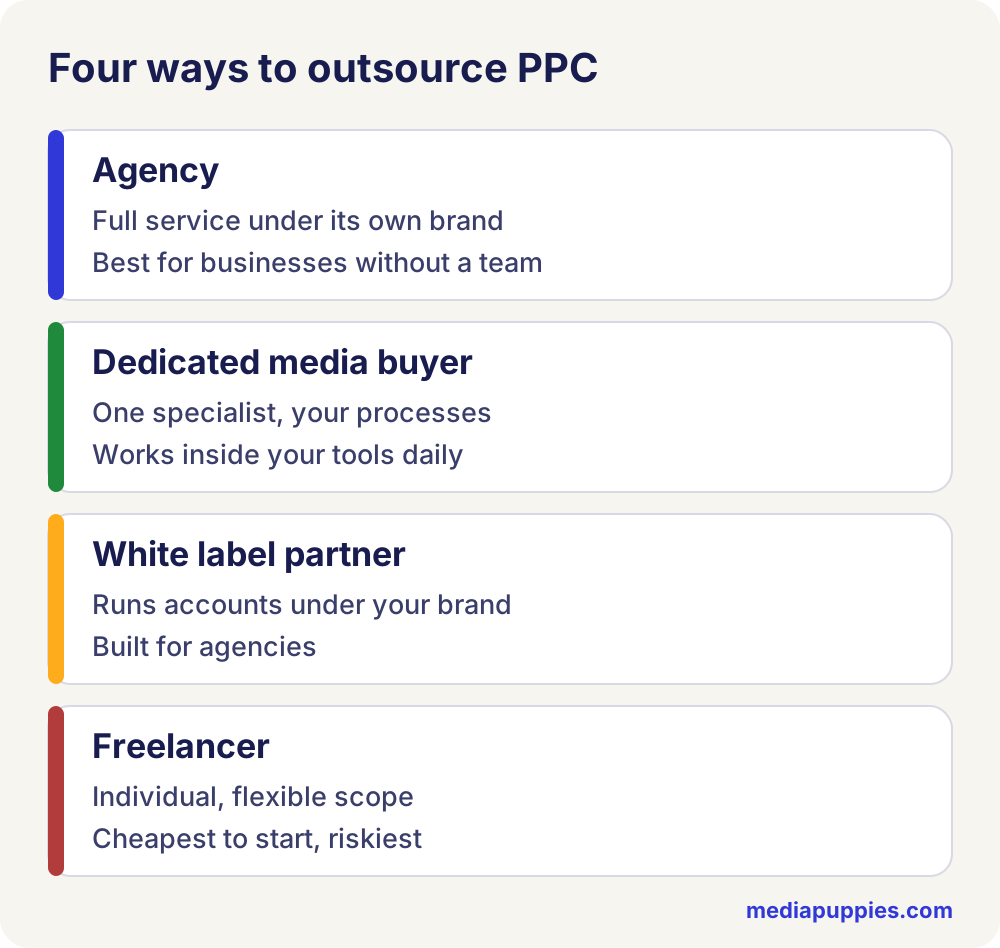
| Model | Who it suits | How it works | Main risk |
|---|---|---|---|
| Agency | Businesses without an in-house marketing team | Strategy, setup, management and reporting as a service | Junior staff on your account; generic reporting |
| Dedicated media buyer | Businesses or agencies with their own processes | A named specialist works inside your tools and meetings | Depends on one person; needs good management |
| White label partner | Agencies selling PPC to their clients | Partner runs accounts under the agency's brand | Scope gaps; communication through the agency |
| Freelancer | Small, focused accounts | Individual on hourly or monthly terms | Availability, continuity and security controls |
Agencies reselling PPC usually want a white label PPC partner. Businesses that want a specialist working as part of their team usually want to hire a dedicated media buyer.
Time zones: making the overlap work
India Standard Time is UTC+5:30 and does not change for daylight saving, so the gap with your office moves twice a year.
| Your location | Gap with India | Typical overlap |
|---|---|---|
| US Eastern | India is 9.5 hours ahead (summer) or 10.5 hours (winter) | India's evening is your early morning |
| US Pacific | 12.5 or 13.5 hours | Little natural overlap; plan around one daily window |
| UK | 4.5 hours (summer) or 5.5 hours (winter) | Your morning is India's afternoon: three to four shared hours |
| Sydney | India is 4.5 hours behind (winter) or 5.5 hours (summer) | Your afternoon is India's morning |
Daylight saving shifts catch teams out every March and November, when the US, UK and Australia change clocks on different dates and India does not change at all. Put meeting times in both zones in the calendar invite, and confirm them the week clocks change.
The overlap matters less than people expect if the work is designed for it. Changes, investigations and reports happen during India's day; one short call or a written summary hands over to your team. Use our time zone overlap calculator to find the shared hours, and read working with an offshore media buyer for how to make writing the default.
What to keep in-house
Outsourcing the execution does not mean outsourcing the decisions. Keep these with someone on your side:
- Business goals and targets: what a customer is worth, what you can pay for one, and which products or services matter most.
- Approvals for budget increases, new campaigns and anything legally sensitive in ad copy.
- Brand voice and regulated claims, especially in finance, health and legal services.
- Sales feedback: which leads were good, which were not. No partner can see that without you.
- Ownership of every account and asset.
Access and ownership
- You own the ad accounts, the analytics property, the tag manager container and the Meta Business portfolio. The partner gets user access through your manager account or business portfolio.
- Give the least access that does the job: Standard rather than Admin in Google Ads where possible; specific asset permissions in Meta.
- Keep billing on your card or invoice, not the partner's.
- Use named individual logins with two-step verification, never shared passwords.
- Review access quarterly and remove people who have left the account.
- Keep a simple access register: who has access to which account, at what level, and since when. It makes offboarding a five-minute job.
If a partner insists on running your ads from accounts they own, walk away. Your account history is a business asset.
Contracts: what to put in writing
A short, clear agreement prevents most disputes. At a minimum, cover:
- Scope: platforms, campaign types, number of accounts, reporting, and what costs extra (creative, landing pages, tracking projects).
- Fees and payment terms, and whether the fee changes as spend grows.
- Response times and working hours, stated in both time zones.
- Ownership: accounts, data, reports, creative and campaign structures belong to you.
- Confidentiality and non-solicitation (important for agencies using white label partners).
- Notice period and handover: what the partner must hand back, and how quickly, when the engagement ends.
- Governing law and dispute resolution: many international agreements name the client's jurisdiction or use arbitration.
Our checklist of what to check in an agency contract goes clause by clause.
Data protection
PPC work involves customer data: conversion uploads, customer match lists, CRM exports and call recordings. Handle it deliberately.
- UK and EU clients: India does not have an adequacy decision from the UK or the EU, so transfers of personal data usually need a transfer mechanism such as the EU standard contractual clauses or the UK's international data transfer agreement or addendum, plus a data processing agreement.
- India's Digital Personal Data Protection Act, 2023 applies to the partner's own handling of personal data in India.
- US clients: state privacy laws and, for health-related businesses, HIPAA may apply to customer data shared for advertising.
- Minimise: share hashed lists and only the fields the platform needs; avoid emailing raw customer files.
Payments and invoicing
- Currency: most Indian agencies invoice international clients in USD, GBP, AUD or EUR. Agree who carries exchange-rate movement.
- Method: bank wire, or payment platforms that handle international business payments. Ask which the partner uses and what fees each side pays.
- Tax: exports of services from India are usually zero-rated for GST when the supplier files a letter of undertaking, so a properly set-up Indian partner should not add Indian GST to your invoice.
- Your side: check your own country's rules for paying overseas suppliers, such as US tax forms or UK reverse-charge VAT.
Monthly invoicing in advance for a fixed fee is the most common arrangement. Avoid paying several months upfront to a partner you have not worked with before.
The details are in paying an Indian agency from overseas.
The first 30 days
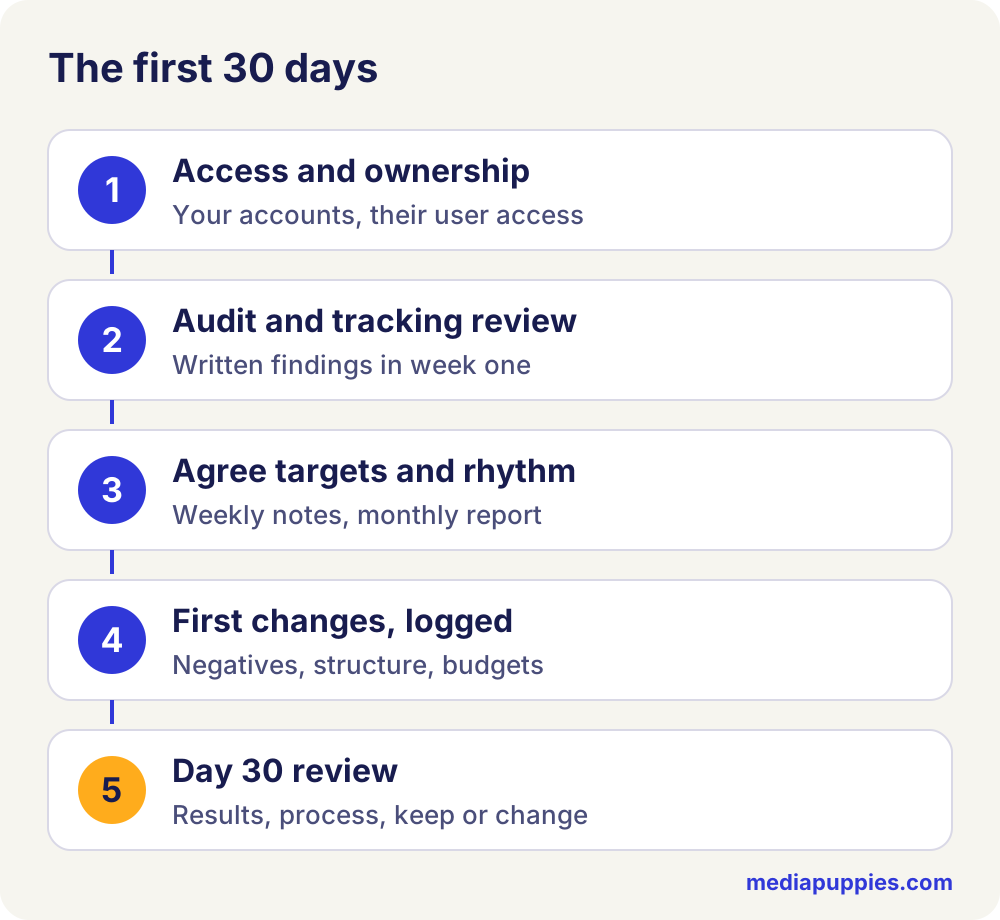
- Days 1 to 3: access granted, onboarding questionnaire completed, goals and targets agreed in writing.
- Days 3 to 10: account and tracking audit, with written findings and a prioritised plan.
- Days 10 to 20: tracking fixes first, then the clearest wins: negatives, location settings, budget reallocation, broken pages.
- Days 20 to 30: first structural changes, logged, and the first full report with commentary.
- Day 30: a review call on results and on the working relationship. Fix process problems now, while they are small.
A communication rhythm that works across time zones
- Daily: a short written note only when something changed or broke.
- Weekly: changes made, results against target, next week's plan, questions for you.
- Monthly: a report in business terms with commentary, and a call in the overlap window.
- Quarterly: strategy review, forecast and targets for the next quarter.
- Urgent issues: a named contact and channel on each side, with a response time in the agreement.
Red flags when outsourcing PPC
- They want to own or create your ad accounts.
- Guaranteed results or guaranteed rankings.
- Vague reporting built on clicks and impressions, with no cost per lead or sale.
- No named person on your account, or frequent unexplained changes of contact.
- Hidden markups on ad spend, or reluctance to let you see the account.
- No questions about your business, margins or sales process before proposing a plan.
- Long lock-in contracts before they have proved anything.
- Shared logins or requests for your passwords.
Questions to ask on the first call
- Who exactly will work on our account, how many other accounts do they manage, and who covers when they are away?
- Can we see an anonymised account you manage, with its change history and a recent report?
- How do you handle access, and will you work entirely inside our accounts?
- What will you do in the first 30 days, and what will we have in writing at the end of it?
- How do you set targets, and what happens when results fall short?
- Which hours will you be reachable in our time zone, and how fast do you respond to urgent issues?
- How is the fee calculated, and what costs extra?
Good partners answer these specifically and without hesitation. Vague answers about "our team" and "our process" are a warning.
Testing a partner with a pilot
A short pilot shows more than any proposal. Pick one account or one campaign group, agree what success looks like, and run it for six to eight weeks.
- Define the measure before starting: cost per qualified lead, cost per acquisition or return on ad spend, compared with the previous period and adjusted for seasonality.
- Judge the process as well as the numbers: quality of the audit, clarity of weekly notes, speed of response, and whether they asked the right questions about your business.
- Agree the exit: if the pilot fails, access is removed and everything built stays with you.
Our guide to an agency pilot project has a template.
Holidays, cover and continuity
Indian public holidays differ from US, UK and Australian ones, and the biggest, such as Diwali and Holi, move each year with the calendar. A professional partner shares its holiday calendar in advance and arranges cover so accounts are monitored every day. Ask how they document each account, so that a second person can step in during leave or illness without starting from scratch. Continuity also matters at your end: name a backup contact who can approve urgent changes when your main contact is away.
What good outsourced PPC reporting looks like
Reporting is how you see what you are paying for. A good monthly report from an outsourced team:
- opens with results against the target you agreed, in business terms;
- explains what changed in the account and why, in plain language;
- states honestly what did not work and what will be tried next;
- reconciles with what you see in the ad platforms and your CRM;
- arrives on the agreed day, every month.
If you cannot tell from the report whether the account is getting better, ask for a different report. Our guide on how to read an ads report shows what to look for.
Common misconceptions
- "Offshore means junior." Experience varies everywhere. Judge the named person and their work, not the location.
- "We will lose control." Control comes from ownership, access rules and reporting, all of which stay with you.
- "Communication will be hard." Written, scheduled communication often works better than ad hoc calls, and it leaves a record.
- "It only makes sense for big budgets." It makes sense when professional management pays for itself, which depends on margins and goals more than spend alone.
Regulated industries need local knowledge
An India-based team running ads for US, UK or Australian businesses must know the rules of the client's market, not just the platforms. Test for it before signing.
- US: Meta's special ad categories for housing, employment and credit limit targeting; state privacy laws affect tracking; health businesses may face HIPAA questions on pixels and data.
- UK: the CAP Code governs ad claims, and financial services ads must meet FCA financial promotion rules; see FCA financial promotions in paid media. Consent Mode matters for UK tracking.
- Australia: consumer law on misleading claims, and strict rules for health services and therapeutic goods.
Ask the partner how they handled a recent policy rejection or compliance issue in your industry. A specific, confident answer is a good sign.
Outsourcing for an agency versus for your own business
The setup differs depending on whose ads they are.
- For your own business, the partner works directly with your marketing lead, joins your meetings when useful, and reports to you. A dedicated media buyer or an agency fits.
- For an agency's clients, the partner stays behind the agency's brand, never contacts the client directly, and writes reports in the agency's template and voice. That is a white label arrangement, and it needs non-solicitation and confidentiality terms in the contract.
Be clear which you need from the first conversation; it changes how the partner staffs, communicates and reports.
A day in an outsourced PPC relationship
Here is how a typical day can run for a hypothetical Chicago-based home services company working with a team in India.
- 8:30am Chicago (7pm in India): the client's marketing manager reads the overnight note: two disapproved ads fixed, 35 negative keywords added, budget moved from a weak service area to a strong one, and a question about a new promotion.
- 9am Chicago (7:30pm in India): a 15-minute call on the promotion while the India team lead is still online.
- During the Chicago day: the client's team handles leads and sales; the India team is offline.
- Overnight in Chicago (the India working day): the team builds the promotion campaign, checks tracking, and has it ready for approval by morning.
The client's team spends its day on customers, and the account work is done by the time they start. The model only works because everything is written down.
Is outsourcing PPC to India right for you?
It usually suits businesses and agencies that spend enough on ads for professional management to pay for itself, can name one person to own the relationship on their side, and are comfortable working mostly in writing. It suits them less when the work depends on constant real-time collaboration during US business hours, or when nobody internally can give feedback on lead quality. If you are weighing it against building a team, see outsourcing PPC management and building an offshore marketing team.
Media Puppies is based in Noida, India, and runs Google, Meta and LinkedIn ads for businesses and agencies in the US, UK, Canada and Australia, as an agency, a dedicated media buyer or a white label partner. You get a named specialist, partner access on your own accounts and a weekly written report, month to month with no lock-in. Fees depend on scope, and we say it on the first call.
Questions people ask before hiring
Is it safe to outsource PPC to India?
Yes, when you keep ownership of every ad account, give named users the least access needed, sign a clear contract with data protection terms, and get written weekly reporting.
How do time zones work when outsourcing PPC to India?
India is UTC+5:30 with no daylight saving. US clients typically get work done overnight with a short morning overlap; UK clients share three to four working hours.
Which outsourcing model should I choose?
Businesses without a team usually choose an agency or a dedicated media buyer; agencies selling PPC to clients usually choose a white label partner.
Who should own the ad accounts when outsourcing?
You should. The partner works through user access on accounts, analytics and tag manager that remain in your name.
Do Indian agencies charge GST to overseas clients?
Exports of services are usually zero-rated for GST when the supplier files a letter of undertaking, so a properly registered partner normally does not add Indian GST.
What are the red flags when outsourcing PPC?
Wanting to own your accounts, guaranteed results, vague reporting, no named contact, hidden markups on spend and long lock-in contracts.
What should I keep in-house when I outsource PPC?
Business goals, targets, approvals, brand and legal sign-off, sales feedback on lead quality, and ownership of every account.