

White label Google Ads management is an arrangement where a specialist partner builds and runs Google Ads campaigns for an agency's clients, while the agency sells, owns the relationship and reports under its own brand. The client sees one agency. Behind it, the partner's team handles keyword research, campaign builds, bidding, Performance Max, Shopping feeds, conversion tracking and weekly optimisation.
Done properly, white label Google Ads management lets an agency offer paid search without hiring a PPC team, and grow the service without each new client adding a week of work to someone already stretched. It depends on three things being set up cleanly from the start: who owns and accesses each account, exactly what the partner does inside it, and how results reach the client under the agency's name. This guide covers each of those for the Google Ads side specifically. For the model in general, see how white label PPC works.
How white label Google Ads management works
The usual flow looks like this:
- The agency signs the client and agrees goals, budget and services under its own contract.
- The agency briefs the partner: business, offer, locations, goals, existing account history and any constraints.
- The partner audits the existing account or builds a new one inside the client's Google Ads account.
- The partner runs the account week to week and keeps a written change log.
- The agency receives a report and commentary each month (and often weekly notes) and presents it to the client as its own.
- The agency handles client calls, upsells and renewals; the partner joins calls only if the agency wants a "team member" there under the agency's name.
The partner never invoices the client and never contacts them outside what the agency agrees. The agency stays in charge of the relationship and the margin.
The model suits agencies of different kinds: SEO and web design agencies whose clients ask for paid search, social-first agencies that want to add Google, and established PPC agencies that need overflow capacity or a specialist for Shopping and Performance Max. What they share is a need for consistent delivery without the cost and risk of hiring before the client base justifies it.
Account access: MCC, ownership and billing
Most white label problems start with access. Get this right on day one and almost everything else becomes easier.
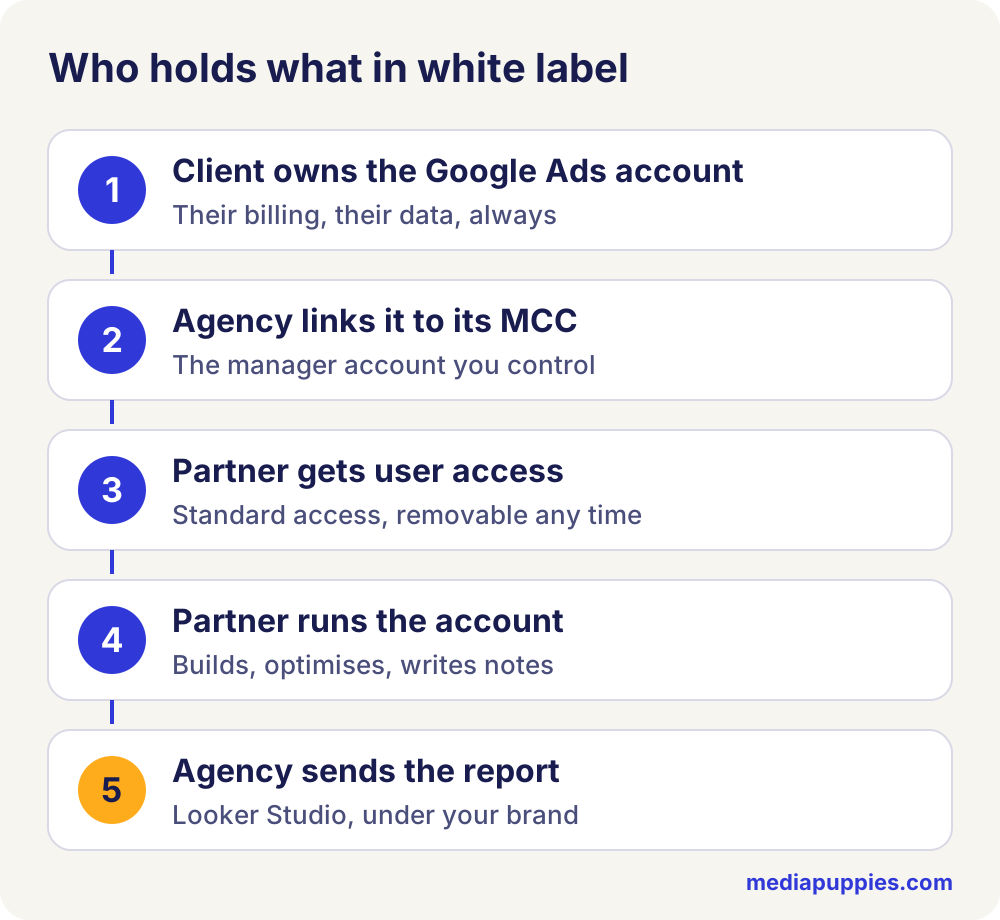
- The client owns the Google Ads account. Their business details, their payment method, their data. If the relationship ends, the account and its history stay with them. This protects the client and, in practice, the agency's reputation too.
- The agency links the account to its manager account (MCC). That gives the agency a single place to see every client and control access.
- The partner gets user access to each client account, usually Standard access, or works through a sub-manager account under the agency's MCC. Either way, the agency can remove it in minutes.
- Billing stays with the client. Paying for media through the agency adds cash-flow risk and makes the agency a creditor to Google for client spend. Most agencies avoid it.
- Analytics and tag access follow the same pattern: the client owns the GA4 property and the Google Tag Manager container; the agency and partner get user access.
Avoid any setup where the partner creates accounts under its own manager account or its own email. If the partner disappears, the agency and client lose the account history.
What the partner should handle, campaign by campaign
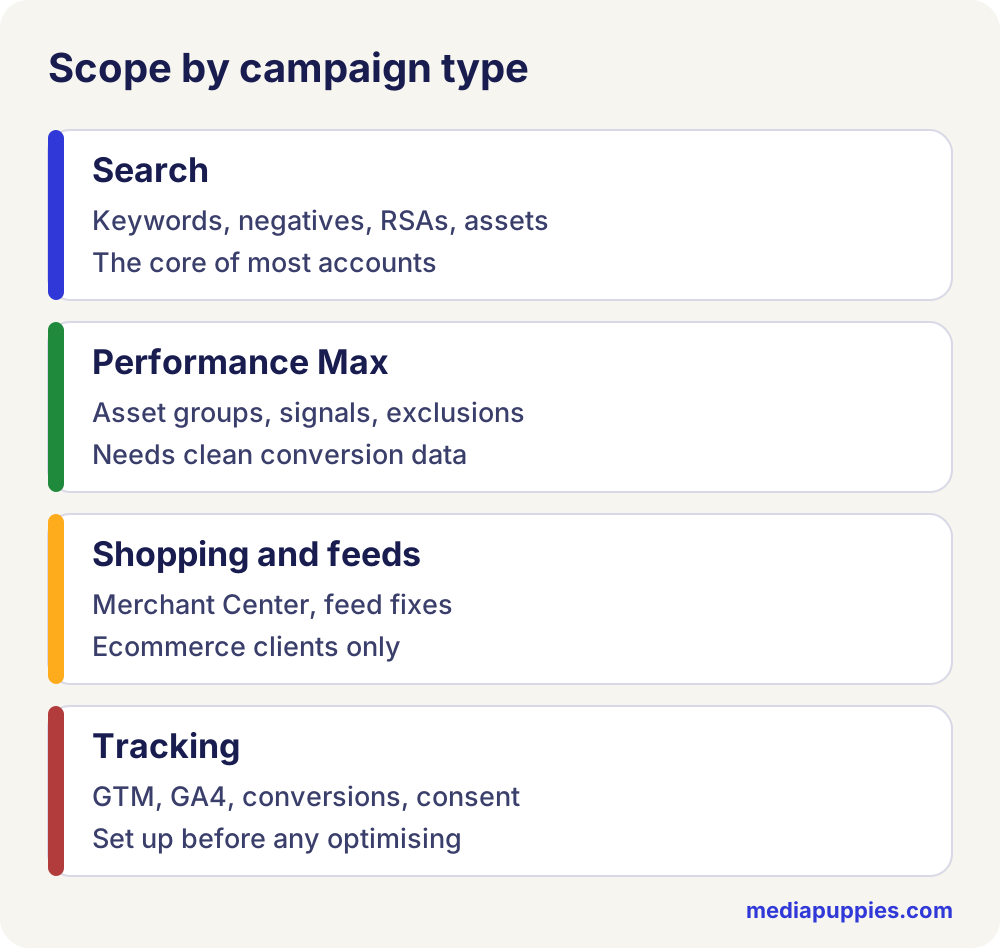
"We'll manage your Google Ads" means different things to different partners. Write the scope down by campaign type.
| Area | Typical partner tasks | Agree up front |
|---|---|---|
| Search | Keyword research, structure, responsive search ads, assets, negatives, bids, search terms review | How many campaigns and ad groups are included; how often search terms are reviewed |
| Performance Max | Asset groups, audience signals, brand exclusions, placement and URL exclusions, feed links | Who supplies images and video; whether new assets are produced |
| Shopping and Merchant Center | Feed diagnostics, product disapprovals, custom labels, campaign split by margin | Who fixes the feed at source (often the client's developer) |
| Display and YouTube | Remarketing, placement exclusions, video campaigns | Whether video creative is included or extra |
| Local Services Ads | Setup, job types, budget, disputes | Who answers lead disputes and verification requests |
| Tracking | Conversion actions, GA4 links, GTM tags, enhanced conversions, offline imports | Who has access to the website and CRM |
| Landing pages | Recommendations, sometimes builds | Whether page builds are in scope |
The most common gap is creative and landing pages. Performance Max needs images and video, and a weak landing page caps what any bid strategy can do. Decide who produces them before the client asks.
Conversion tracking before optimisation
A white label partner who starts optimising before tracking is fixed is optimising toward the wrong thing. Tracking is the first deliverable, not an extra.
- Audit existing conversion actions: duplicates, page-view goals set as primary, imported GA4 goals that double count, and missing call tracking.
- Set primary conversions to the actions the business actually values: purchases, qualified leads, booked calls.
- Turn on enhanced conversions where the site and consent setup allow it.
- Handle consent properly for UK and EU visitors with Consent Mode, and check US state privacy rules for the client's market.
- Plan offline conversion imports for lead generation clients whose CRM records which leads became customers.
The checks are set out in how to check Google Ads conversion tracking. Agencies should insist on a written tracking summary for each new account before any bid strategy changes.
Reporting in Looker Studio under your brand
Reporting is where white label becomes visible to the client, so it needs to look and read like the agency's own work.
- Looker Studio dashboards built on the agency's template, with the agency's logo, colours and domain, connected to Google Ads, GA4 and, where available, CRM data.
- Owned by the agency's Google account, shared with the partner for editing and with the client for viewing.
- A written monthly summary in the agency's voice: what happened, why, what changed, what comes next. Numbers without commentary are not a report.
- Business metrics first: leads, qualified leads, sales, revenue, cost per acquisition and return on ad spend, ahead of clicks and impressions.
Our guide to white label reporting covers report contents and branding in more detail.
Communication: how the agency and partner work together
The client relationship belongs to the agency, but the agency needs enough information to sound confident on every call.
- A shared channel per client (Slack, Teams or email thread) where the partner posts weekly notes and the agency asks questions.
- A weekly summary of changes and results for each account, even when nothing dramatic happened.
- Alerts within the day for anything urgent: disapprovals, tracking breaks, budget overspend, a sudden drop in conversions.
- A briefing before every client call on request, so the account manager can answer questions without guessing.
- Agreed response times, set out in the service agreement, including how time zones affect them.
Partners in India often run accounts while US and UK agencies sleep, so changes, notes and reports are ready at the start of the agency's day. That only works if the hand-off is written, not dependent on calls.
An onboarding checklist for each new client
A repeatable onboarding saves a week on every account and stops important details falling between the agency and the partner.
- Access: Google Ads linked to the agency MCC, partner user added, GA4 and Tag Manager access granted, Merchant Center access for ecommerce, and website or CMS access if tracking changes are in scope.
- Business brief: services or products in order of priority, margins or lead values, locations served, seasonality, competitors, and anything the client must never say in ads.
- Goals: one primary measure (cost per qualified lead, cost per acquisition or return on ad spend) and a target agreed with the client.
- History: what was tried before, what worked, what failed, and why the client changed agencies if they did.
- Approvals: who signs off on ad copy, landing pages and budget changes, and how quickly.
- Reporting: which template, which day of the month, and whether weekly notes go to the client or stay internal.
- Escalation: named contacts at the agency and the partner for urgent issues.
Keep the completed checklist in a shared folder for each client. When someone new joins either side, it is the first document they read.
Handling client questions and calls
Clients ask about their Google Ads at awkward moments: a sudden drop in leads, a competitor's ad they saw, a recommendation email from Google. The agency answers; the partner makes sure the agency can.
- Google's recommendation emails: clients often forward them. The partner should explain which recommendations suit the account and which do not, in plain words the agency can pass on.
- "Why did my leads drop?": the partner should be able to show, within a day, whether the cause was tracking, budget, competition, seasonality or the website.
- Competitor ads: the auction insights report shows who else appears and how often. It turns a worried client question into a short, factual answer.
- Calls with the client: some agencies bring the partner's specialist on as a member of their team, using an agency email address. Agree this in advance, and keep it consistent.
When to bring Google Ads in-house instead
White label is not the right answer forever for every agency. It usually makes sense while the agency has fewer clients than would justify a full-time specialist, or when it needs to grow quickly without hiring risk. Bringing the work in-house becomes worth considering when:
- the agency manages enough Google Ads spend and accounts to keep one or more specialists fully busy;
- clients increasingly want to talk to the specialist directly and often;
- the agency wants paid search to become a core skill it sells and teaches, not a service it resells.
Even then, many agencies keep a partner for overflow, holidays and specialist work such as Shopping feeds or offline conversion imports. The agency vs in-house calculator helps compare the cost of each route.
Ecommerce clients: Shopping, feeds and Performance Max
Ecommerce accounts add work that service accounts do not have, and they are where a white label partner's depth shows most.
- Merchant Center health: disapproved products, missing identifiers, price and availability mismatches, and shipping settings. A partner should check diagnostics weekly and send the agency a short list of fixes for the client's developer.
- Feed quality: product titles that lead with what people search for, accurate product types, and custom labels for margin, best sellers and seasonal lines, so campaigns can bid differently on each.
- Campaign split: separating high-margin products, best sellers and the long tail stops Performance Max spending most of the budget on a few cheap items.
- Brand protection: brand exclusions in Performance Max and a separate brand Search campaign keep reported results honest; see Performance Max brand exclusions.
- Value-based bidding: passing real order values, and ideally profit-adjusted values, so return on ad spend targets reflect margin rather than revenue.
Agree up front whether feed fixes at source are the partner's job, the client's developer's, or a paid extra. It is the single most common scope dispute on ecommerce accounts.
Pricing models for white label Google Ads
Partners usually charge in one of three ways: a fixed fee per account, a percentage of the client's ad spend, or hourly or per task. Each has trade-offs for the agency's margin and for how the partner behaves as spend grows. We compare them in white label PPC pricing. Whatever the model, agree what is excluded: account builds, tracking projects, landing pages, creative and extra platforms are the usual extras.
Google's own third-party policy matters here. Agencies that manage Google Ads for clients are expected to give those clients access to cost and performance data and to be honest about how they charge. White label arrangements need to respect that: the client should be able to see their own account data at any time, even if the agency's report is the main view.
A worked example: one month on a new account
All numbers here are hypothetical, to show what a partner's first month typically covers. Say an agency signs a US home improvement client spending $8,000 a month on Search, with no conversion tracking beyond a GA4 page-view goal.
- Week 1: the partner audits the account, finds the page-view goal set as primary and call tracking missing, and sends the agency a written plan.
- Week 2: with the client's developer, the partner sets up form and call conversions, removes the page-view goal from primary, and adds 140 negative keywords from the last 90 days of search terms.
- Week 3: campaigns are split by service, ads rewritten with location and service in headlines, and location targeting changed to presence only.
- Week 4: the first branded Looker Studio report and a one-page summary go to the agency, which presents them to the client.
Say reported conversions fall from 210 page-view "conversions" to 38 real leads. That looks like a drop, and it is the most important result of the month: the client now knows what the account actually produces. The agency's job is to explain that clearly before the client sees the number. The month-two work then focuses on raising those 38.
Choosing a white label Google Ads partner
- Ask to see a real account, anonymised, with the change history and a recent report.
- Ask how they handle access: do they insist on client-owned accounts and agency control?
- Ask for their tracking checklist and how they treat Performance Max brand exclusions.
- Ask who exactly works on your accounts, how many accounts each person manages, and who covers holidays.
- Start with a pilot of one or two accounts with clear success measures. Our guide to an agency pilot project sets one up.
- Read the agreement for non-solicitation of your clients, confidentiality, data handling and notice periods.
Risks, and how to avoid them
- The partner contacts your client directly. Prevent it with a non-solicitation clause and by keeping all client communication through the agency.
- Accounts sit in the partner's MCC. Keep every account client-owned and linked to your MCC.
- Reports arrive late or generic. Agree delivery dates and a commentary standard in writing.
- Scope creep. Landing pages, creative and tracking projects arrive as surprises unless the agreement lists them.
- Client sees a different story in Google Ads. Make sure report numbers reconcile with the account, and explain differences between Google Ads and GA4 figures upfront.
- Single point of failure. Ask how the partner documents each account so another person can pick it up.
Getting started with white label Google Ads management
Start with one client whose account you know well, so you can judge the partner's work against your own understanding. Agree access, scope, tracking standards, reporting format and response times before the first login, then review after 30 and 90 days. Once the process works, every new client follows the same playbook.
Our white label PPC team runs Google Ads for agencies in the US, UK, Canada and Australia under the agency's brand, with partner access on the client's own account, a named buyer, and reporting in your template (in your Looker Studio workspace if you use one). Pricing depends on the number of accounts and campaign types, and we say it on the first call.
Questions people ask before hiring
What is white label Google Ads management?
A partner builds and runs Google Ads campaigns for an agency's clients, while the agency owns the client relationship, sets the price and reports under its own brand.
Who should own the Google Ads account in a white label setup?
The client. The agency links the account to its manager account and gives the partner user access, which the agency can remove at any time.
Does the client know a white label partner is involved?
Usually not. The partner works under the agency's name and does not contact the client unless the agency arranges it, although the client can always see its own account data.
What should a white label Google Ads partner cover?
Search, Performance Max, Shopping where relevant, conversion tracking and reporting. Agree in writing whether creative, landing pages and tracking projects are included.
How are white label Google Ads reports branded?
Usually as Looker Studio dashboards on the agency's template and Google account, with a written summary in the agency's voice.
How is white label Google Ads management priced?
Commonly a fixed fee per account, a percentage of ad spend, or hourly. Each changes the agency's margin and the partner's incentives differently.
How do I test a white label partner?
Run a pilot on one or two accounts with clear goals, access rules and reporting dates, and review the work after 30 and 90 days.