

Offshore digital marketing services are marketing tasks delivered by a team in another country, usually one with a large time-zone difference and a deep pool of specialists, such as India or the Philippines. US, UK and Australian companies use them for paid media management, SEO, creative production, reporting and marketing operations, while keeping strategy, brand and approvals in-house.
The companies that get good results from offshore digital marketing services decide which services to send offshore one at a time, vet providers on their actual work rather than their pitch, and write expectations into a service level agreement (SLA) that covers response times, quality, reporting, security and exit. This guide walks through each of those steps. If you are deciding between building a team and buying a service, start with building an offshore marketing team.
Offshoring is not only for large companies. Smaller businesses often benefit most, because they cannot justify a full-time specialist for each channel but still need paid media, reporting and creative done well every week. Buying those services from a capable offshore provider can give a small team the depth of a much larger one, as long as someone in-house owns the relationship and the decisions.
Which services offshore well, and which do not
The test is simple: work that can be clearly specified, measured and handed over in writing offshores well. Work that depends on constant judgement calls about your brand, your customers or your market in real time stays closer to home.
| Service | Offshores well? | Why |
|---|---|---|
| Paid search and paid social management | Yes | Platform work is measurable, documented in the account, and benefits from overnight attention |
| Technical SEO audits and fixes | Yes | Clear tasks, clear checks, results visible in tools |
| SEO content writing | With care | Needs strong briefs, native-level editing and subject expertise |
| Link building | Caution | Cheap link schemes breach search engine guidelines and can harm rankings |
| Design, resizing and video editing | Yes | Brief-driven production with clear deliverables |
| Analytics, tracking and reporting | Yes | Technical, rule-based, easy to verify |
| Email builds, CRM workflows and QA | Yes | Specification-driven and testable |
| Community management and replies | Partly | Routine replies yes; sensitive issues need local judgement |
| Brand strategy and positioning | Rarely | Depends on deep, current market and customer knowledge |
| PR and crisis communications | No | Needs local relationships and real-time decisions |
Paid media: the most common service to offshore
Google Ads, Microsoft Ads, Meta, LinkedIn and TikTok management offshore well because almost everything is visible in the platforms: changes, results and spend. An offshore specialist can review search terms, adjust budgets, test creative and fix disapprovals during your night, so problems are solved before your team starts work.
- Keep ownership: the accounts, billing and data stay in your name, with user access for the provider.
- Agree targets you set: cost per lead, cost per acquisition or return on ad spend.
- Insist on a change log and weekly notes, so you always know what happened and why.
For PPC specifically, our guide to outsourcing PPC to India covers models, contracts and red flags in detail, and companies that want a specialist inside their team can hire a dedicated media buyer.
SEO: technical work yes, shortcuts no
Technical SEO travels well: crawl audits, page speed fixes, structured data, internal linking, redirects and site migrations follow clear rules and can be checked in tools. Content can work too, with strong briefs, subject-matter input from your team, and editing by someone who writes at native level for your market.
Be careful with link building. Many low-cost offshore SEO offers rely on buying links or placing them on networks of low-quality sites. That breaches Google's spam policies and can cause ranking losses that take months to recover. We explain the risks in should you buy backlinks. A good offshore SEO provider will tell you plainly what it does to earn links, and it will not promise rankings.
Creative and video production
Ad platforms now reward creative volume and variety. Producing enough variations in-house is hard for most teams, and offshore designers and editors fill the gap well.
- Resizing and versioning existing creative for every placement.
- Editing user-generated and testimonial footage into short ads, with captions.
- Static and carousel variations from a brand kit and a brief.
- Motion graphics for product explainers.
Keep the creative strategy, the brief and final approval with your team, and give the provider a clear brand kit: fonts, colours, logo rules, tone of voice, and examples of what good looks like. The creative volume calculator estimates how many new creatives your ad budget needs each month.
Analytics, tracking and reporting
Reporting is one of the best services to offshore, because it is rule-based and repetitive, and because good reporting frees your senior people for decisions.
- Tracking setup and audits: tag manager, GA4, conversion APIs, consent mode.
- Dashboards: Looker Studio or similar, combining ad platforms, analytics and CRM.
- Weekly and monthly reports with commentary, ready at the start of your week.
- Data hygiene: UTM standards, naming conventions and regular checks.
Marketing operations and automation
Behind every campaign sits operational work that slows marketing teams down: CRM hygiene, lead routing, landing page builds, form testing and automation upkeep. It is specification-driven, testable and easy to check, which makes it well suited to an offshore team.
- CRM upkeep: deduplicating records, fixing fields, maintaining lifecycle stages and lead source data.
- Lead routing and alerts: making sure every form, call and chat reaches the right salesperson within minutes.
- Landing pages: building and testing pages from approved designs in your website builder.
- Automation maintenance: checking that email sequences, webhooks and integrations still fire after site or tool changes.
- QA before launches: testing links, forms, tracking and mobile layouts.
These tasks rarely get done well by a busy in-house team, and when they slip, paid media results suffer quietly.
Time zones as an advantage
A large time-zone gap sounds like a problem. For many services it is the main benefit, as long as the work is designed for it.
- Overnight turnaround: a creative brief sent at the end of a US or UK day can come back as finished variations by the next morning.
- Round-the-clock monitoring: ad accounts are checked during your night, when budget overspends and tracking breaks otherwise go unnoticed for hours.
- Ready-made mornings: reports and summaries are waiting when your team arrives.
The price of this is discipline: clear written briefs, one short overlap window for questions, and decisions made in writing. Our guide to working with an offshore media buyer explains how to set up the hand-off.
What to keep onshore
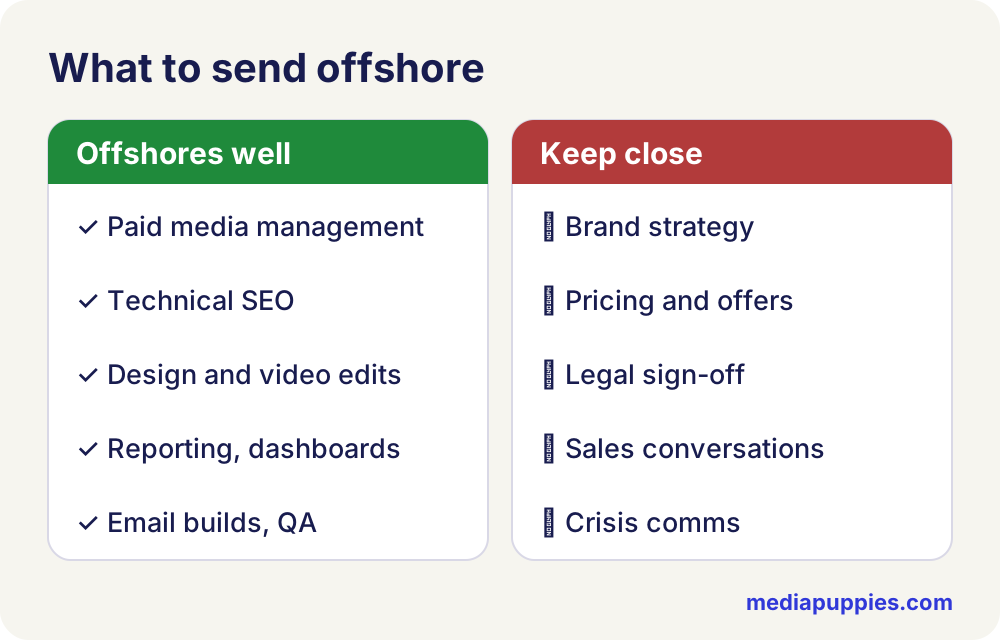
Keep the work that defines your business and carries the most risk if it goes wrong: brand strategy, positioning, pricing and offers, legal and regulatory sign-off, sales conversations, senior client relationships and crisis communications. Offshore teams can support all of these with research, drafts and data, but the decisions belong with people who live in your market and answer for the result.
How to vet an offshore digital marketing provider
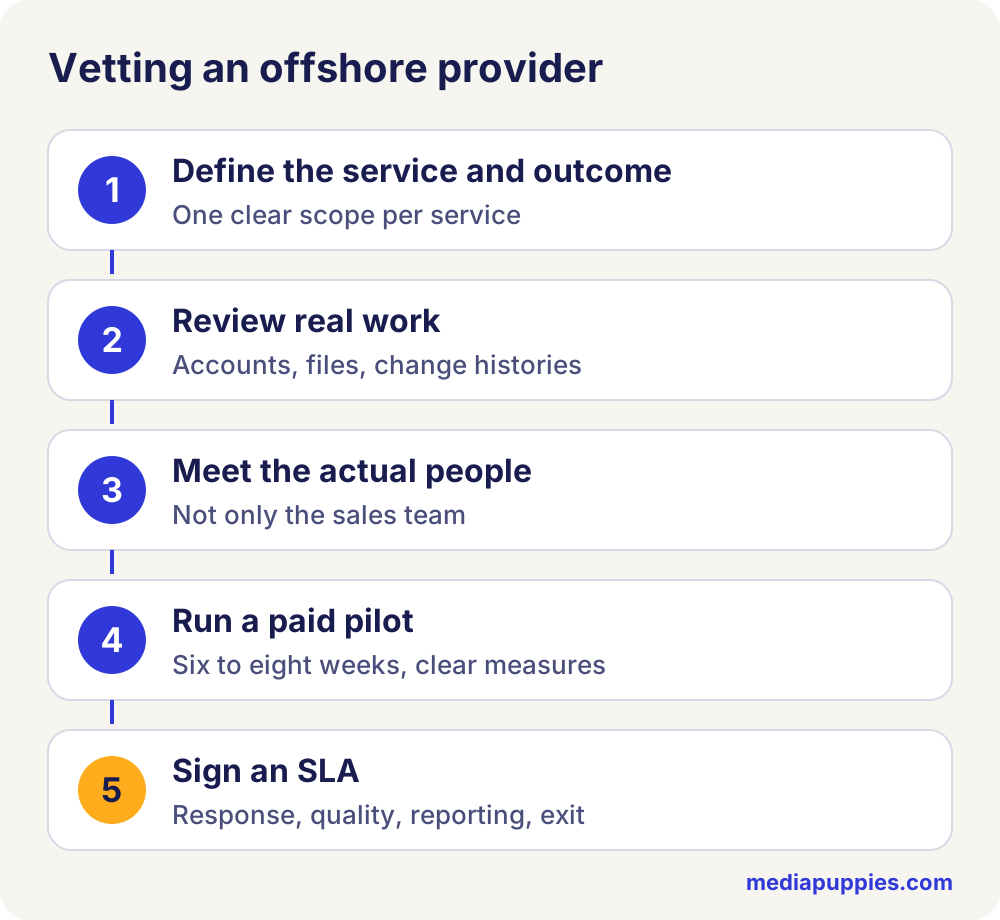
- Define each service and its outcome before talking to anyone. "Manage our Meta ads to a cost per qualified lead under our target" is a scope; "help with marketing" is not.
- Review real work: anonymised ad accounts with change histories, SEO audits they have delivered, design files and before-and-after reports. Pitch decks prove nothing.
- Meet the people who would do the work, not only the sales lead. Ask how many clients each person handles.
- Check references from clients in your country and, ideally, your industry.
- Run a paid pilot of six to eight weeks on one service, with clear success measures. Our guide to an agency pilot project sets one up.
- Sign an SLA before scaling up.
What to put in the SLA
A service level agreement turns expectations into commitments. For offshore digital marketing services, it should cover:
| Area | What to define |
|---|---|
| Working hours and response times | Hours in both time zones; response time for routine requests and for urgent issues |
| Deliverables and turnaround | For example, creative variations within agreed working days; reports by a set day each month |
| Quality standards | Review steps, error correction at no cost, brand guideline compliance |
| Reporting | Format, frequency, metrics and commentary expected |
| Access and security | Named logins, two-step verification, least-privilege access, device and data rules |
| Staffing and continuity | Named people, notice of changes, holiday cover, documentation |
| Escalation | Named contacts and steps when an SLA is missed |
| Exit | Notice period, handover of files, accounts and documentation, and removal of access |
Our guide to a marketing agency SLA includes sample wording, and the marketing agency contract guide covers the legal terms around it.
Security and data protection
- Named individual access to every platform, with two-step verification and no shared passwords.
- Least privilege: give each person only the access their work needs.
- Data processing terms: UK and EU companies usually need a data processing agreement and a transfer mechanism, such as standard contractual clauses or the UK transfer agreement, for personal data sent to countries without an adequacy decision.
- Minimise personal data: share hashed customer lists and only the fields needed.
- Offboarding: remove access the same day someone leaves the account, and review access quarterly.
Onboarding an offshore provider
- Access: named user access to the platforms, analytics, tag manager, design files and shared drives the service needs, and nothing more.
- Documentation: brand guidelines, tone of voice, product information, target audiences, past campaign results and anything that must never be said.
- Process: how requests are made, how approvals work, where work is delivered, and who signs off.
- Tools: a shared project board and a messaging channel, so requests and decisions are written and searchable.
- A first-month plan: agreed priorities, first deliverables and the date of the first review.
Time spent here pays back for the whole relationship. Most early friction comes from missing context, not missing skill.
Questions to ask before signing
- Who exactly will work on our account, and how many other clients do they serve?
- Can we see real, anonymised examples of the service we are buying?
- What happens when a deadline in the SLA is missed?
- How do you protect our data and access?
- Which hours will you overlap with ours, and how do you handle urgent requests outside them?
- What is included in the fee, and what costs extra?
- How do we leave, and what do we get back when we do?
Signs the arrangement is working
- Deliverables arrive on time without chasing.
- Results against targets improve or hold while your team's time goes to higher-value work.
- The provider raises problems and ideas before you notice them.
- Reports reconcile with your own data.
- Your team trusts the work enough to stop re-checking every piece.
If several of these are missing after a quarter, revisit the scope, the SLA or the provider.
Offshore services for agencies
Agencies use offshore services differently from brands. They need the work delivered under their own name, in their own templates, with the provider invisible to their clients. That is white label delivery, and it adds three requirements to everything above: a non-solicitation clause so the provider never approaches the agency's clients, reporting written in the agency's voice and format, and confidentiality about which clients the agency serves. Paid media is the most common white label service, followed by SEO and creative production. Our white label PPC page explains how that works for Google and Meta ads.
Making communication work
Most offshore relationships that fail do so through misunderstanding rather than lack of skill. A few habits prevent most of it.
- Write briefs that stand alone: goal, audience, examples of good and bad, deadline and who approves.
- Ask for questions early: invite the provider to raise doubts before starting, not after delivering.
- Give feedback specifically: "the headline promises too much for a regulated product" teaches more than "not quite right".
- Explain the why: context about your customers and market helps the provider make good decisions on their own.
- Keep one channel: scattered requests across email, chat and calls create gaps.
How offshore services are priced
Providers usually price in one of four ways: a fixed monthly fee per service or account, a dedicated person at a monthly rate, hourly or per-task billing, or a percentage of ad spend for paid media. Fixed fees and dedicated people are easiest to budget; hourly billing suits irregular work; percentage-of-spend models can reward the provider for spending more rather than performing better. Whatever the model, list what is included and what costs extra. The agency vs in-house calculator helps compare against hiring locally.
Managing quality over time
The first months of a new provider are usually the best documented. Quality slips later if nobody keeps watching.
- Monthly review of results against targets and of SLA performance.
- Quarterly business review: what is working, what is not, what to add or stop.
- Spot checks: read a sample of the provider's work each month, such as search terms decisions, creative files or report accuracy.
- Feedback both ways: tell the provider what your sales team hears about lead quality, and ask what slows them down on your side.
A worked example: offshoring three services
This example is hypothetical. Say a US software company with a three-person marketing team spends most of its week on campaign management, creative resizing and reporting, and little on strategy.
- It offshores paid social management, creative versioning and weekly reporting to one provider, under an SLA with next-morning turnaround for routine requests.
- Reports now arrive on Monday morning with commentary. Creative variations for each campaign arrive within the agreed turnaround. Paid social is monitored daily.
- The in-house team uses the time it gets back for positioning, product launches and sales enablement.
The company keeps one internal owner for the relationship, a short weekly check-in in the overlap window, and a monthly review against the SLA. Paid search stays in-house for now, because the team wants to learn from the first service before adding a second.
The measure of success is not the fee saved. It is whether results improve and the in-house team does more valuable work. Review both after one quarter.
Common mistakes with offshore digital marketing services
- Offshoring everything at once instead of one service at a time.
- Choosing on price alone, then paying for it in wasted spend or rework.
- Vague scopes that guarantee disagreements later.
- No SLA, so missed deadlines have no consequence.
- Letting the provider own accounts or creative files.
- Buying cheap link building that harms search rankings.
- No internal owner for the relationship.
Getting started
Pick the one service that takes your team the most time and is easiest to specify, often paid media management, reporting or creative versioning. Write the scope and the outcome, vet two or three providers on real work, run a paid pilot, and sign an SLA before adding more. Expand only when the first service runs smoothly.
Media Puppies is based in Noida, India, and provides paid media management for companies and agencies in the US, UK, Canada and Australia, either as a dedicated media buyer working inside your team or as a white label partner for agencies. Month to month, no lock-in, and we say the fee on the first call.
Questions people ask before hiring
What are offshore digital marketing services?
Marketing work such as paid media management, SEO, creative production and reporting delivered by a team in another country, usually with a large time-zone difference.
Which marketing services are best to offshore?
Work that can be clearly specified and measured: paid media management, technical SEO, design and video editing, analytics and reporting, and email or CRM builds.
What should not be offshored?
Brand strategy, pricing and offers, legal sign-off, sales conversations, senior client relationships and crisis communications are usually best kept close.
How do I vet an offshore marketing provider?
Define the scope, review real work such as account histories and delivered files, meet the people who would do the work, check references, and run a paid pilot.
What goes in an SLA for offshore marketing?
Working hours and response times, deliverables and turnaround, quality standards, reporting, access and security, staffing continuity, escalation and exit terms.
Is offshore link building safe?
Cheap link building that buys or places links on low-quality networks breaches search engine spam policies and can harm rankings. Ask exactly how links are earned.
How are offshore digital marketing services priced?
Commonly as a fixed monthly fee, a dedicated person at a monthly rate, hourly or per task, or a percentage of ad spend for paid media.