

Key findings
- Only 26.2% of the 355 US local advertisers we scored passed all four basics: an offer in the ad, a clear ask in the ad, a way to call or enquire on the first phone screen of the landing page, and Meta pixel code on that page. 2% passed none.
- The offer was the basic most often missing. 54.1% had an offer in at least one ad's text, against 66.8% with Meta pixel code on the page, 76.6% with a way to act on the first screen and 79.2% with a clear ask.
- Of the 163 advertisers with no offer in their ad text, 43 (26.4%) had a free offer such as a free consultation or estimate on the landing page.
- Advertisers whose ads had both an offer and a clear ask were more likely to have Meta pixel code on the page (74.9% against 59.6%), but no more likely to show a way to act on the first screen (74.3% against 78.7%).
- Med spas had the highest all-four rate, 33.1%. Real estate agents had the lowest, 14%, and 14% of them passed none of the four.
Meta Ad Library (ads) and our own phone visits to the landing pages · 355 advertisers scored, out of 723 advertisers with 1,112 live ads · 3 November 2026 (ads) and 7 November 2026 (landing pages) · How we did this · Download the data (CSV)
This study follows Facebook ads for local business from the ad to the page someone lands on after tapping it. We joined four of our own studies of live US ads from law firms, dentists, med spas, home service firms and real estate agents, and scored 355 advertisers on four basics.
Only 26.2% passed all four. The checks were simple: an offer in the ad, a clear ask in the ad, a way to call or enquire on the first screen of the landing page, and Meta pixel code on that page. The basic most often missing from Facebook ads for local businesses was the offer, and 43 of the advertisers without one in their ads had a free offer on their landing page. The per-advertiser data is free to download at the end.
What we checked in Facebook ads for local businesses
We chose checks anyone can see from the outside, without access to the ad account. Each uses the same rule as the study it came from.
- An offer in the ad. At least one of the business's English ads mentions something like a free consultation or estimate, a price, a discount, financing or a special, in its main text, headline or link description. The rule is from our Facebook ad copy study.
- A clear ask in the ad. At least one ad has an action button such as Book now, Call now, Contact us or Get quote, or tells the reader what to do in its main text. A Learn more button does not count.
- A way to act on the first screen. The landing page shows a phone link, a form or an action button before the visitor scrolls, on a phone. This is from our landing page study.
- Meta pixel code on the landing page. The page carries Meta's pixel, which lets the ad account record what visitors do after the click.
Our view is that these four are the floor for a local business. The offer gives a reason to tap, the ask says what to do next, the page makes it easy, and the pixel lets Meta learn which people act. Passing all four does not guarantee leads, and a business can do well while missing one. In our view, missing two or more is a warning sign.
A quarter passed all four
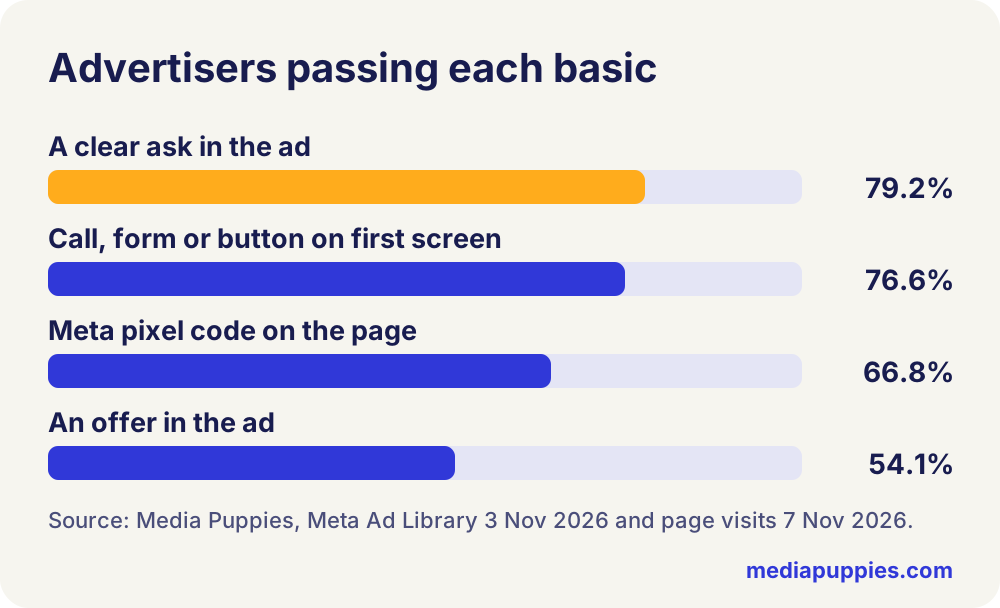
79.2% of the advertisers had a clear ask, and 76.6% had a way to act on the first screen of the page. 66.8% had Meta pixel code on the page, and only 54.1% had an offer in at least one ad. 61.4% had an instruction in the ad text, and 63 more passed on an action button alone.
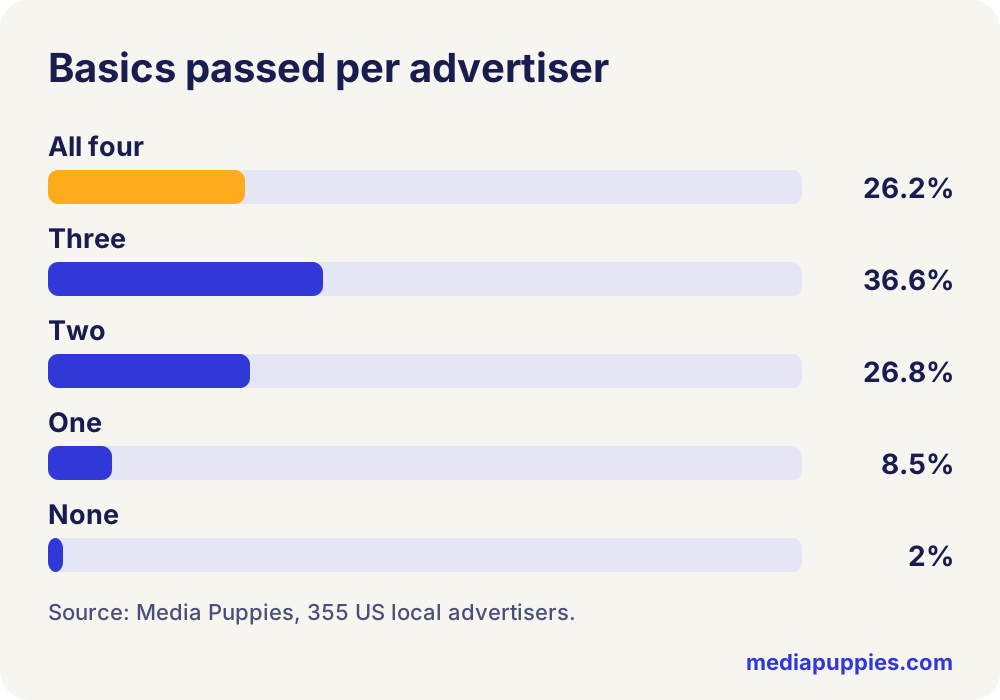
93 of the 355 advertisers passed all four checks. The largest group, 36.6%, passed three. 26.8% passed two, 8.5% passed one and 2% passed none. Among the 130 advertisers that passed exactly three, the missing check was the offer in 42.3% of cases, the first-screen action in 24.6%, the pixel in 23.8% and the ask in 9.2%.
How each trade scored
| Trade | Advertisers scored | Offer in the ad | Clear ask | Act on first screen | Meta pixel code | All four | Average checks passed |
|---|---|---|---|---|---|---|---|
| Law firms | 74 | 52.7% | 66.2% | 85.1% | 74.3% | 20.3% | 2.78 |
| Dentists | 47 | 55.3% | 85.1% | 83% | 68.1% | 29.8% | 2.91 |
| Med spas | 139 | 59.7% | 89.9% | 74.1% | 68.3% | 33.1% | 2.92 |
| Home services | 52 | 55.8% | 82.7% | 82.7% | 57.7% | 23.1% | 2.79 |
| Real estate | 43 | 34.9% | 55.8% | 55.8% | 58.1% | 14% | 2.05 |
| All five trades | 355 | 54.1% | 79.2% | 76.6% | 66.8% | 26.2% | 2.77 |
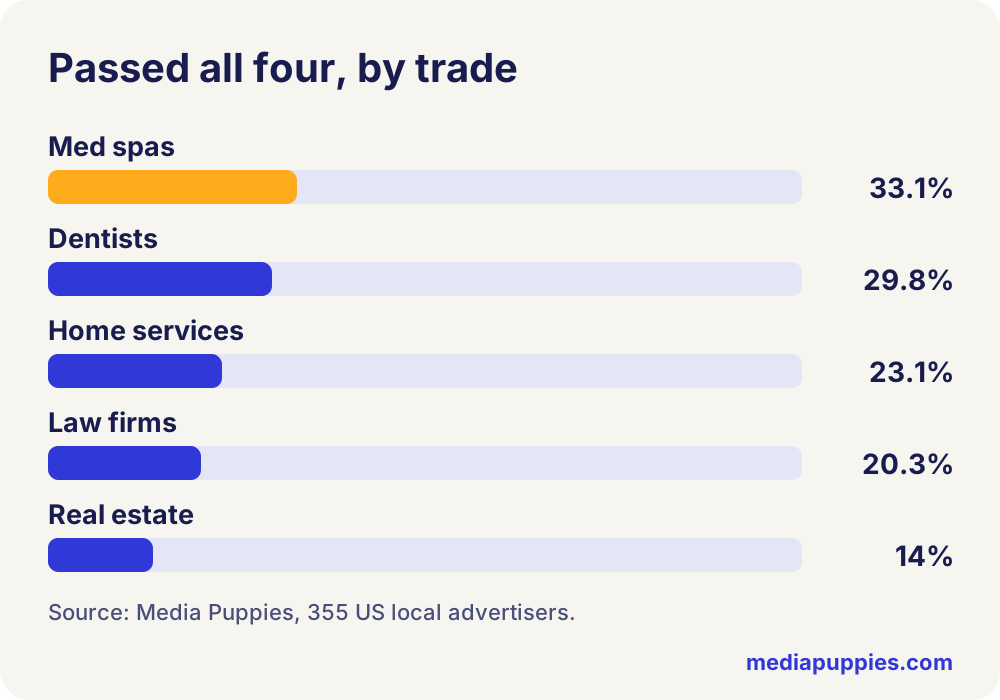
Med spas had the highest all-four rate, 33.1%, helped by the most frequent clear ask (89.9%), often a Book now button. About half their first-screen passes (50 of 103) came from a button alone; only 38.1% of med spas had a phone link or form there. Dentists came next at 29.8%. They also averaged 2.7 English ads each in our sample, more than any other trade, which gave them more chances to pass the two ad checks.
Law firms had the strongest pages. 85.1% showed a call link, form or action button on the first screen (78.4% a call link or form) and 74.3% carried pixel code. Their ads did less well: 52.7% had an offer and 66.2% a clear ask, the second lowest after real estate. Home service firms had the lowest pixel rate, 57.7%. Real estate agents scored lowest on almost every check, averaging 2.05 of the four. Only 11.6% of their advertisers used an action button, and 14% passed none of the checks.
The page made the offer and the ad did not
Of the 163 advertisers with no offer in their ad text, 43 (26.4%) had a free offer on the landing page, such as a free consultation, a free estimate, a free inspection or a no-fee-unless-we-win promise. We visited the pages four days after collecting the ads, so a few may have changed in between.
We think this is the cheapest fix on the list. The business already makes the offer, and one line in the ad can repeat it. Meta's own ads guide recommends short primary text for feed image ads, as our ad copy study noted, so the offer belongs near the start.
Ads with an offer and an ask had the pixel more often
Of the 167 advertisers whose ads had both an offer and a clear ask, 55.7% also passed both page checks. Of the other 188, 47.3% did. The gap came from the pixel: 74.9% of the first group had pixel code on the page, against 59.6% of the rest. On the first screen the order flipped, with 74.3% against 78.7%.
Our guess is that the ad and the page are often made by different people at different times, and nobody checks the two together. Anyone can run that check: open your own ad on a phone, tap it, and see what a customer sees.
Home pages were the least likely own-site pages to carry the pixel
On advertisers' own sites, pixel rates differed sharply by type of landing page. 87.1% of the scored advertisers sending clicks to a separate landing page had Meta pixel code there, against 70.5% of those using an inner page and 52.1% of those using the home page. The home page was also the most common destination, used by 39.4% of the advertisers. The 10 advertisers sending clicks to pages on other companies' sites did worst of all, at 40%.
More ads, slightly better basics
Only 22.5% of the scored advertisers had two or more live ads in our sample. Treat that number with care: our searches only returned ads matching the words we searched, so a business with one ad in the sample may run others. Those with two or more passed all four checks in 30% of cases, against 25.1% for those with one. Part of that gap is mechanical, because more ads give more chances to include an offer or an ask (70% against 49.5% had an offer). The pixel, which more ads cannot help an advertiser pass, was also more common: 73.8% against 64.7%. The first-screen check went the other way, at 72.5% against 77.8%.
A checklist before you spend more on Facebook ads
- Put the offer in the ad text. If your page promises a free consultation, estimate or first-visit price, say it in the ad's first lines or headline too.
- Use an action button. In our view, Book now, Call now or Get quote tells people more than Learn more.
- Open your landing page on a phone. Without scrolling, can you call or start a form? If not, move the button up.
- Check the pixel. Meta's free Pixel Helper extension for Chrome, or the test events tool in Events Manager, shows whether the pixel loads on your page.
- Consider a page made for the ad if your home page has no pixel or no way to act on the first screen.
If you run Facebook or Instagram ads for a business in the US, UK, Canada or Australia, give us read access to the account. A senior buyer will write a free audit of where the spend goes, whether your tracking counts real results, how your creative is holding up, and the three things we would fix first. It takes about two working days and the document is yours. Our Meta ads management runs month to month with a named buyer. More studies are on our research page.
How we did this
- Source
- Meta Ad Library (ads) and our own phone visits to the landing pages
- Country
- United States (ads shown)
- Collected
- 3 November 2026 (ads) and 7 November 2026 (landing pages)
- Sample
- 355 advertisers scored, out of 723 advertisers with 1,112 live ads
- Trades
- law firms, dentists, med spas, home services, real estate
- Scored
- 355 advertisers whose landing page loaded and who ran at least one ad with readable English text
This study collects nothing new. It joins four studies we published earlier, advertiser by advertiser. On 3 November 2026 we collected 1,112 live US ads from 723 advertisers in five trades from the Meta Ad Library, for our Facebook Ad Library study and our med spa study. Our ad copy study measured the words in those ads. On 7 November 2026 we opened each advertiser's most-used website link once on an iPhone-sized screen for our landing page study.
An advertiser passes a check if at least one of its ads in our sample passes. The offer check reads each English ad's main text, headline and link description for a free consultation, estimate or similar, a price, a discount, financing, specials and similar words; it uses the rule from the ad copy study, which misses some offers and never reads the image or video. The ask check passes on an action button (Book now, Call now, Contact us, Send message, Get quote, Sign up, Apply now or Get offer) or an instruction to the reader in the main text, such as call, book or schedule. Learn more, See details and no button do not count.
The page checks are the same as in the landing page study. The first-screen check passes on a phone link, a form or an action button visible before scrolling on a phone: 69 of the 272 passes came from a button alone, and 54.9% of scored advertisers had a phone link there. The pixel check passes if Meta's pixel code was in the page, its fbq function existed or the browser called facebook.com/tr; 31 of the 237 pages with pixel code sent no page view during our visit. A pixel held in Google Tag Manager behind a trigger or a consent choice would not show, and tracking that runs only on a server is invisible.
Of the 723 advertisers, 420 linked at least one ad to a website we visited, and 363 of those pages loaded. 8 of those advertisers had no readable English ad text (6 had empty or template text, 2 wrote only in Spanish). That leaves 355 scored. Each advertiser counts once, on its most-used link.
Limits. The Ad Library searches only returned ads that matched the words we searched, so an advertiser with one ad in our sample may run others; we report the number of ads but do not score it. Advertisers with more ads in the sample had more chances to pass the copy checks: dentists averaged 2.7 English ads, against 1.1 for real estate and home services. Ads were collected four days before the page visits, and each page was visited once. These checks say nothing about results: we have no spend or lead data for these advertisers. The CSV has one row per scored advertiser, with no names or links.
Download the data (CSV). Free to reuse with a link to this page.
Questions about Facebook ads for local businesses
What should a Facebook ad for a local business include?
We check four basics: an offer in the ad, a clear ask in the ad (an action button or an instruction), a way to call or enquire on the first phone screen of the landing page, and Meta pixel code on that page. Of 355 US local advertisers we scored, 26.2% had all four.
Which local businesses get the basics right most often?
Med spas had the highest all-four rate in our sample, 33.1%, followed by dentists at 29.8%. Real estate agents had the lowest, 14%, and averaged 2.05 of the four checks.
Do I need a landing page for Facebook ads?
Not always, but in our sample 87.1% of advertisers using a separate landing page had Meta pixel code on it, against 52.1% of those sending clicks to the home page. If you use your home page, make sure it has the pixel and a call button or form on the first screen.
How do I check if the Meta pixel is on my landing page?
Install Meta's free Pixel Helper extension for Chrome and open the page, or use the test events tool in Events Manager. Both show whether the pixel loads.
Can I use this data?
Yes. Download the CSV from this page and reuse it with a link back to the study. It has one row per advertiser with our checks and no names or links.