

Key findings
- Cost research was the cheapest of six home services intent groups we priced: a median Semrush US CPC estimate of $6.21, against $27.91 for emergency searches, 4.49 times as much.
- 91.7% of 36 US cost questions showed an AI Overview, and all 33 of those AI Overviews quoted a dollar figure. None of the 33 showed a business rating, phone number or address.
- Near me searches showed an AI Overview only 34.4% of the time, and 14 of the 21 that did named a business with a rating, phone or address.
- Adding near me moved home services prices very little: it cost more in 9 of 17 keyword pairs, with a median difference of $0.21. In dental it cost more in 7 of 9 pairs.
- In law, personal injury keywords had a median estimated CPC of $156, 16.08 times the $9.70 median of 22 other practice keywords.
Semrush Keyword Overview (US database, USD) and Google US results pages · 339 US keywords checked for AI Overviews; within them 169 home services, 37 legal and 37 dental keywords priced by intent · 3 November 2026, compiled 17 November 2026 · How we did this · Download the data (CSV)
A Google Ads audit usually starts with settings, tracking and bids. We wanted to start one step earlier, with the question of which searches an account should be paying for at all. So we took 339 US keywords we had already priced in Semrush on 3 November 2026, sorted them by what the searcher is trying to do, and checked which of those searches showed a Google AI Overview on the results page.
This page is the Google Ads audit we built from that data. It covers home services, law and dental searches in the US, plus AI Overview checks on all 339 keywords, and every figure comes from four studies we have already published. The cost per click figures are Semrush keyword tool estimates, not what anyone paid. The AI Overview figures are our own count of real US results pages on one day. We say which is which as we go.
What a Google Ads audit by search intent looks at
A common way to work through the search terms report is to sort by cost and cut whatever spent the most without converting. That works, but it treats every search the same. Our view is that the faster question is what kind of search each term is. In our home services study we grouped 169 keywords across 8 trades into six intents: emergency, near me, company, repair, install or replace, and cost research.
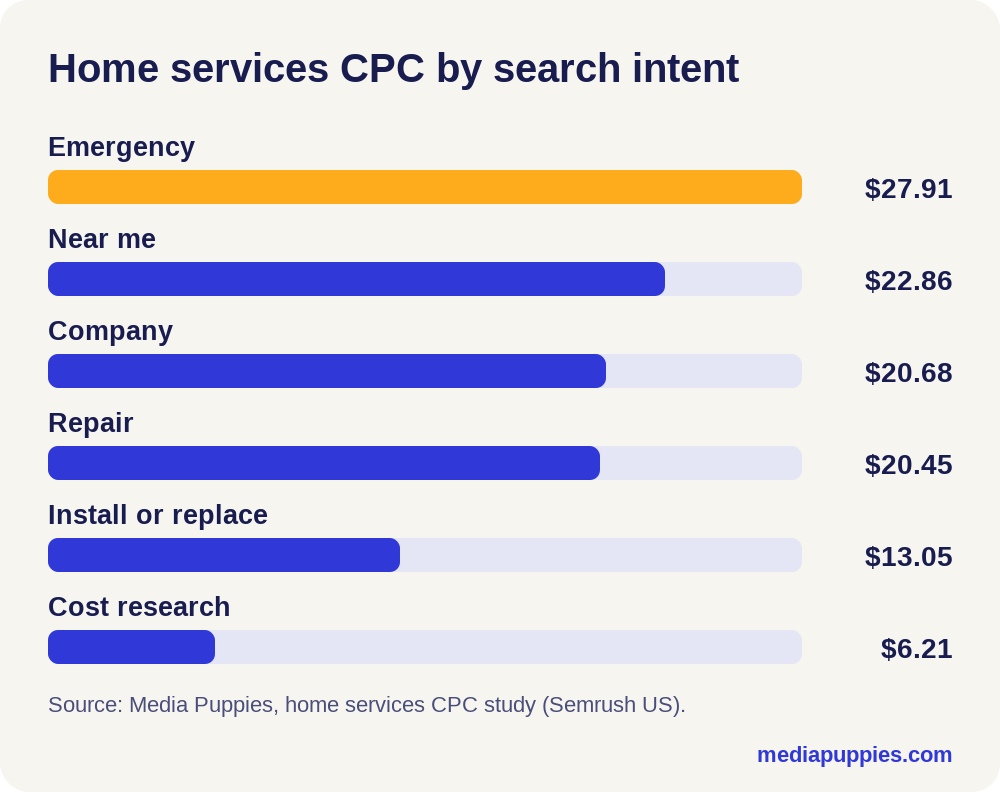
Emergency searches had the highest median estimated CPC at $27.91. Near me came next at $22.86, then company searches at $20.68 and repair at $20.45. Install or replace sat at $13.05, and cost research was far below everything else at $6.21. The median across all 169 keywords was $17.62.
The cost research group was also the smallest by search volume. Its 30 keywords added up to 198,620 US searches a month in Semrush, against 3,220,500 for the 25 near me keywords. Cheap, and rare.
Cost questions: cheap clicks that Google already answers
We expected cost searches to be cheap, and they were. 26 of the 30 home services cost research keywords had an estimated CPC under $10, with tankless water heater cost the lowest at $1.71. What we did not expect was how completely Google now answers them on the results page.
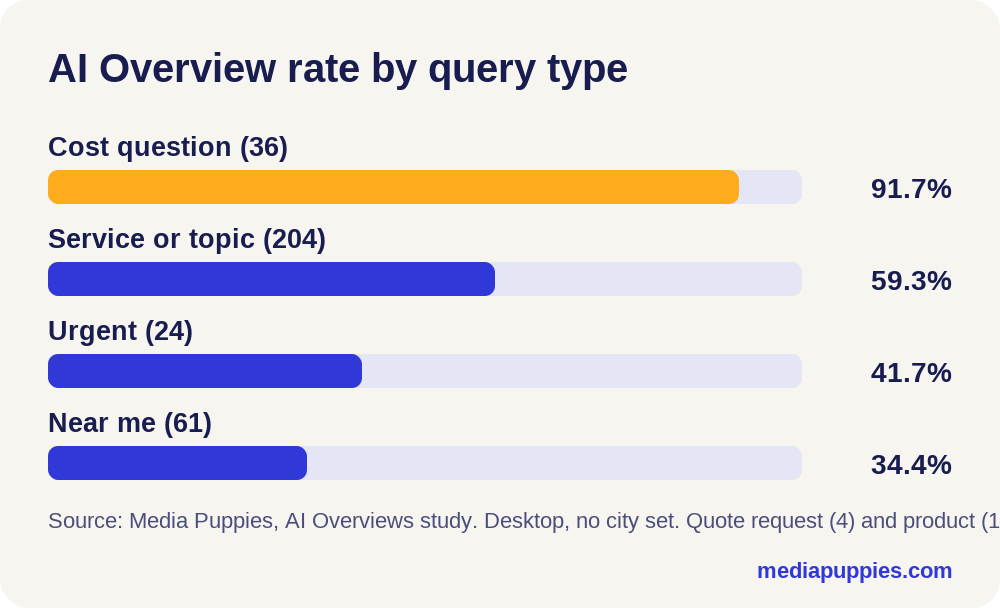
Across all 339 US keywords, 57.8% of results pages showed an AI Overview. For the 36 cost questions (any search with cost, price or how much in it) the rate was 91.7%, the highest of any query type with more than a handful of keywords. All 33 of those AI Overviews contained a dollar figure. None of the 33 named a business with a star rating, review count, phone number or address. In home services alone, 27 of the 30 cost searches showed an AI Overview.
So a person who types a cost question can often read a price range on the results page without clicking anything. People also ask boxes appeared on 95.9% of the 339 pages as well, another set of answers on the same page. Our scraper did not see ads, so we cannot say where the ads sat against either box. Our view: for most local service accounts, a click on a cost question is someone who is still comparing, and Google is now doing that comparing for them. We would not chase these clicks with a full bid.
There were four exceptions in home services, and they are worth knowing before anyone adds cost as a blanket negative. Repipe cost had an estimated CPC of $32.42, water damage restoration cost $21.61, garage door spring replacement cost $11.99 and sewer line replacement cost $10.33. Our view: those read like searches from people with a job already in front of them. The keyword data shows the higher prices; it cannot show the reason for them.
Dental showed the same pattern in a cleaner form. In all 5 of the treatment and cost pairs we priced, the cost version was cheaper. Dental implants had an estimate of $9.80, and dental implants cost $6.14.
Emergency searches: a 4.49 times higher CPC estimate, and fewer AI Overviews
At the other end, the emergency median of $27.91 was 4.49 times the cost research median and 1.36 times the repair median. Emergency beat repair in 7 of the 8 trades. The single most expensive home services keyword we priced was emergency water damage restoration at $66.23, and emergency plumber came in at $43.65.
AI Overviews were less common here. 41.7% of the 24 urgent searches (all of them home services or dental terms) showed one. Those 24 urgent searches had a median estimated CPC of $24.04, against $5.91 for the 36 cost questions. We worked out those two medians from the AI Overviews study's data file for this page. Among the four query types with 24 or more keywords, urgent searches had the highest median CPC estimate and the second lowest AI Overview rate, and cost questions had the lowest estimate and the highest rate. That is a pattern in 339 keywords on one day and does not show that one causes the other. The dearest CPC band in the same check, $60 and up, still showed an AI Overview on 70% of its 20 keywords.
Our view: emergency terms are the ones an audit should protect first. If they are losing impression share to budget while cost questions are spending, the money is in the wrong place.
Repair against install: a smaller gap than the median suggests
Repair searches had a median estimated CPC of $20.45 against $13.05 for install or replace, a ratio of 1.57. That looks like a clear rule. When we compared the two inside each trade, repair was dearer in only 4 of the 6 trades where we had both. Electrical and locksmith went the other way, by small amounts.
In our view this is a case for checking your own trade before setting a rule. A repair search is often more urgent, but an install job is often worth more. An audit should compare cost per booked job for each group, which the keyword price alone cannot tell you.
Does near me deserve a premium?
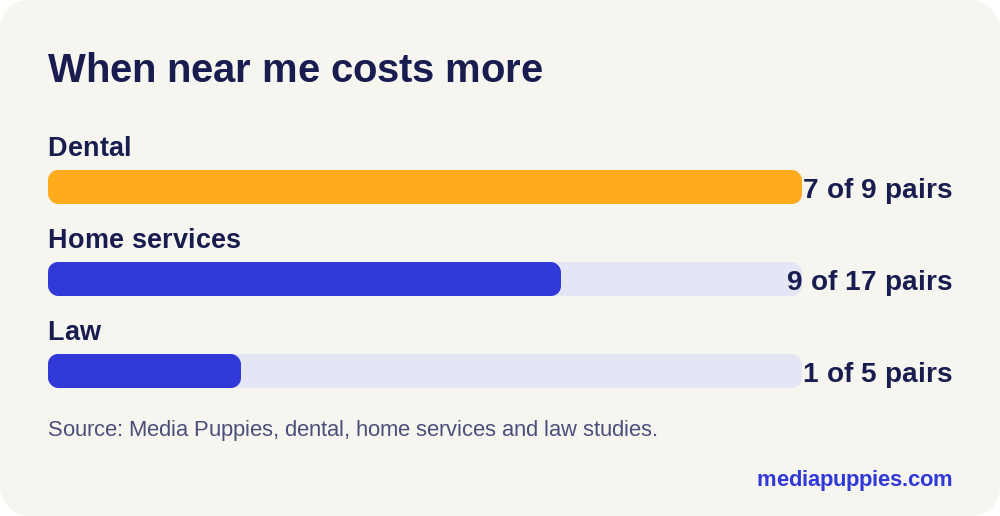
We assumed near me would always cost more. In home services it barely mattered. Across 17 keyword pairs with and without near me, the near me version cost more in 9, and the median difference was $0.21. Law went the other way: near me cost more in only 1 of 5 pairs.
Dental was the outlier. Near me cost more in 7 of 9 pairs, and the gap could be large: dental implants near me had an estimated CPC of $17.88, against $9.80 for dental implants.
The AI Overview data adds a second reason to look at near me terms closely. Only 34.4% of the 61 near me searches showed an AI Overview, the lowest rate of any type. When one did appear, 14 of the 21 named a business with a rating, phone number or address. Our view: near me terms are where the map pack, reviews and ads compete for the same click, so the audit question is whether your ad, your listing and your reviews line up, more than whether the bid is high enough.
When one practice area sets the bill
Law showed how much a single group of searches can dominate an account. The 13 personal injury keywords we priced had a median estimated CPC of $156, against $9.70 for 22 other practice keywords, a ratio of 16.08. The dearest was truck accident lawyer at $252.78. 6 of the 11 personal injury searches without near me showed an AI Overview.
Our view: a firm that takes personal injury cases alongside other work should run them in their own campaign with their own budget. Otherwise a handful of personal injury clicks can use up a day's spend before a family law or estate search gets a chance.
The Google Ads audit table we use for search terms
Here is how we would sort a search terms report using these figures. The calls in the last column are our view for a local service business; the data alone does not make them. The AI Overview column gives the rate for the closest query type across all 339 keywords in our check, which is not a home services only figure.
| Search intent | Median CPC estimate (home services) | AI Overview rate, closest query type | Our call |
|---|---|---|---|
| Emergency | $27.91 | 41.7% (urgent) | Keep and bid up if calls convert |
| Near me | $22.86 | 34.4% (near me) | Keep, check reviews and listing match |
| Company | $20.68 | 59.3% (service or topic) | Keep, watch competitor names |
| Repair | $20.45 | 59.3% (service or topic) | Keep, judge by cost per booked job |
| Install or replace | $13.05 | 59.3% (service or topic) | Keep where job value is high |
| Cost research | $6.21 | 91.7% (cost question) | Cap or exclude, with exceptions |
How we would run it in the account
- Tag every search term by intent. Export 90 days from the search terms report and label each term emergency, near me, company, repair, install or cost. A spreadsheet filter on words like cost, price, how much, emergency and near me does most of it.
- Compare spend share with lead share. In our view, any intent group that takes a bigger share of spend than of booked jobs is the first thing to fix.
- Protect emergency terms. Check impression share lost to budget on them before anything else. They were the dearest home services intent group, and urgent searches showed fewer AI Overviews than every query type except near me.
- Cap or exclude cost questions. Add cost and price phrases as negatives, or move them into a low-budget campaign, but keep the few that signal a job in hand, such as repipe cost or sewer line replacement cost in plumbing.
- Split dear groups into their own campaigns. Personal injury in law is the clearest case in our data.
- Write the negatives down. Our negative keyword audit covers how to build the list, and the Google Ads audit checklist covers tracking, settings and bids after the intent pass.
For the full price list by trade, see our Google Ads cost study for home services, and for what the AI Overviews say and cite, see our AI Overviews study. If you run Google Ads for a business in the US, UK, Canada or Australia and want a second pair of eyes, give us read access and a senior buyer will write a free ad account audit, including an intent pass on your search terms. If you would rather hand the account over, see our Google Ads management. More studies are on our research page.
How we did this
- Source
- Semrush Keyword Overview (US database, USD) and Google US results pages
- Country
- United States
- Collected
- 3 November 2026, compiled 17 November 2026
- Sample
- 339 US keywords checked for AI Overviews; within them 169 home services, 37 legal and 37 dental keywords priced by intent
- Sources
- Home services CPC study, law firm marketing study, dental marketing study, AI Overviews on high-CPC searches study
This page collects nothing new. It takes the search-intent figures from four studies we published in November 2026, each with its own method: our Google Ads cost study for home services (169 keywords in 8 trades and 6 intent groups), our law firm marketing study, our dental marketing study and our AI Overviews study, which fetched the US Google results page for all 339 priced keywords on 3 November 2026 (desktop, English, no city set).
Every cost per click on this page is a Semrush keyword tool estimate for the US national average, pulled on 3 November 2026. It is not what any advertiser paid, and real auction prices vary by city, hour, quality score and competition. The keyword lists are our own selection. Two figures were worked out for this page from the source data files and are marked in the dataset: how many home services cost searches sat under $10, and the median estimated CPC of each query type across all 339 keywords. Query types come from the keyword text: a cost question contains cost, price or how much, and an urgent search contains words such as emergency, 24 hour, same day or lockout. An AI Overview counts as naming a business when it shows a star rating, a review count, a phone number or an address.
Limits. The AI Overview check was one pass on one day, on desktop with no location, and Google varies AI Overviews by user, place and time. The scraper did not see ads, so this page says nothing about how many ads appeared on those pages. No figure here comes from a client account.
Download the data (CSV). Free to reuse under CC BY 4.0 with a link to this page.
Questions about a Google Ads audit by search intent
What should a Google Ads audit check first?
We start with what kind of searches the money goes to. In our US data, emergency home services searches had a median estimated CPC of $27.91 and cost research searches $6.21, so in our view the mix of intents is the first thing to check.
Should I add cost and price as negative keywords?
In our view, mostly yes for local service accounts, with exceptions. 91.7% of 36 US cost questions showed an AI Overview, and every one of the 33 that did quoted a dollar figure. But a few cost searches, such as repipe cost at an estimated $32.42, look like people with a job in hand.
Are near me keywords more expensive on Google Ads?
It depends on the industry. In home services the near me version cost more in 9 of 17 pairs, with a median difference of $0.21. In dental it cost more in 7 of 9 pairs, and in law in 1 of 5.
Do AI Overviews show up on searches that advertisers pay for?
Often. 57.8% of the 339 US searches we checked on 3 November 2026 showed one. The rate was highest on cost questions (91.7%) and lowest on near me searches (34.4%).
Are these real CPCs from ad accounts?
No. They are Semrush keyword tool estimates for the US, pulled on 3 November 2026. Real auction prices vary by city, time and competition, so use them to compare intents, not to set bids.