

Key findings
- The median agency named 15 of our 33 PPC tasks on its public pages, with a range of 2 to 29. Only reporting was listed by more than three in four agencies (84%).
- Basic account hygiene was rarely spelled out. 41% listed negative keyword work and 62% conversion tracking. Only 10 of 37 (27%) named negatives, conversion tracking and ad testing together.
- On reporting cadence, 15 agencies promised a monthly report, 4 a weekly one and 6 only a live dashboard. 12 (32%) gave no cadence at all.
- 46% promised a dedicated account manager and 41% regular calls or meetings. 13 agencies (35%) mentioned neither. US pages were the most explicit: 69% named an account manager, against 38% in the UK and 27% in Australia.
- Microsoft Ads was listed by 65% of agencies (85% in the UK), Google Shopping or Performance Max by 68%, and Local Services Ads by 16%.
- Agencies that publish their fees listed more: a median of 18 tasks against 13, and Microsoft Ads 83% against 36%. Part of that gap is because we also read their pricing pages.
Public PPC service pages and pricing pages of PPC and Google Ads agencies, read as plain text · 37 agencies with a PPC services page (US 13, UK 13, Australia 11), from a wider sample of 43 found through 33 web searches for PPC pricing and management terms. 23 publish their own fees and 14 do not. · 19 November 2026 · How we did this · Download the data (CSV)
Ask five agencies what PPC management includes and you get five lists. We wanted to see the lists side by side. On 19 November 2026 we read the PPC service pages, and the pricing pages where they exist, of 37 agencies in the US, the UK and Australia, and logged which of 33 common tasks each one names.
The short answer: the typical agency names 15 tasks. Almost all promise reporting, and most name keyword research, bid management and campaign set-up. Far fewer put the routine work of PPC management in writing. 41% mention negative keywords, 62% conversion tracking, and 32% never say how often you will get a report.
We sell PPC management ourselves, so we have a view here, and we say where it is ours. The numbers below come from the agencies' own pages. Our clients and ad accounts are not in this data. If you want the week by week work itself, our guide to PPC campaign management covers it. This post is about what agencies promise.
What PPC management includes, by share of agencies
Reporting was the only task named by more than three in four agencies, at 84%. Next came keyword research (73%), bid management and campaign build (70% each) and strategy or planning (68%). Below that the list thins out fast.
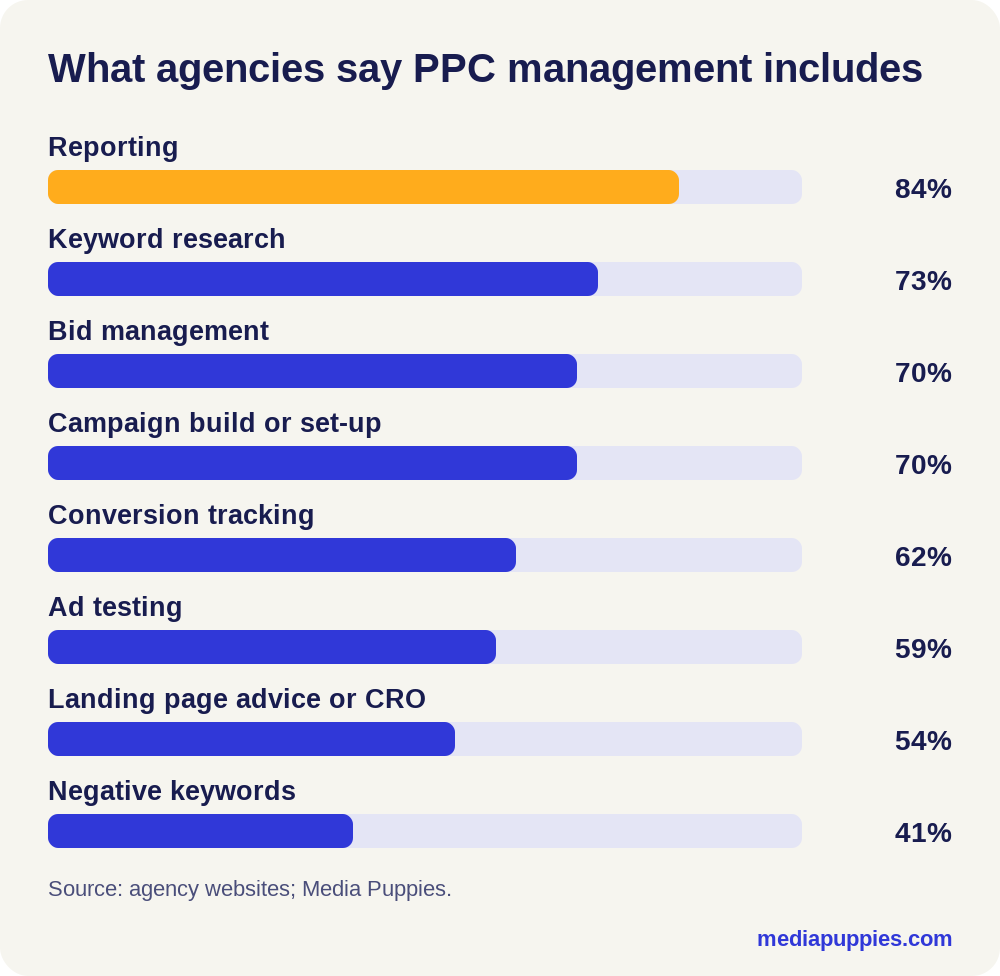
We expected conversion tracking near the top, since every other task depends on it. It came eighth, at 62%. We also expected negative keywords to be close to universal, because search term cleanup is the most common weekly job in a Google Ads account. 15 of 37 agencies mention it.
| Task | All (37) | US (13) | UK (13) | Australia (11) |
|---|---|---|---|---|
| Reporting | 84% | 85% | 100% | 64% |
| Keyword research | 73% | 77% | 62% | 82% |
| Bid management | 70% | 77% | 77% | 55% |
| Strategy or planning | 68% | 54% | 92% | 55% |
| Conversion tracking | 62% | 69% | 69% | 45% |
| Account audit | 57% | 46% | 92% | 27% |
| Landing page advice or CRO | 54% | 54% | 62% | 45% |
| Negative keywords | 41% | 69% | 31% | 18% |
| Call tracking | 19% | 46% | 0% | 9% |
The country pattern is clear even with small groups. UK pages lead with the audit and the plan: 92% name an account audit and 92% strategy. US pages go further into the account itself, with 69% naming negative keywords and 46% call tracking. No UK agency in our sample mentioned call tracking. Australian pages were the shortest overall, with a median of 13 tasks against 18 in the US and 15 in the UK.
The work that rarely makes the page
Five tasks in our list are what we would call account hygiene: negative keywords, conversion tracking, ad testing, budget management and landing page advice. Each one on its own was named by 41% to 62% of agencies. All five together appeared on 8 pages, or 22%.
| Task or combination | Agencies | Share |
|---|---|---|
| Any measurement task (tracking, GA4, call tracking, CRM import) | 27 | 73% |
| Conversion tracking | 23 | 62% |
| Negative keywords and conversion tracking together | 11 | 30% |
| Negatives, conversion tracking and ad testing together | 10 | 27% |
| CRM or offline conversion import | 10 | 27% |
| Call tracking | 7 | 19% |
| Ad assets (extensions) | 3 | 8% |
| Click fraud protection | 2 | 5% |
Landing pages split the field. 70% of agencies mention landing pages in some form, but advice and building are different promises. 54% offer advice or conversion rate work, 41% say they build pages, and 24% say both.
Our view: a task missing from a sales page is no proof the agency skips it. Many good agencies write short pages. It does mean the buyer cannot hold them to it. If negatives and tracking are not in the proposal or the contract, you have no written way to check they happen. Our self-audit guide shows how to check both yourself in an afternoon.
How often agencies report
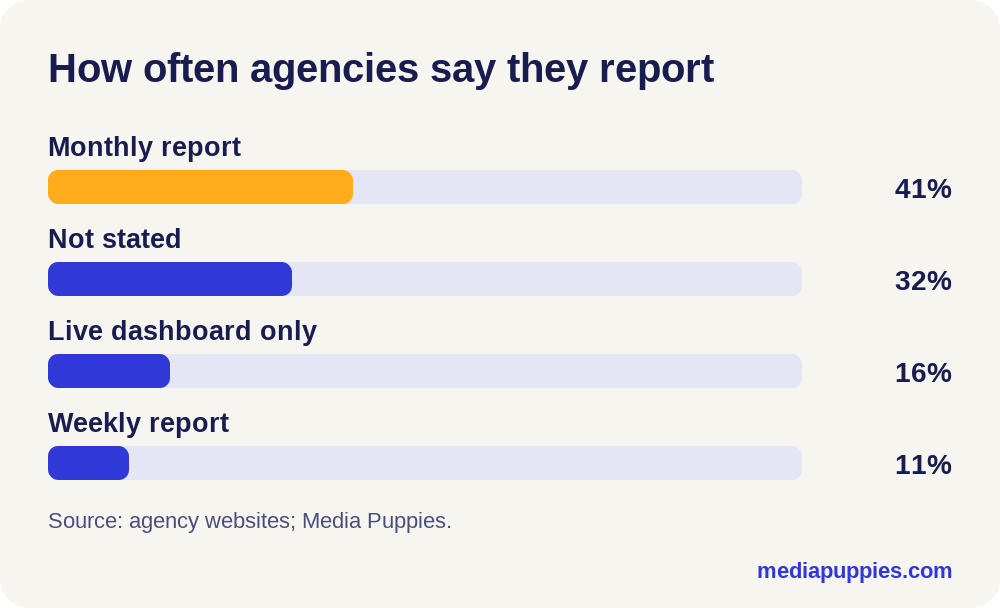
Almost every agency promises reporting. Far fewer say when. 15 agencies (41%) named a monthly report as their quickest written update, 4 (11%) a weekly one and 6 (16%) only a live dashboard. The other 12 (32%) gave no cadence. Of the 25 that stated one, 60% said monthly and 16% weekly.
Dashboards came up on 10 pages (27%), and for 6 agencies a dashboard was the whole reporting promise. A dashboard shows numbers. It does not say what changed in the account or why. Our view is that a written note on what was done and what comes next is the part worth paying for, and our guide on reading an ads report explains what to look for in one.
Country made a difference here too. In the UK, 11 of 13 agencies stated a cadence. In Australia, 6 of 11 did not.
Account managers and calls
We counted two contact promises: a dedicated or named account manager, and regular calls or meetings.
| Promise | All (37) | US (13) | UK (13) | Australia (11) |
|---|---|---|---|---|
| Dedicated account manager | 46% | 69% | 38% | 27% |
| Regular calls or meetings | 41% | 62% | 31% | 27% |
24 agencies (65%) made at least one of the two promises and 8 (22%) made both. 13 (35%) made neither. A few pages made a point of the opposite, saying clients speak to the specialist directly with no account manager in between. We did not count that as a dedicated manager, so the true share of agencies offering one named contact is likely a little higher.
Platforms beyond Google Search
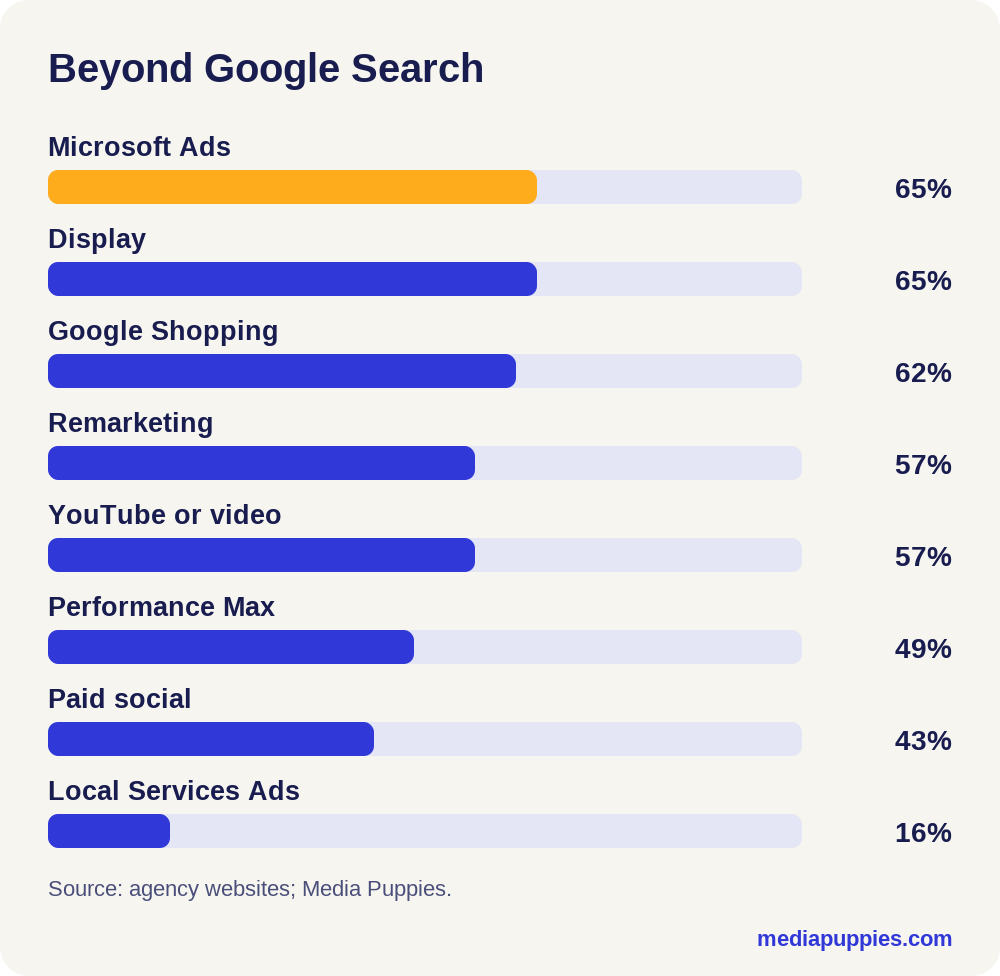
86% of agencies listed at least one platform or campaign type beyond Google Search. Microsoft Ads and Display tied at 65%, and 68% listed Google Shopping or Performance Max. In the UK, 85% of agencies named Microsoft Ads, against 54% in the US and 55% in Australia.
Listing a platform is easier than tagging for it. When we audited the home pages of the same agencies, 20 of those whose page loaded list Microsoft Ads, and none of the 20 showed the Microsoft UET tag in their own home page HTML.
Local Services Ads was the surprise at the other end. Only 6 agencies (16%) listed it, even though Local Services Ads often show above the search ads on US home service searches. Paid social was named by 43%, which tells you how many PPC pages are really full-service pages.
Agencies that publish fees list more
We split the 37 into the 23 that publish their own fees and the 14 that do not. We are not reporting fee levels here. The difference in what they list was large.
Fees are covered separately in our Google Ads management fees study, drawn from the same agency sample.
| Measure | Publish fees (23) | No published fees (14) |
|---|---|---|
| Median tasks named | 18 | 13 |
| Median platforms named | 6 | 2 |
| Microsoft Ads | 83% | 36% |
| Remarketing | 74% | 29% |
| Paid social | 65% | 7% |
| Negative keywords | 39% | 43% |
| Conversion tracking | 61% | 64% |
Read this with care. For 19 of the 23 fee publishers we also read a pricing page, which gives them more text and more room to list things. The gap is biggest on platforms, which is what package tables tend to list. On the hygiene tasks the two groups were level: 39% against 43% for negatives, 61% against 64% for tracking.
A monthly PPC management checklist (our view)
This section is our opinion, built from the gaps above. It is what we would want in writing from any agency, us included, before signing. The data shows most pages leave at least part of it out.
Every week
- Search terms reviewed and negatives added. Ask to see the list of what was excluded. Our guide to the search terms report shows what that looks like.
- Spend checked against the monthly budget, with campaigns paced so the money lasts the month.
- Conversion tracking checked for drops or double counts after any site change.
- A short written note: what changed, why, and what is next. We send a weekly written report for this reason.
Every month
- A report in cost per lead or cost per sale, with the changes made that month listed beside it.
- At least one ad test closed out, with the winner kept and a new one started.
- Landing page notes: which pages convert, which do not, and one change to try.
- A review of bids, budgets and bid strategy against the target you agreed.
- A call, or a written review if you prefer, with the person who actually runs the account.
Every quarter
- Account structure and audiences checked against what the business now sells.
- A decision on other platforms (Microsoft Ads, Shopping, Performance Max, Local Services Ads) based on the numbers, with no channel added just to fill a package.
Put the list in the contract or the statement of work. Our post on what to check in an agency contract covers the clauses around it.
What we would change
Our view, as a team that sells PPC management: agency pages lean on the visible work (strategy, audits, reports) and say little about the routine work that decides results. We would rather see every page state, in plain words, who runs the account, how often they write to you, and whether negatives, tracking and ad tests are done on a schedule. On our own PPC management page we name the buyer, work month to month with no lock-in and send a weekly written report. Agencies that resell PPC under their own brand can get the same through our white label PPC service, with reporting in the agency's own template.
How we did this
- Source
- Public PPC service pages and pricing pages of PPC and Google Ads agencies, read as plain text
- Country
- United States, United Kingdom, Australia
- Collected
- 19 November 2026
- Sample
- 37 agencies with a PPC services page (US 13, UK 13, Australia 11), from a wider sample of 43 found through 33 web searches for PPC pricing and management terms. 23 publish their own fees and 14 do not.
- Task list
- 33 fixed task tokens in 5 groups: account work, measurement, landing pages, contact and reporting, platforms
- Parent data
- PPC agency public pages, 43 agencies, collected the same day
On 19 November 2026 we searched for PPC management pricing and fees in the US, UK and Australia, took agencies in result order, and saved the text of each one's PPC service page, pricing page and terms page. Marketplaces, directories, software vendors, agencies based outside the three countries and Media Puppies were left out. 37 of the 43 agencies had a service page, and that is the base here.
For each agency we recorded which of 33 fixed tasks its pages name, with a quote from the page. Where an agency also had a pricing page, tasks named there count too. We then re-checked every page with keyword patterns for each task and read each hit by eye. That added 25 tasks across 18 agencies, each with the exact text. Site menus, case studies and market guides describing what agencies "should" do were not counted. The list of changes is in compile.py.
Reporting cadence is the quickest written report the pages name. Six agencies named more than one; we kept the quickest and flagged any live dashboard separately.
Limits. A service page is marketing copy. A task on the page does not prove the agency does it, and a missing task does not prove it skips it. 19 of the 23 fee-publishing agencies had a pricing page read as well, which gives them more text and more chances to list a task. With 11 to 13 agencies per country, one agency moves a country share by 8 or 9 points. The sample leans toward small-business agencies, because large agencies rarely publish prices or terms. Agency names are in the data file only.
Download the data (CSV). Free to reuse under CC BY 4.0 with a link to this page.
Questions about what PPC management includes
What is PPC management?
PPC management is the ongoing running of paid search accounts such as Google Ads: research, set-up, bids, budgets, ads, tracking and reporting. On the public pages of 37 agencies we read, the median agency named 15 of 33 common tasks, and reporting was the most common at 84%.
What should monthly PPC management include?
In our view: weekly search term and negative keyword work, budget pacing, tracking checks and a written note, plus a monthly report in cost per lead or sale, a closed ad test and landing page notes. Only 27% of the agencies we read named negatives, tracking and ad testing together.
How often should a PPC agency report?
Of 37 agencies, 41% promised a monthly report, 11% a weekly one and 16% only a live dashboard, while 32% gave no cadence. Ask for the cadence in writing, and ask what each report explains beyond the numbers.
Do PPC agencies manage Microsoft Ads too?
65% of the agencies we read listed Microsoft Ads, rising to 85% in the UK. 68% listed Google Shopping or Performance Max, and 16% listed Local Services Ads.
Is a dedicated account manager standard?
No. 46% of agencies promised a dedicated account manager and 41% regular calls or meetings. 35% mentioned neither. US pages were the most likely to name one, at 69%.