

PPC campaign management is the ongoing work of running pay-per-click campaigns after launch: checking spend and tracking, reading search terms, adding negative keywords, adjusting bids and budgets, testing ads and landing pages, and reporting results against a business target such as cost per lead or return on ad spend. It applies to Google Ads, Microsoft Advertising and, with different tasks, paid social platforms.
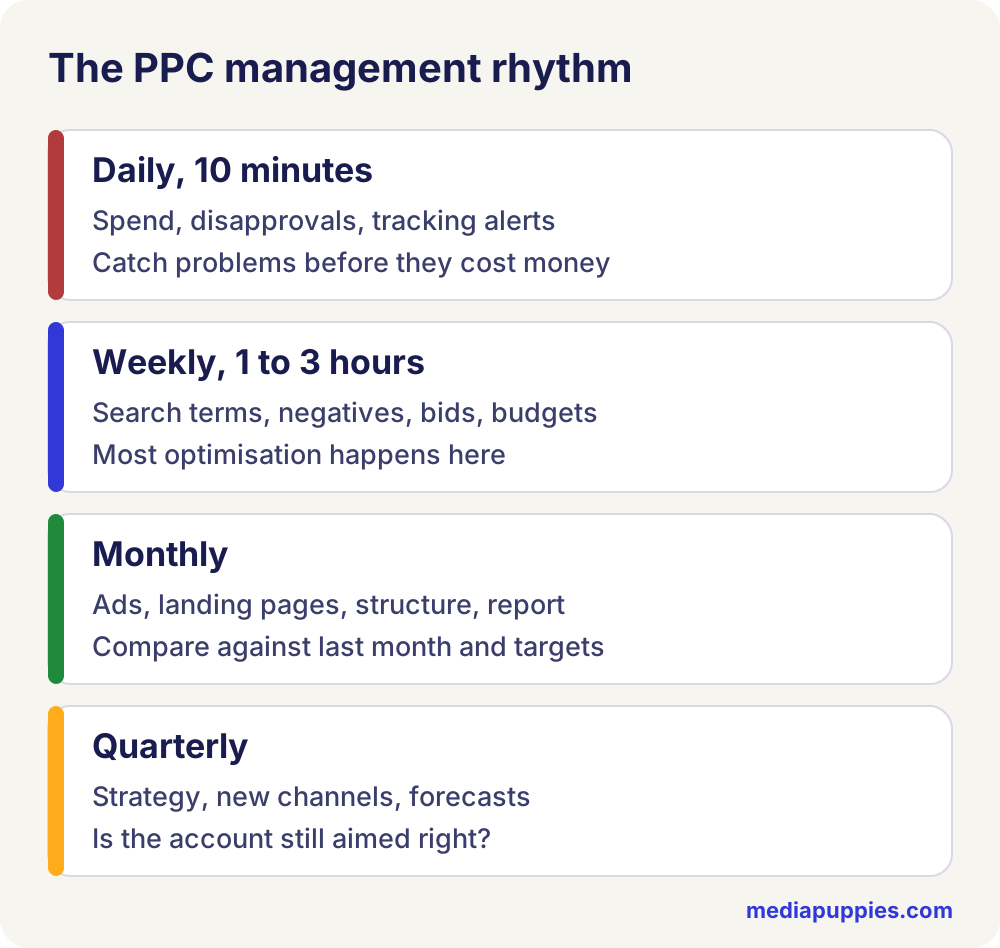
Good PPC campaign management follows a rhythm. A few minutes a day catch problems, one to three hours a week do most of the optimisation, a monthly review checks direction, and a quarterly review asks whether the strategy is still right. Accounts that skip the rhythm rarely fail all at once. They drift: more wasted search terms, stale ads, budgets stuck on old winners, and costs that creep up month after month.
What PPC campaign management covers
The work splits into six areas. Whoever manages the account should be able to say what they did in each, and why.
| Area | What it involves | Why it matters |
|---|---|---|
| Tracking | Making sure conversions fire correctly and match real sales or leads | Every other decision depends on it |
| Traffic quality | Search terms, negatives, match types, placements, locations, schedules | Stops paying for clicks that never convert |
| Bids and budgets | Bid strategies, targets, budget moves between campaigns | Puts money where it earns most |
| Ads and assets | Headlines, descriptions, sitelinks, images, testing | Lifts click-through rate and relevance |
| Landing pages | Speed, message match, forms, offers | Often the biggest lever on cost per lead |
| Reporting | Results against targets, what changed, what comes next | Keeps the business and the account aligned |
Set the target before managing anything
Management without a target is just activity. Before any optimisation, agree one number the account is judged on, and how it is measured.
- Lead generation: cost per lead is the starting point, cost per qualified lead or cost per sale is better. Work it out from what a customer is worth: if a sale brings a certain gross profit and one in five qualified leads becomes a sale, the most you can pay for a qualified lead is a fifth of that profit, before any margin for the business.
- Ecommerce: return on ad spend or, better, profit after ad spend. The break-even ROAS is 1 divided by the gross margin; at a 40% margin the account must return at least 2.5 times spend just to break even. Our break-even ROAS calculator works it out for any margin.
- Apps and subscriptions: cost per trial or install is a proxy; payback period on customer acquisition cost is the real test.
Write the target down, with the date it was set and the reasoning behind it. When results are discussed later, the conversation is about the gap to the target, not about whether a click-through rate feels high enough.
Daily PPC campaign management checks
The daily check is short and defensive. Its job is to catch anything that will waste money before the next weekly session.
- Spend against expectation. Is yesterday's spend roughly where it should be? Google can spend up to twice a campaign's average daily budget on a busy day, so one high day is normal. Three high days in a row, or spend at zero, needs a look.
- Conversions. Did conversions record yesterday? A sudden drop to zero usually means broken tracking, a site change or a form fault, not a sudden collapse in demand.
- Disapprovals and policy issues. Disapproved ads, limited assets, suspended accounts, payment problems.
- Alerts. Large changes in cost per click, conversion rate or impression share. Automated rules or scripts can email these.
Ten minutes is enough for a small account. The discipline matters more than the time: the worst PPC losses come from a broken tracking tag or a runaway campaign that nobody looked at for a fortnight.
Weekly tasks: where most optimisation happens
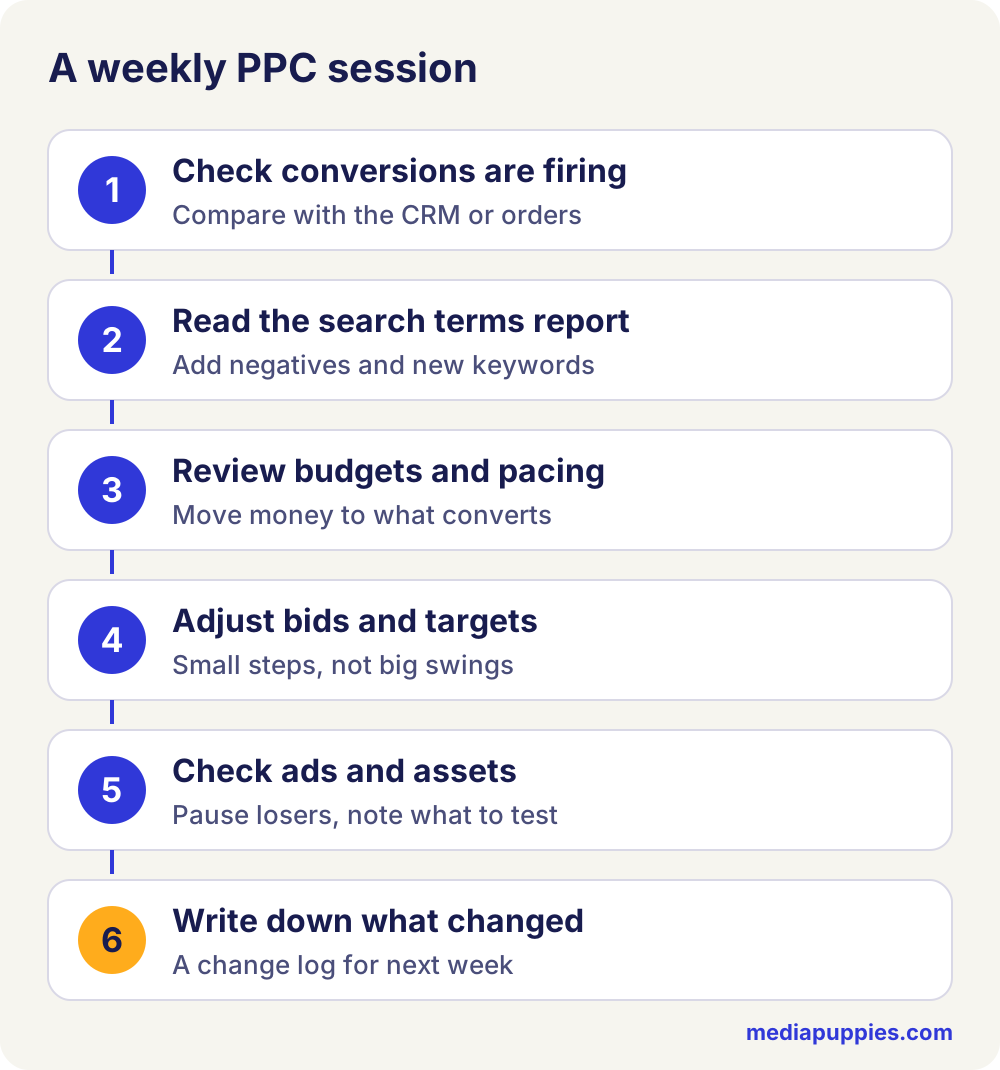
The weekly session is the core of PPC campaign management. For a typical small or mid-sized account it takes one to three hours.
- Check tracking against reality. Compare conversions in the ad platform with leads in the CRM or orders in the shop. If they drift apart, fix tracking before anything else.
- Read the search terms report. Add negatives for irrelevant searches and add strong converting searches as keywords. Our guide to the search terms report covers the method.
- Review budgets and pacing. Which campaigns are limited by budget while converting well? Which spend freely without results? Move money between them. The logic is in the budget pacing formula.
- Adjust bids and targets. With Smart Bidding, adjust target CPA or target ROAS in small steps, about 10 to 20% at a time, and give each change time to settle. With manual bidding, move bids on keywords that are clearly above or below target.
- Check ads and assets. Pause clear losers, note which messages win, plan the next test.
- Log what changed. A short change log turns next week's numbers into lessons instead of guesses.
A common trap is making too many changes too often. Smart Bidding needs stable inputs to learn. Changing targets, budgets and structure every two days resets that learning, so the account never settles. Weekly is the right cadence for most changes, with daily action reserved for problems.
Monthly tasks: performance, ads, pages and structure
Once a month, step back from individual keywords and look at the account as a whole.
- Results against targets. Cost per lead, cost per sale, return on ad spend or revenue, compared with last month, the same month last year where seasonality matters, and the target agreed with the business.
- Ad testing. Review the asset report for responsive search ads, replace low-rated headlines and descriptions, and write new versions around the messages that work.
- Landing pages. Conversion rate by page and device, page speed, form completion. A landing page change can move cost per lead more than a month of bid changes.
- Structure. Are campaigns and ad groups still split by intent and margin? Has a product line, service or location grown enough to need its own campaign?
- Audiences and exclusions. Remarketing lists, customer match lists, placement exclusions for Display, Performance Max, Demand Gen and Video.
- Reporting. A short written summary: what happened, why, and what changes next month.
A full monthly or quarterly audit uses a longer list; our Google Ads audit checklist sets it out.
Quarterly reviews: is the account still aimed at the right goal?
Every three months, ask the bigger questions.
- Is the target still right? Margins, prices, sales capacity and lifetime value change. A target CPA set a year ago may now be too high or too low.
- Are we measuring the right thing? Moving from lead counts to qualified leads or sales, and importing offline conversions, often changes what the account should optimise for.
- Where is the headroom? Impression share lost to budget shows where more money would buy more results. Impression share lost to rank shows where relevance or bids hold the account back.
- Should we add or drop a channel? Microsoft Advertising, Performance Max, Shopping, YouTube or paid social each make sense at different stages.
- What is the forecast for next quarter, including seasonality?
Managing automated bidding and Performance Max
Automation has changed PPC campaign management more than any other development of the last decade. Smart Bidding sets bids for each auction. Broad match finds searches you never listed. Performance Max decides where ads appear across Google. The manager's job has moved from pulling levers to controlling inputs.
- Conversion data. Automated bidding chases whatever is marked as a primary conversion. Feeding it qualified leads or real sales, instead of every form fill, is the single most effective change in many accounts.
- Targets. Setting realistic target CPA or ROAS values, and changing them gradually.
- Exclusions. Negative keywords, brand exclusions, placement and content exclusions, and audience exclusions where the platform allows them.
- Creative and assets. Headlines, images, videos and product feeds. In Performance Max especially, the assets are much of what the manager controls.
- Budget split. Deciding how much goes to automated campaigns versus tightly controlled Search campaigns.
"The algorithm handles it" is not management. An automated campaign with poor inputs spends confidently in the wrong direction.
What good PPC management reporting looks like
A management report exists to help someone make a decision. Long exports of every metric rarely do that. A good monthly report fits on one or two pages and covers:
- Results against the business target, in the business's terms (leads, qualified leads, sales, revenue, return on ad spend).
- Spend and the main efficiency numbers, compared with the previous period.
- What changed in the account and why.
- What did not work, stated plainly.
- The plan for next month, and anything the manager needs from the business (offers, stock, landing page fixes, sales feedback).
Clicks, impressions and click-through rate belong in an appendix. If the report leads with them, ask for the cost per sale. Our guides to reading an ads report and the weekly marketing report show the format we recommend.
A month of PPC management decisions
All numbers here are hypothetical, to show how management decisions add up. Say a B2B software company spends $20,000 a month on Google Ads and its target is $250 per demo request.
- Week 1. The search terms report shows $1,800 in the previous month went to "free", "open source" and "jobs" searches. The manager adds negatives.
- Week 2. CRM data shows half the demo requests from one campaign are students and competitors. The manager adds a qualifying question to the form and starts importing qualified demos as the primary conversion.
- Week 3. The brand campaign is limited by budget while a broad non-brand campaign spends freely at $400 per demo. The manager moves $2,000 from the broad campaign into brand and the best-performing competitor-comparison campaign.
- Week 4. A new landing page with a shorter form goes live for half the traffic as a test.
Say demo requests fall from 80 to 72, but qualified demos rise from 40 to 50. Cost per demo request rises from $250 to about $278, which looks worse. Cost per qualified demo falls from $500 to $400, which is what the sales team cares about. Good PPC campaign management changes what gets measured as often as it changes bids, and the report has to explain that clearly.
Tools that make PPC campaign management faster
The platforms themselves cover most needs. Extra tools save time on larger accounts.
- Google Ads Editor and Microsoft Advertising Editor. Free desktop apps for bulk changes: new ad groups, keyword lists, ad copy edits across many campaigns at once.
- Automated rules and scripts. Rules can pause keywords or email alerts when numbers cross a threshold. Scripts can check for broken landing pages, flag budget overspend or build reports. Both reduce the time spent on daily checks.
- Looker Studio or a reporting tool. Pulls ad data, analytics and CRM numbers into one report that updates itself.
- Call tracking. For businesses where leads phone in, call tracking credits each call to a campaign and keyword, and recordings show lead quality.
- A change log. A shared document or sheet listing every meaningful change, date and reason. The simplest tool, and the one most often missing.
Tools speed up the work. They do not decide what to change, and no tool replaces reading the search terms report with the business in mind.
Managing Microsoft Advertising alongside Google
Microsoft Advertising shows ads on Bing, Yahoo, DuckDuckGo and partner sites, and its audience skews older and more desktop-heavy, which suits many B2B and professional services. Campaigns can be imported from Google Ads, which makes setup quick. Management cannot be copied the same way. Search terms differ, click costs are often lower, conversion volumes are smaller, and automated bidding has less data to learn from. Treat it as its own account: its own negatives, its own targets, and a check every week or two rather than an occasional re-import that overwrites what you learned.
Taking over an account someone else managed
The first month on an inherited account is different from routine management. Resist the urge to rebuild everything in week one, because a big restructure throws away the bidding history the account has built.
- Get admin access and make sure the business, not the previous manager, owns the account, the analytics property and the tag manager container.
- Audit tracking first, then read twelve months of change history and performance to see what was tried.
- Fix clear waste quickly: negatives, location settings, broken pages, duplicate conversions.
- Agree the target and the reporting format with the business.
- Plan structural changes for weeks three to eight, one area at a time, so the effect of each is visible.
Who should manage PPC campaigns
| Option | Works well when | Watch out for |
|---|---|---|
| Business owner | One or two Search campaigns, owner has a few hours a week | Time disappears in busy months; tracking often left incomplete |
| In-house marketer | Steady spend, PPC is part of a wider role | Generalists can miss platform changes and advanced tactics |
| In-house specialist | Large spend across several platforms | Hiring and keeping good specialists is hard |
| Freelancer | Focused accounts, clear scope | Single point of failure; capacity limits |
| Agency | Several platforms, need for process, cover and reporting | Junior staff on the account; check who does the work |
Agencies that sell PPC under their own brand often use a white label PPC partner for the day-to-day management. We compare the options in more detail in outsourcing PPC management, and cover pricing models in Google Ads management cost.
Signs your PPC campaigns are not being managed
- The change history in Google Ads shows few or no changes in recent weeks.
- The negative keyword list has not grown in months.
- The same ads have run unchanged for a year.
- Reports lead with clicks and impressions and never mention cost per lead or sale.
- Nobody can explain why spend or results moved last month.
- Conversion numbers in the ad platform differ widely from the CRM and nobody has investigated.
The change history is the quickest check. It sits under Change history in the Google Ads menu and shows every edit, who made it and when. Our list of where ad budget leaks covers what the gaps usually cost.
PPC campaign management across the US, UK and Australia
The method is the same everywhere. A few details change with the market.
- Time zones. Ad schedules and daily budgets run in the account's time zone. An account managing campaigns for several countries needs separate campaigns per market so schedules and budgets fit local hours.
- Consent. In the UK and EU, consent banners and Google's Consent Mode affect how many conversions are observed, so reported conversions can fall without real demand falling. Managers need to account for this in targets.
- Seasonality. Australia's summer and holiday peaks fall in December and January, so year-on-year comparisons and budgets follow a different calendar from the US and UK.
Our Google Ads agency team manages Search, Shopping and Performance Max campaigns for businesses and agencies in the US, UK, Canada and Australia, on a weekly rhythm with a written monthly report. Fees depend on the number of accounts and platforms, and we say it on the first call.
Questions people ask before hiring
What is PPC campaign management?
The ongoing work of running pay-per-click campaigns after launch: tracking checks, search terms and negatives, bids and budgets, ad and landing page tests, and reporting against a business target.
How often should PPC campaigns be managed?
A short daily check for problems, one to three hours of optimisation each week, a monthly performance and testing review, and a quarterly strategy review.
How many hours does PPC management take?
A small Google Ads account needs roughly two to four hours a week. Larger accounts across several platforms need much more, often a dedicated specialist.
What should a PPC management report include?
Results against the business target, spend and efficiency compared with last period, what changed and why, what did not work, and the plan for next month.
Does Smart Bidding remove the need for PPC management?
No. Automated bidding needs good conversion data, realistic targets, exclusions and strong assets, and someone has to manage those inputs.
How can I tell if my PPC campaigns are being managed?
Check the Google Ads change history. Regular edits, a growing negative keyword list and updated ads are signs of active management.
Should I manage PPC in-house or use an agency?
Owners and in-house marketers can run small accounts with a set routine. Agencies or specialists make sense for larger spend, several platforms or when time is short.