

Plumbing PPC is pay-per-click advertising for plumbing companies, mainly Google Search ads and Google Local Services Ads, with some Microsoft Advertising and remarketing. The plumber pays when someone clicks an ad or, with Local Services Ads, when a qualifying lead calls or messages. Done well, plumbing PPC fills the schedule with emergency calls, repair visits and installation estimates from homeowners and businesses inside the service area.
The short answer to "does plumbing PPC work" is yes, when four things are in place: separate campaigns for emergency, repair, installation and commercial work; ad schedules that match the hours someone answers the phone; a strong negative keyword list that keeps DIY searchers out; and tracking that counts booked jobs rather than clicks. Plumbing is one of the most competitive local categories on Google, so accounts that skip any of these pay for it quickly.
How plumbing PPC works: Search, Local Services Ads and call assets
A plumber has three main ways to buy leads on Google, and they work best together.
| Ad type | How you pay | Best for | Main limitation |
|---|---|---|---|
| Google Search ads | Per click | Every intent, especially installs and commercial | Needs weekly search terms and negatives work |
| Local Services Ads | Per qualifying lead | Emergency and repair calls from people who want a vetted plumber | Little control over keywords or text; reviews and responsiveness decide ranking |
| Search ads with call assets | Per click or call | Mobile searchers who want to phone straight away | Calls must be answered or the money is wasted |
Local Services Ads show at the very top of the results in most US metros, with the Google Guaranteed badge, and charge only for leads. Search ads sit below them and give full control over keywords, ad copy, landing pages, schedules and bids. Most US plumbers should run both. Our guide to Google Local Services Ads in the US covers the LSA side in depth.
Plumbing search intent: emergency, repair, install and commercial
A homeowner with water pouring through the kitchen ceiling and a property manager comparing quotes for repiping an apartment block are different customers. They search differently, convert differently and are worth very different amounts.
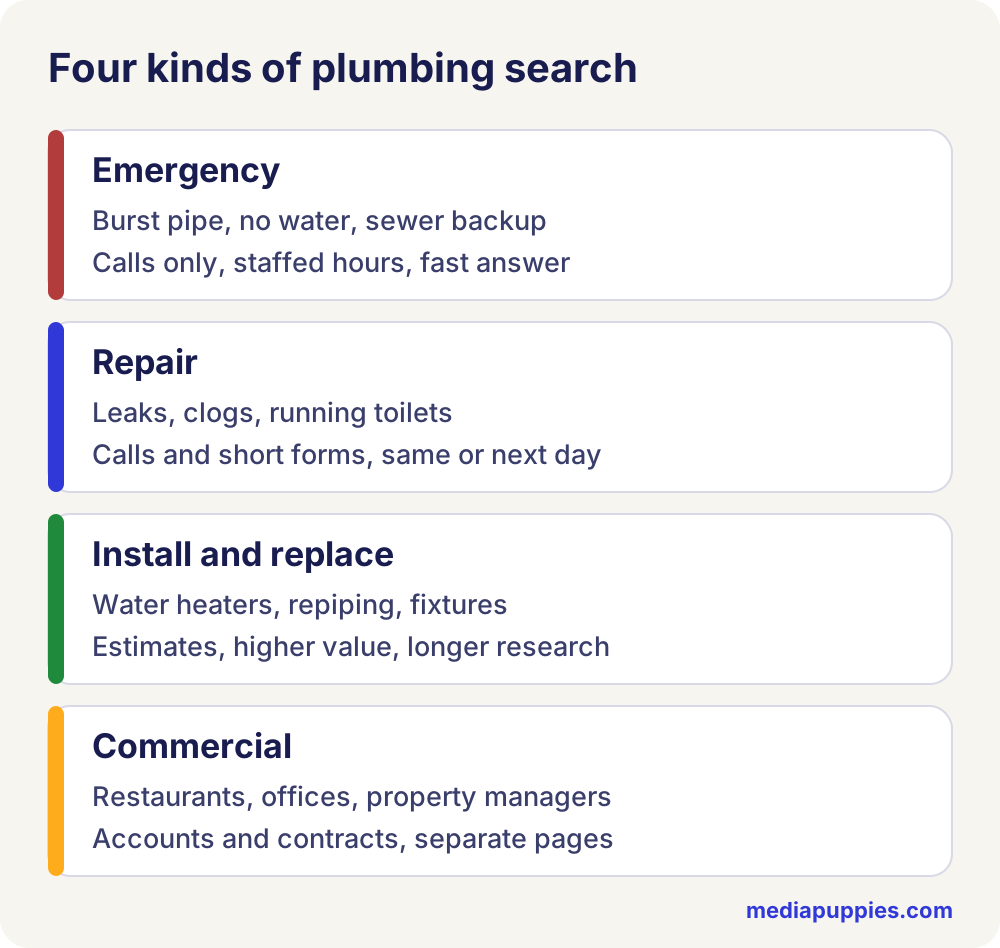
- Emergency. "Emergency plumber", "burst pipe", "24 hour plumber", "sewer backup", "no hot water". Very high urgency, almost all phone calls, the highest conversion rates in the account.
- Repair. "Leaking pipe repair", "clogged drain", "toilet repair", "drain cleaning [city]". Urgent but not frantic. Calls and short forms, booked same or next day.
- Install and replace. "Water heater installation", "tankless water heater", "repipe house", "bathroom plumbing". Lower volume, longer research, much higher job value. The conversion is an estimate request.
- Commercial. "Commercial plumber", "restaurant plumbing", "grease trap cleaning", "backflow testing". Different buyers, often repeat work and contracts.
Putting all four in one campaign lets Google spend where clicks are cheapest. Separate campaigns give each its own budget, schedule, copy and landing page.
Building plumbing PPC campaigns
A sound starting structure for a plumbing company looks like this:
- Emergency campaign, scheduled only for staffed hours, with call assets, a landing page that leads with the phone number and "available now", and ad copy about response times.
- Repair campaign, split into ad groups for drains, leaks, toilets, faucets and general plumbing, each with its own ads.
- Water heater and installs campaign, often the most profitable, with ad groups for tank, tankless, repair versus replacement and brand names you install.
- Commercial campaign, if you do commercial work, with its own landing page and offers.
- Brand campaign, protecting your company name cheaply and kept separate.
Start with phrase and exact match. Broad match can come later once each campaign has a steady flow of real conversions. Set location targeting to "Presence: people in or regularly in your included locations", and target by ZIP code or radius matched to where your vans actually go. The general approach is covered in how to structure Google Search ads, and the same principles drive HVAC PPC.
Emergency plumbing keywords and ad schedules
Emergency searches are the most valuable clicks in plumbing PPC and the easiest to waste.
- Only run emergency ads when someone answers. A 2am click on "emergency plumber" that reaches voicemail costs money and usually a bad review. Either use an answering service that can dispatch, or schedule emergency campaigns for staffed hours only.
- Bid up when demand peaks. Evenings, weekends and cold snaps (frozen and burst pipes) bring more emergency searches. Use ad schedule bid adjustments if you bid manually, or let Smart Bidding handle it once tracking is clean.
- Write for urgency and trust. Response time, licensed and insured, upfront pricing policy, local. Do not promise arrival times you cannot meet.
- Use location assets and call assets. A visible phone number and local address raise click-through and calls from mobile searchers.
Call-only ads are ending: use call assets instead
Many plumbers relied on call-only ads, now called call ads, which showed a phone number instead of a website link. Google has stopped the creation of new call ads, and existing ones are scheduled to stop serving in February 2027. The replacement is a responsive search ad with a call asset attached at the account, campaign or ad group level.
For plumbing PPC this means three changes:
- Build responsive search ads for every emergency and repair ad group that still depends on call ads, and attach call assets.
- Make the landing page work as a call page on mobile: the phone number large at the top, tap to call, minimal scrolling.
- Track calls from call assets and calls from the website separately, with a minimum call length (often 60 seconds) so short calls do not count as conversions.
Plan the switch before the deadline. Moving ad groups over one at a time lets you compare results instead of discovering a drop in calls the week everything changed.
Local Services Ads for plumbers
Plumbing was one of the first categories Google offered Local Services Ads for, and in many US cities LSAs now take a large share of the clicks for emergency and repair searches.
- Verification. Google checks licences, insurance and background checks before the ad runs, depending on the location.
- Ranking. Reviews, responsiveness, proximity and business hours matter most. Answer every LSA call and message quickly, and keep asking happy customers for reviews.
- Job types. Choose only the job types you want. If you do not want small faucet repairs, leave them out.
- Disputes. Leads outside your area or for services you do not offer can be disputed for credit. Check them weekly.
LSAs and Search ads support each other. LSAs bring steady emergency and repair calls; Search ads reach installs and commercial searches LSAs handle poorly, and send each one to a page built for it.
Watch for overlap in reporting. A homeowner may see your LSA, click your Search ad, and call from your Google Business Profile, all in the same hour. Each platform may claim the job. Judge the combined result with your own booked-job data from the office or field service software, and compare months on total spend against total booked jobs. That stops one channel looking brilliant only because it takes credit for work the others started. It also shows whether adding a new channel brought extra jobs or simply moved the same callers to a different button.
Negative keywords for DIY plumbing searches
Plumbing attracts more DIY searchers than almost any other trade. People search "how to unclog a drain" and "toilet keeps running fix" in huge numbers, and every click from them is money gone.
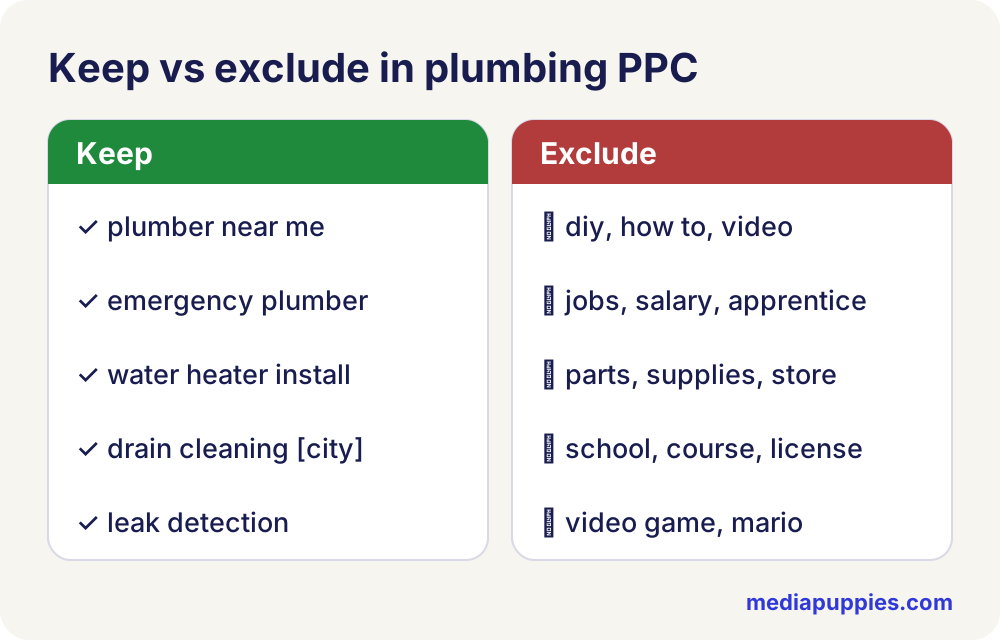
Add a negative list on day one that covers:
- DIY and information: diy, how to, how do, video, youtube, tutorial, guide, yourself.
- Jobs and training: jobs, salary, hiring, apprentice, apprenticeship, school, course, license exam, union.
- Products and stores: parts, supplies, supply store, home depot, lowes, amazon, wholesale.
- Unrelated meanings: mario, video game, costume, and anything else your search terms report shows.
Then read the search terms report every week for the first two months and every two weeks after. Our negative keywords audit and the search terms report guide explain the method.
Tracking plumbing PPC by booked jobs
Calls and form fills are inputs. The number that matters is the cost per booked job, and for installs, the cost per sold job.
- Call tracking with dynamic number insertion, so each website call is credited to the right campaign and keyword, with recordings to check quality. Our guide to call tracking for home services covers setup.
- A minimum call length for counting a call as a conversion.
- Forms tracked separately from calls, with enhanced conversions switched on.
- Booked and sold jobs imported back. Field service software such as ServiceTitan, Housecall Pro or Jobber records which calls became jobs. Importing those back into Google Ads as offline conversions lets bidding chase revenue instead of call volume.
Listen to a sample of calls every week. Many plumbing accounts that seem to underperform have a call-answering problem, and why leads don't answer calls covers the other side of that coin.
A worked example: cost per booked plumbing job
All numbers here are hypothetical, to show the arithmetic. Say a plumber in Dallas spends $6,000 a month on Search ads and the average click costs $25. That buys 240 clicks.
- 20% call or submit a form: 48 leads.
- After removing wrong numbers, existing customers, spam and people outside the area, 38 are real requests.
- The office books 70% of them: about 27 booked jobs.
- Cost per booked job: $6,000 ÷ 27 = about $222.
Split by type: say 22 were repairs with an average gross profit of $200, and 5 were water heater replacements with an average gross profit of $900. That is $4,400 plus $4,500, so $8,900 of gross profit on $6,000 of spend. The water heater campaign earns half the profit from a fifth of the jobs, which is why install campaigns deserve their own budget. If the office booked 80% of real requests instead of 70%, the same spend would bring about 30 jobs and the cost per booked job would fall to $200. Our lead funnel calculator runs the numbers for any account.
Landing pages that turn plumbing clicks into calls
Sending every plumbing ad to the home page is one of the most expensive habits in home services PPC. Each campaign needs a page that matches what the searcher wants in the first second.
- Emergency page. Phone number at the top, large and tap-to-call, with "available now" or the real hours someone answers. Licence and insurance, review score, service area, and a short line on how fast someone can arrive. Very little else.
- Repair page. Phone number and a short form for people who cannot talk right now, the common problems you fix, and a line on how pricing works without stating figures you cannot hold to.
- Water heater and install page. An estimate form, the brands and types you install, financing if you offer it, warranties, and photos of real installs. These buyers compare, so give them reasons to choose you.
- Commercial page. Types of property served, compliance work such as backflow testing, account and contract options, and a contact route for property managers.
Every page must load fast on a phone. Most plumbing searches happen on mobile, often in a stressful moment, and a slow page loses the call to the next ad. Check pages on a real phone over mobile data, not only on office Wi-Fi.
Seasonality and budgets in plumbing PPC
Plumbing demand is steadier than HVAC or roofing, but it still moves. Cold snaps bring frozen and burst pipes, holidays bring kitchen drain and garbage disposal calls, spring thaws bring sump pump and basement flooding searches, and heavy rain brings sewer backups. Click costs rise when everyone's phones are ringing.
- Review budgets weekly in busy periods and move money toward the campaign the weather favours.
- Protect capacity. When technicians are booked out, cut emergency budgets and keep install estimates running, since those can be scheduled further ahead.
- Use quiet months for installs. Water heater replacements and repiping projects can be promoted when emergency demand drops, which keeps crews busy.
Microsoft Advertising and remarketing for plumbers
Microsoft Advertising reaches searchers on Bing, Yahoo and DuckDuckGo, and many desktop users who never change their default search engine. Click costs are often lower than on Google, volume is smaller, and the audience skews older, which suits homeowners and property managers. Import the Google Search campaigns, then manage them separately with their own negatives and bids.
Remarketing helps install campaigns more than emergency ones. Someone researching tankless water heaters may visit three plumbers' sites before deciding; a remarketing list for install page visitors keeps you in front of them for a few weeks. Emergency visitors rarely need reminding, because they have usually booked someone within the hour.
Common plumbing PPC mistakes
- One campaign for everything. Budget drifts to cheap repair clicks and installs go unserved.
- Emergency ads running when nobody answers. Paid calls to voicemail cost money and reviews.
- A thin negative list. DIY searchers quietly take a large share of spend.
- Waiting until the last minute to replace call ads. Switch to call assets ahead of the February 2027 cutoff.
- Counting every call as a lead. Existing customers, suppliers and spam calls inflate results.
- Ignoring LSA reviews and response times. They decide how often your LSA shows.
- Same budget all year. Cold snaps, holidays and storms change demand fast. Google can spend up to twice the average daily budget on a busy day, so plan for spikes with the budget pacing calculator.
Plumbing PPC in the UK, Australia and Canada
- UK. Searchers use "plumber near me", "emergency plumber", "boiler repair" and "blocked drain". Boiler and heating work often makes up a big share of plumbing demand, and Gas Safe registration is a strong trust signal in ad copy for gas work. Local Services Ads are limited in the UK, so Search ads carry most of the load.
- Australia. Common terms include "plumber near me", "blocked drain", "hot water system", "gas fitter" and "emergency plumber". Licence numbers in ads build trust and are often expected. Summer runs December to February, so seasonal patterns differ from the northern hemisphere.
- Canada. Winter brings frozen pipe and heating searches, and sump pump and basement flooding searches peak in the spring thaw. Quebec needs French-language campaigns.
If you run campaigns in more than one country, give each its own campaigns, budget and schedule.
Running plumbing PPC in-house or with an agency
An owner or office manager can run a small plumbing PPC account with three to five hours a week for search terms, budgets and call reviews. Past a few campaigns, a second service area, LSAs plus Search, or the call ads switch, most plumbers bring in help. Ask any agency how they track booked jobs, who listens to calls, and how they handle emergency scheduling. Plumbers who also do roofing or drainage work can apply the same structure to roofing ads.
Our home services lead generation team runs plumbing, HVAC and roofing accounts for contractors in the US, Canada and Australia, with call tracking and booked-job reporting set up in the first month. Fees depend on the number of service areas and campaigns, and we say it on the first call.
Questions people ask before hiring
What is plumbing PPC?
Pay-per-click advertising for plumbing companies, mainly Google Search ads and Local Services Ads, paid per click or per lead, aimed at booked jobs inside the service area.
Is plumbing PPC worth it?
It usually is when campaigns are split by intent, phones are answered quickly and results are judged on cost per booked job rather than clicks or calls.
Are Google call-only ads still available for plumbers?
No new call ads can be created, and existing ones are scheduled to stop serving in February 2027. Use responsive search ads with call assets instead.
Should plumbers use Local Services Ads or Google Search ads?
Most US plumbers should run both. LSAs bring emergency and repair calls at the top of the page; Search ads cover installs and commercial work with full control.
What negative keywords should plumbers use?
Start with diy, how to, video, jobs, salary, apprentice, school, course, parts, supplies and store names, then add more from the weekly search terms report.
Should emergency plumbing ads run 24 hours?
Only if someone answers and can dispatch around the clock. Otherwise schedule emergency campaigns for staffed hours.
What should plumbing PPC track as conversions?
Calls over a minimum length, estimate and booking forms, and ideally booked and sold jobs imported from field service software.