

Roofing ads are paid ads that put a roofing company in front of homeowners who need a repair, a full replacement or a storm inspection. In practice that means Google Search ads and Local Services Ads for people already looking for a roofer, and Facebook and Instagram ads for homeowners who have not started searching yet. Roofing ads work when each platform does the job it is good at and every lead is followed through to a signed contract.
The short answer for most US roofers: start with Google, because the person typing "roof repair near me" has water coming through the ceiling today. Add Facebook roofing ads once Google is tracked and profitable, to reach replacement buyers earlier and to move quickly after a storm. Judge both on cost per inspection and cost per signed job. Cost per lead on its own hides almost everything that matters in roofing.
How roofing ads work on Google and Facebook
A roofing company has four realistic places to buy attention. Each catches the homeowner at a different point in the decision.
| Platform | What the homeowner is doing | Best roofing use | Watch out for |
|---|---|---|---|
| Google Search ads | Searching for a roofer now | Leaks, repairs, replacement quotes, storm damage | Expensive clicks, DIY and job-seeker searches |
| Local Services Ads | Choosing a vetted local pro from the top of the page | Steady repair and inspection calls | Little keyword control; reviews and response time decide ranking |
| Facebook and Instagram ads | Scrolling, not searching | Replacement awareness, storm follow-up, inspection offers | Lower intent; many form leads never pick up the phone |
| YouTube and Display remarketing | Researching over several weeks | Reminding replacement shoppers who visited the site | Wasted spend on poor placements without exclusions |
Google captures demand that already exists. Nobody searches "roof replacement cost" for fun, so every one of those searches is a homeowner with a real project. The limit is volume: in a given town only so many people search for a roofer each week, and you compete with every other roofer for them.
Facebook creates demand. It reaches the homeowner whose roof is 22 years old and curling at the edges but who has not started looking yet. That reach is the strength and the weakness. Facebook roofing ads produce more leads at a lower cost per lead, and a smaller share of those leads turn into inspections. Accounts that compare the two platforms on cost per lead always conclude Facebook is cheaper. Accounts that compare them on cost per signed job often find the opposite, or find that each works for a different job type.
Storm, replacement and repair: three kinds of roofing demand
Roofing has three distinct buyers, and a campaign that mixes them lets the platform spend wherever leads are cheapest, which is rarely where the profit is.
Storm and insurance work. After hail or high winds, searches for "hail damage roof", "roof inspection after storm" and "roof insurance claim" jump within hours in the affected ZIP codes. These homeowners want an inspection first and help with the insurance process second. Volume is lumpy and competition is fierce, because every roofer in the region turns their ads on at once.
Planned replacement. Searches like "roof replacement", "new roof cost", "metal roof installation" and "architectural shingles". These homeowners compare three or four quotes over weeks or months. Job values are high, sales cycles are long, and trust signals matter more than speed: years in business, manufacturer certifications, warranties, financing and photos of finished roofs in the same neighbourhood.
Repairs and leaks. "Roof leak repair", "roofer near me", "missing shingles". Urgent, mostly phone calls, smaller tickets. A good repair visit often becomes a replacement conversation, so repair leads are worth more than the first invoice suggests.
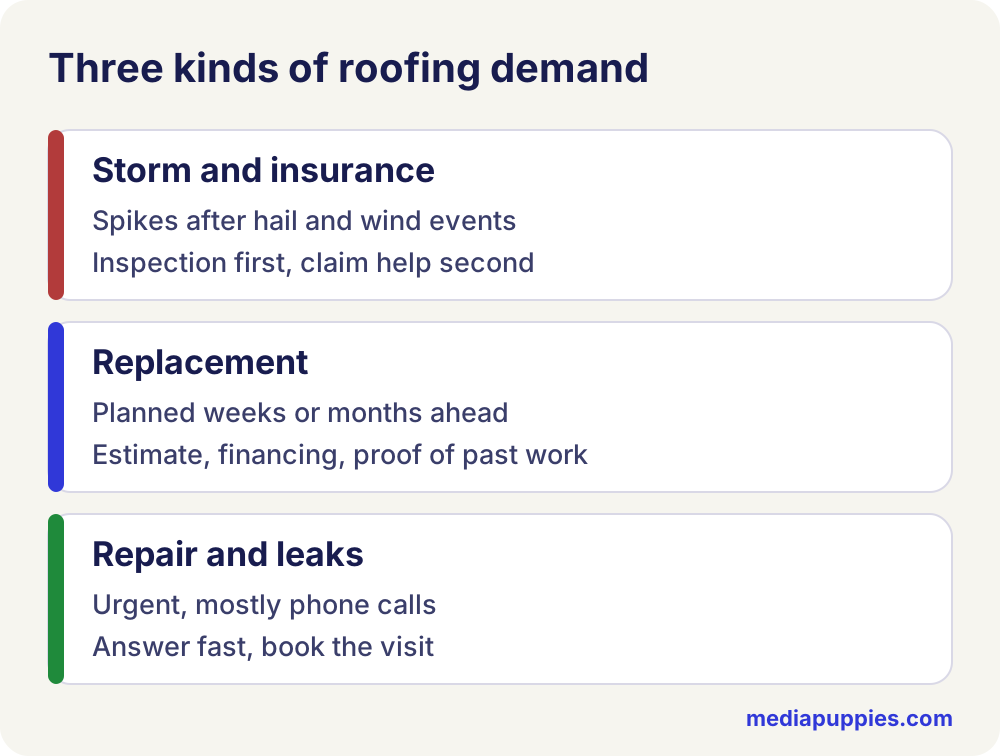
Give each type its own campaign, budget, ad copy and landing page. The storm page leads with "free inspection" and the areas you are working in this week. The replacement page leads with the estimate form, financing, warranties and a gallery. The repair page leads with the phone number and how fast someone can come out.
Google ads for roofing: campaigns, keywords and Local Services Ads
A sensible first Google account for a roofer has four Search campaigns and Local Services Ads alongside them.
- Repair and leaks. Keywords such as "roof leak repair", "roof repair [city]", "emergency roofer". Schedule it for the hours someone answers the phone, and add a call asset.
- Replacement. "Roof replacement [city]", "new roof", "metal roofing contractor", "shingle roof replacement". The conversion is an estimate request or booked inspection.
- Storm and insurance. "Hail damage roof repair", "storm damage roofer", "roof insurance claim help". Keep it paused or on a small budget until a storm hits your area, then raise it for the affected ZIP codes.
- Brand. Your company name, kept separate so cheap brand clicks do not flatter the other campaigns.
Start with phrase and exact match. Broad match can work later, once the account has a steady flow of real conversions for Smart Bidding to learn from. Set location targeting to "Presence: people in or regularly in your included locations". The default setting also shows ads to people merely interested in your area, which spends money on searchers in other states. The wider structure is the same one we describe in how to structure Google Search ads.
Local Services Ads are available for roofers in most US metros. They sit above the normal ads, carry the Google Guaranteed badge, and charge per lead instead of per click. You choose job types, service area, hours and budget. Google decides ranking largely from reviews, responsiveness and proximity, so the roofer who answers every LSA call and asks every happy customer for a review wins more of them. Our guide to Google Local Services Ads in the US covers setup, disputes and the badge checks.
Roofing searches attract a lot of people you do not want to pay for. Add negatives from day one: "diy", "how to", "jobs", "salary", "hiring", "training", "materials", "supply", "home depot", "lowes", "calculator", "rv", "shed", "car". Review the search terms report weekly for the first two months.
Roofing Facebook ads: targeting, offers and creative that works
Facebook roofing ads succeed or fail on creative and offer, because targeting options are thin. Meta removed most of the detailed targeting that once identified homeowners, so a modern roofing campaign usually targets everyone in the service area within an age range and lets the creative and the form do the filtering.
Check the special ad category first. Meta asks advertisers to declare a special ad category for housing, credit and some other subjects. Its housing definition can reach home repair services, and a roofing ad that promotes financing can bring in its rules on credit and financial products. If either applies, Meta restricts age, gender and postcode targeting; in the US housing ads use a minimum radius of 15 miles around a location. Read Meta's current special ad category help page for your exact offer, and declare the category when in doubt. An ad set that should have declared it can be rejected, and repeated rejections put the whole ad account at risk.
Offers that work for roofers.
- A free roof inspection with photos, especially after storms.
- A replacement estimate with clear options (repair, overlay where allowed, full replacement).
- Financing availability, worded within Meta's rules and your lender's rules.
- A seasonal booking window ("book now for spring installs").
Creative that works. Real crews on real roofs beat stock photography every time. The strongest formats in roofing tend to be drone footage of a finished roof, before and after shots of the same house, a short owner-to-camera video explaining what an inspection involves, and a crew time-lapse of a tear-off and install. Show local landmarks or recognisable housing styles so the ad feels local. Avoid fear-heavy storm creative that implies damage you have not seen; it attracts complaints and the wrong leads.
Run three to five distinctly different creatives at once. Meta's delivery system now leans on creative variety to find different pockets of buyers, so five versions of the same photo with different headlines teach it very little.
Lead forms vs calls vs landing pages for roofing leads
How the homeowner contacts you changes lead quality more than almost any targeting setting.
- Phone calls from Google are the highest intent and the easiest to qualify, as long as someone answers.
- Landing page forms cost more per lead than instant forms, and the homeowner has seen your site, your reviews and your gallery before they submit.
- Meta instant forms are fast and cheap, and produce more people who forget they filled them in. Use the "Higher intent" form type, which adds a review screen, and ask two or three qualifying questions: do you own the home, roughly how old is the roof, is this an insurance claim.
We compare the trade-offs in detail in lead form ads vs landing pages. Whichever you choose, the follow-up decides the result. Call new form leads within five minutes during business hours, text if they do not answer, and try again the same day. If leads go cold before anyone calls, the problem is in the office, and why leads don't answer calls covers the fixes.
For US forms, include clear consent language if you plan to text or auto-dial leads. The rules are covered in consent language for US lead forms.
Tracking roofing ads by inspections and signed jobs
A roofing lead is not a sale. Between the click and the signed contract sit a phone call, an inspection, a proposal and often an insurance adjuster. If the ad platforms only see the first step, they optimise for people who fill in forms, which is not the same as people who sign.
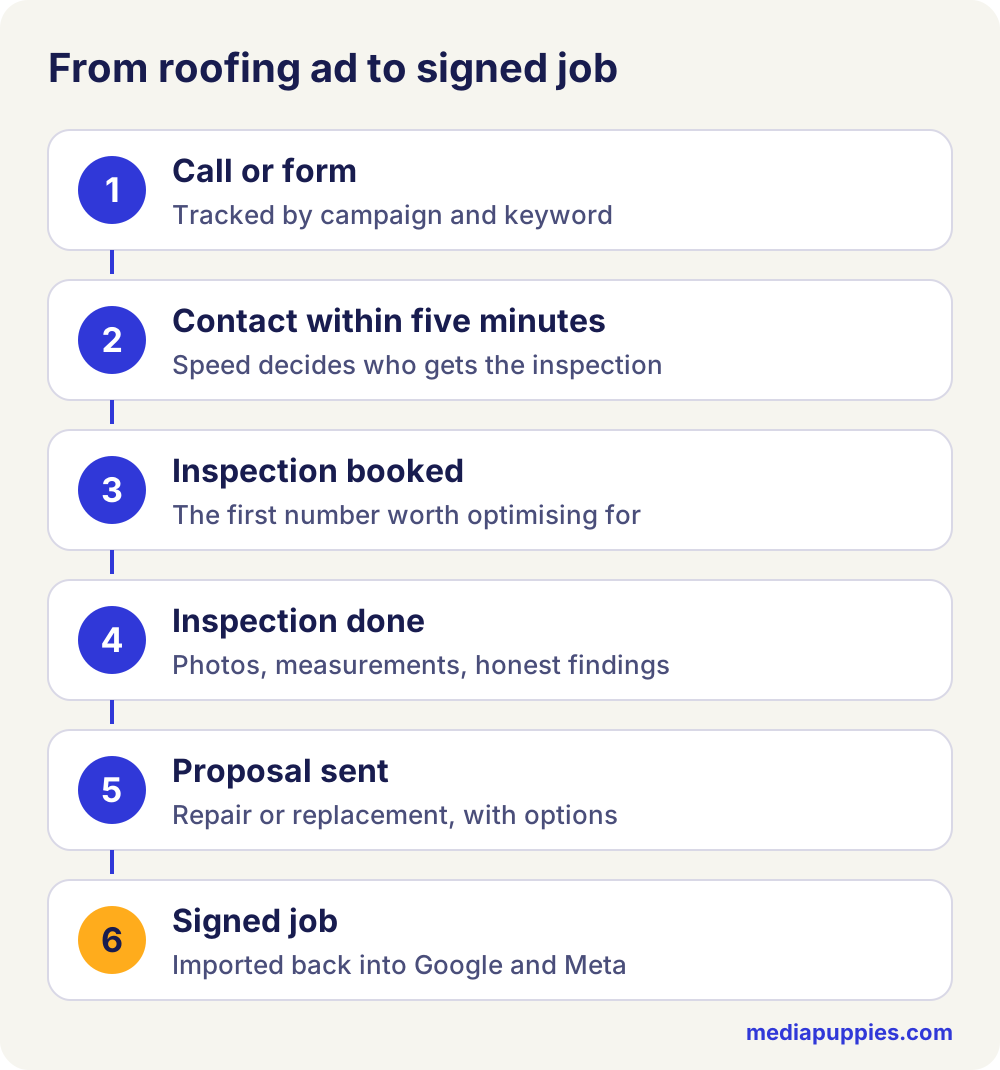
- Call tracking by source. Dynamic number insertion on the website, so a call is credited to the right campaign and keyword, with call recording. Our guide to call tracking for home services explains the setup.
- A minimum call length. Count calls over about 60 seconds as conversions, so hang-ups and wrong numbers do not train Smart Bidding.
- Inspections and signed jobs as offline conversions. Whatever CRM or roofing software you use, record which leads became inspections and which became signed jobs, and import those back into Google Ads and Meta. For Meta, the Conversions API for CRM events does this; see Meta Conversions API for leads.
- Primary conversions only for what you want more of. Make booked inspections and signed jobs the primary goals once volume allows. Page views and button clicks belong in secondary.
A worked example: what a roofing lead is really worth
All numbers below are hypothetical, to show the arithmetic. Say a roofer spends $8,000 in a month: $5,000 on Google and $3,000 on Facebook.
| Google Search | Facebook instant forms | |
|---|---|---|
| Spend | $5,000 | $3,000 |
| Leads | 50 | 120 |
| Cost per lead | $100 | $25 |
| Inspections booked | 30 (60%) | 24 (20%) |
| Signed jobs | 9 | 4 |
| Cost per signed job | About $556 | $750 |
On cost per lead, Facebook looks four times better. On cost per signed job, Google wins in this example. Neither result is universal. A roofer with a strong office team that calls every form lead in two minutes might book 35% of Facebook leads and flip the comparison. The point is to measure to the signed job before moving budget.
The same arithmetic shows where the cheapest gains are. If the office lifted Facebook inspection rates from 20% to 30%, the same spend would produce about six signed jobs instead of four, without touching the ads. Our lead funnel calculator runs these numbers for any account.
Roofing ads after a storm: moving fast without breaking rules
A hailstorm can create more roofing demand in a week than a normal quarter. The roofers who do well plan for it before it happens.
- Keep the storm campaign built and paused. Ads, landing page and ZIP code lists ready, so you can switch on within an hour of a storm report.
- Target the affected area only. Use hail maps and local news to pick ZIP codes, and raise budgets there instead of across the whole service area.
- Know how Google paces spend. Google can spend up to twice the average daily budget on a busy day and balances it across the month, so a sudden surge can burn a monthly budget fast. The budget pacing calculator shows where the month will land.
- Protect capacity. If crews are booked for six weeks, say so in the ad and the form, or pause and keep only inspections running.
- Stay inside the law. Several states, including Texas and Colorado, prohibit contractors from offering to waive or pay the homeowner's insurance deductible. "We cover your deductible" ads can break those rules. Licensing, registration and door-to-door rules also vary by state and city.
Common roofing ads mistakes
- Judging platforms on cost per lead. The cheapest leads are often the least likely to book an inspection.
- One campaign for every job type. Budget drifts to cheap repair and storm clicks, and replacement searches go unserved.
- Slow follow-up. A form lead called the next morning has usually booked someone else.
- Stock photos. Homeowners can tell, and they want to see your crew and your work.
- Location set to "presence or interest". Money leaks to people outside the area.
- No negatives. DIY, supplies, jobs and unrelated roofs (RV, shed, car) eat budget quietly.
- Ignoring special ad categories on Meta. Rejections and account restrictions cost more than the targeting you give up.
Roofing ads in Canada, the UK and Australia
- Canada. The installation season is shorter, so replacement demand concentrates in spring, summer and early autumn, and winter brings ice dam and snow load searches. Quebec needs French-language campaigns.
- UK. Homeowners search "roofer near me", "roof repairs", "flat roof replacement" and "chimney repairs" more than "roofing contractor". Trade body membership and guarantees build trust in copy, and claims in ads must follow the CAP Code. Google Local Services Ads have limited availability in the UK, so Search ads carry most of the load.
- Australia. Common searches include "roof restoration", "re-roofing", "metal roof replacement" and "roof leak repairs". Hail seasons in parts of Queensland and New South Wales produce sharp spikes, and summer runs December to February, so the calendar flips.
If you run more than one country, give each its own campaigns, budget and schedule.
Running roofing ads yourself or with an agency
An owner can run a small Google account for one service area if they have a few hours a week for search terms, bids and call reviews. It gets harder once Facebook, storms, several service areas and offline conversion imports are added. When you compare agencies, ask how they track signed jobs, how fast they can launch a storm campaign, and who listens to the calls. Roofing works on the same principles as HVAC PPC and plumbing PPC, with longer sales cycles and bigger tickets.
Our home services lead generation team runs Google and Meta ads for roofing, HVAC and plumbing companies in the US, Canada and Australia, with call tracking and signed-job reporting set up in the first month. Fees depend on the number of service areas and platforms, and we say it on the first call.
Questions people ask before hiring
What are roofing ads?
Paid ads that bring a roofing company leads for repairs, replacements and storm inspections, mainly on Google Search, Google Local Services Ads and Facebook and Instagram.
Are Google ads or Facebook ads better for roofers?
Google usually brings higher-intent leads because the homeowner is already searching. Facebook brings cheaper leads that need faster follow-up. Compare them on cost per signed job, not cost per lead.
Do roofing ads on Facebook need a special ad category?
They can. Meta's housing definition can cover home repair services, and financing offers can bring in its credit rules. Check Meta's current help page for your offer and declare the category when in doubt.
What should a roofing company track from its ads?
Calls over a minimum length, form leads, booked inspections and signed jobs, with inspections and signed jobs imported back into Google Ads and Meta as offline conversions.
How should roofing ads change after a storm?
Switch on a pre-built storm campaign for the affected ZIP codes, raise budgets there, make sure crews can handle the volume, and avoid offers that break state insurance rules.
What negative keywords should roofers add?
Common ones are diy, how to, jobs, salary, hiring, training, materials, supply, calculator, and unrelated roofs such as rv, shed and car.
How quickly should roofing leads be contacted?
Within five minutes during business hours where possible. Form leads go cold fast, and the first roofer to book the inspection usually wins the job.