

Key findings
- Of 87 US real estate advertisers with live Facebook or Instagram ads, 92% had only one ad in our sample, and the median ad had been live for 347 days.
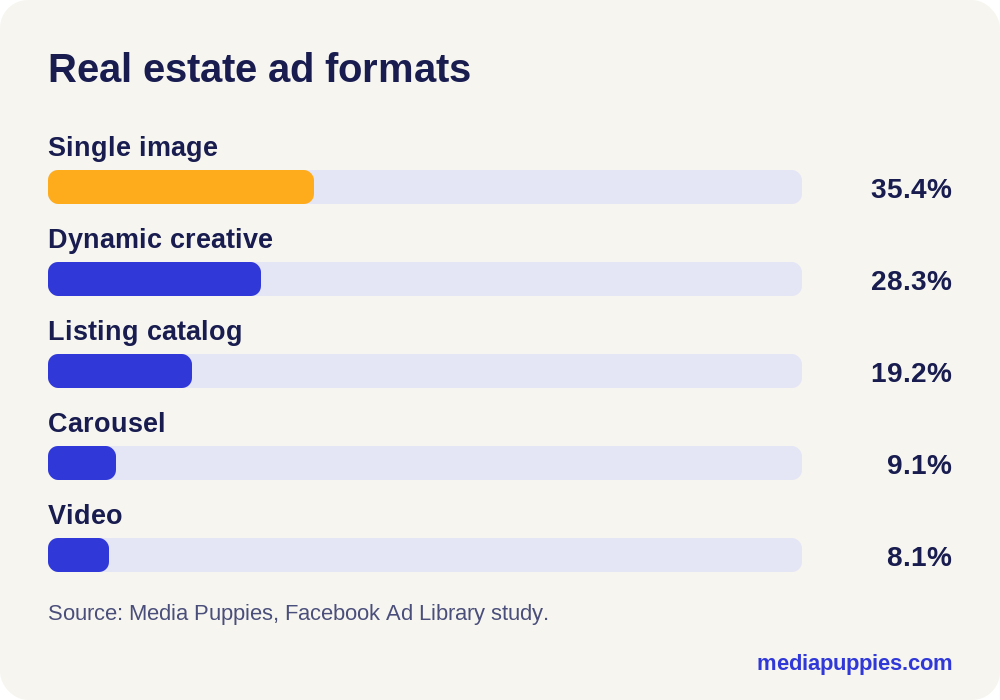
- Real estate ads were mostly single images (35.4%), dynamic creative (28.3%) and listing catalog ads (19.2%). Only 8.1% were videos, and 61.6% used a Learn more button.
- Only 34.5% of the English real estate ad texts made an offer, and 21.4% put it in the first line. 44.2% named a place, the highest of the five trades we studied.
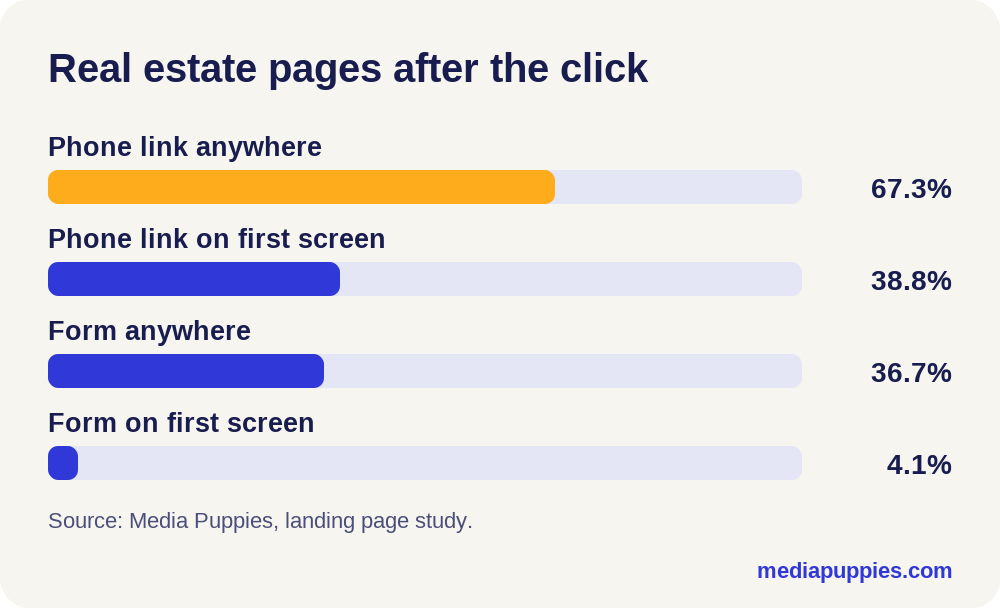
- After the click, only 38.8% of real estate pages showed a phone link on the first screen of a phone, and 4.1% showed a form there.
- Only 14% of 43 real estate advertisers passed all four of our basics, the lowest of five trades, and 30.8% of the 26 we looked up ran Google ads in the last 30 days.
Meta Ad Library, our own page visits and Google Ads Transparency Center · Real estate in five studies: 99 ads from 87 advertisers; 86 distinct ad texts; 49 landing pages; 43 scored advertisers; 26 Google checks · 3 to 12 November 2026 · How we did this · Download the data (CSV)
Real estate Facebook ads are easy to see one at a time and hard to judge as a market. In November we studied live Facebook and Instagram ads from US local businesses five different ways: the ads themselves, the words in them, the page after the click, a four-point scorecard and a check of who also runs Google ads. This page pulls out what we found about real estate.
The short version: in our data, most real estate advertisers ran a single ad, most ads were close to a year old and used a Learn more button, few made an offer, and most pages kept the phone number off the first screen. Real estate came last of the five trades on our scorecard. The full figures, with the study each comes from, are free to download at the end.
What real estate Facebook ads look like
We found 99 live US real estate ads from 87 advertisers. 92% of the advertisers had only one ad in our sample, the highest share of the four trades in that study, and none had five or more. The ads were old: the median had been live for 347 days, 89.9% for 90 days or more and 48.5% for over a year. Only 3% had started in the last 30 days.
The formats differ from the other trades. 35.4% of the ads were single images, 28.3% used dynamic creative (several images, headlines and texts that Meta mixes) and 19.2% were catalog ads, which pull listings from a feed, 19 ads in all. Only 8.1% were videos, against 37% for law firms in the same study.
Most ads used Learn more: 61.6% of them, 8.1% had no button and 6.1% used See details. Contact us, Book now and Call now were each at 3% or less. 74.7% sent people to a website, 10.1% used Meta's instant form, 9.1% had no link and asked people to call or message, and 6.1% sent people to Facebook, Instagram or WhatsApp.
88.9% of the ads ran under Meta's housing special ad category, which US housing ads must use and which does not allow targeting by age, gender or ZIP code. Our view is that the remaining ads should be checked: an ad that should be in the category and is not can be rejected.
What the ads say
We measured 86 distinct real estate ad texts. The median text was 33 words, or 193 characters, and 61.6% ran past 150 characters, the top of the 50 to 150 characters Meta's ads guide suggests for single-image ads.
Offers were rare. Only 34.5% of the English texts made one, and 21.4% put it in the first line. In the Ad Library data, none of the 99 ads used the free-offer phrases we searched for, such as free consultation or free home valuation. Reading the texts, we found only about five that offered a complimentary valuation, a free consult or a free report in other words. 12.1% gave a price and 5.1% mentioned financing. Only 2% mentioned reviews or ratings, and 10.1% wrote a phone number in the text.
Place was the strong point. 44.2% of the texts named a state or county, gave a city with its state code, or used words such as local, near you or serving, the highest of the five trades in the ad copy study. 45.2% told the reader what to do, 20.9% opened with a question, 33.7% used an emoji and 44.2% an exclamation mark. The median text read at about grade 8 (Flesch-Kincaid 7.7, English texts of 20 words or more).
Where real estate ads appear
98% of the ads ran on Facebook and 91.9% on Instagram. 57.6% also ran on Meta's Audience Network, which places ads inside other apps, and 29.3% on Threads. Our view is that an agent should compare Audience Network leads with Facebook and Instagram leads before leaving it on, because a cheap lead that never answers the phone costs more in the end.
The page after the click
We opened the most-used link of 49 real estate advertisers on an iPhone-sized screen. 44.9% sent clicks to the home page, 40.8% to an inner page and only 8.2% to a separate landing page. Only 24.5% of the sites ran on WordPress. The median page weighed 3.8 MB, the heaviest of the five trades, and 28.6% were over 5 MB.
The phone was hard to find. 67.3% of the pages had a tap-to-call link somewhere, but only 38.8% showed it on the first screen and 26.5% kept it fixed as you scrolled. 36.7% had a form, and only 4.1% showed it on the first screen. 36.7% of the links passed through at least one redirect before the page loaded.
On tracking, 63.3% of the pages loaded the Meta pixel and 53.1% fired it during our visit, while 95.9% had a Google tag. Our view is that this gap matters more in real estate than elsewhere, because the housing category limits targeting and Meta has to learn from the pixel who becomes a lead.
How real estate scores on four basics
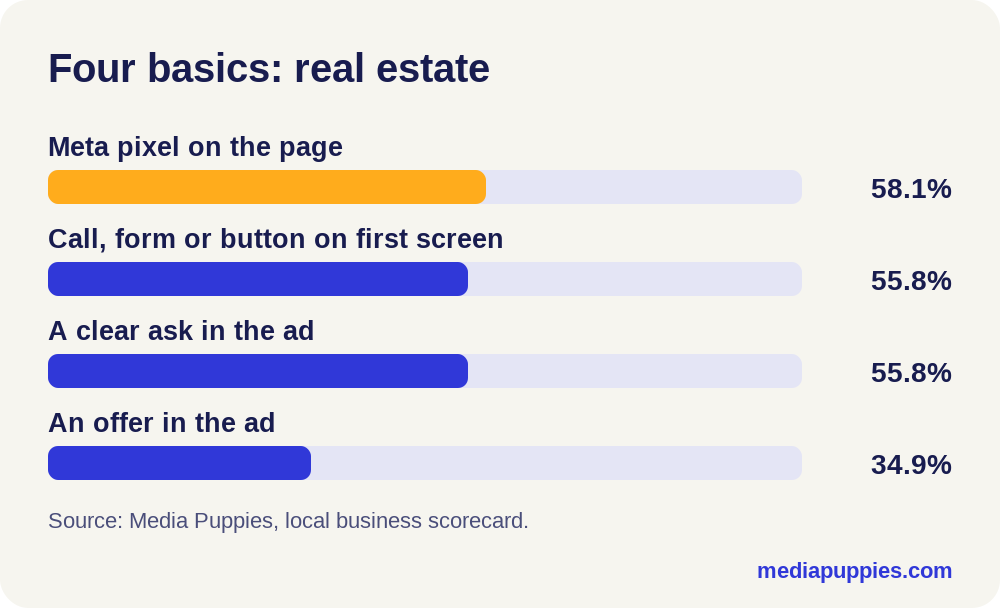
In our local business scorecard we checked 43 real estate advertisers on four basics: an offer in the ad, a clear ask in the ad, a way to call or enquire on the first screen of the page, and the Meta pixel. Only 14% passed all four, 6 advertisers in all, the lowest of the five trades. The average advertiser passed 2.05 of the four checks, also the lowest.
The offer was the weakest check: only 34.9% had an offer anywhere in the ad text, headline or link description. A clear ask and a way to act on the first screen each reached only 55.8%. Of the 13 advertisers that passed three checks, 5 were missing the offer and 4 the pixel.
Facebook alone or Facebook plus Google
We looked up 26 real estate advertisers from the same set in Google's Ads Transparency Center. Only 30.8% had shown Google ads in the US in the last 30 days, 8 in all, the lowest of the five trades, and 34.6% had any Google ads on record. Of the 9 with Google ads, 5 were builders, a brokerage or other companies rather than individual agents. For most real estate advertisers in this sample, Facebook was the only paid channel we could see.
The pixel showed a pattern here too. 6 of the 13 advertisers with the Meta pixel had run Google ads in the last 30 days, against 2 of the 13 without it. Our reading is that advertisers who track are also more likely to use Google; the data does not show which leads to which.
What we would change in real estate Facebook ads
- Give a reason to click. Only about five of the 99 ads offered anything free. In our view, a free home valuation, an area price report or a first-time buyer guide gives a seller or buyer a reason to leave their details.
- Put the phone on the first screen. Only 38.8% of pages did. A buyer who sees a listing at night may still call in the morning, if the number is easy to find.
- Send clicks to a page made for the ad. Only 8.2% used a separate landing page. In our view, a short page that matches the ad, with one form and a call button, does more than a home page.
- Fix the pixel and stay in the housing category. More than a third of pages did not load the pixel. With targeting limited, tracking is how the campaign learns.
- Refresh the ads. The median ad was almost a year old. Our view is that an agent should test at least one new ad a month, and video, which only 8.1% used, is the obvious test.
For what real estate clicks cost on Google, see our real estate marketing data, and for what agents pay per lead, see real estate leads in 2026. If you run Facebook or Google ads for a real estate business in the US, UK, Canada or Australia, give us read access to the account. A senior buyer will write a free audit of where the spend goes, whether your tracking counts real results, how your creative is holding up, and the three things we would fix first. It takes about two working days and the document is yours. More studies are on our research page.
How we did this
- Source
- Meta Ad Library, our own page visits and Google Ads Transparency Center
- Country
- United States
- Collected
- 3 to 12 November 2026
- Sample
- Real estate in five studies: 99 ads from 87 advertisers; 86 distinct ad texts; 49 landing pages; 43 scored advertisers; 26 Google checks
- Sources
- Facebook Ad Library study, ad copy study, landing page study, local business scorecard, Google Ads vs Facebook ads study
This page collects nothing new. It takes the real estate figures from five studies we published in November 2026, each with its own method page: our Facebook Ad Library study (99 live US real estate ads from 87 advertisers, collected 3 November through the searches real estate agent and homes for sale), our ad copy study (86 distinct real estate ad texts), our landing page study (49 real estate pages opened on a phone on 7 November), our local business scorecard (43 advertisers scored on four basics) and our Google Ads vs Facebook ads study (26 advertisers looked up in Google's Ads Transparency Center on 12 November).
An advertiser counts as real estate when its Facebook page category says so, which takes in agents, teams, brokerages and some builders. The groups in the five studies overlap but are not identical, because each study kept a different subset: only advertisers whose ad linked to a website could be visited, and only those whose page loaded could be scored. Each figure uses the base of the study it comes from, and the dataset lists every figure with its source.
Limits. The advertisers came mostly from two keyword searches, so the sample is not every US real estate advertiser on Facebook. "Live for" means days since the ad started, not proof it ran without a break. None of the sources show spend or results, so nothing here says which ads worked.
Download the data (CSV). Free to reuse under CC BY 4.0 with a link to this page.
Questions about real estate Facebook ads
Do real estate Facebook ads work?
Our data shows what real estate advertisers run, not which ads worked. 87 US real estate advertisers had live Facebook or Instagram ads in our November 2026 sample, and only 14% of the 43 we scored passed all four of our basics.
What should a real estate Facebook ad offer?
Only 34.5% of English real estate ad texts made an offer, and only about five of the 99 ads offered a free valuation, consult or report. In our view, a free home valuation or an area price report gives people a reason to click.
Do real estate Facebook ads need the housing category?
In the US, ads about selling or renting homes must run under Meta's housing special ad category. 88.9% of the real estate ads in our sample did.
How long do real estate Facebook ads run?
The median real estate ad in our sample had been live for 347 days, and 48.5% had been live for over a year.